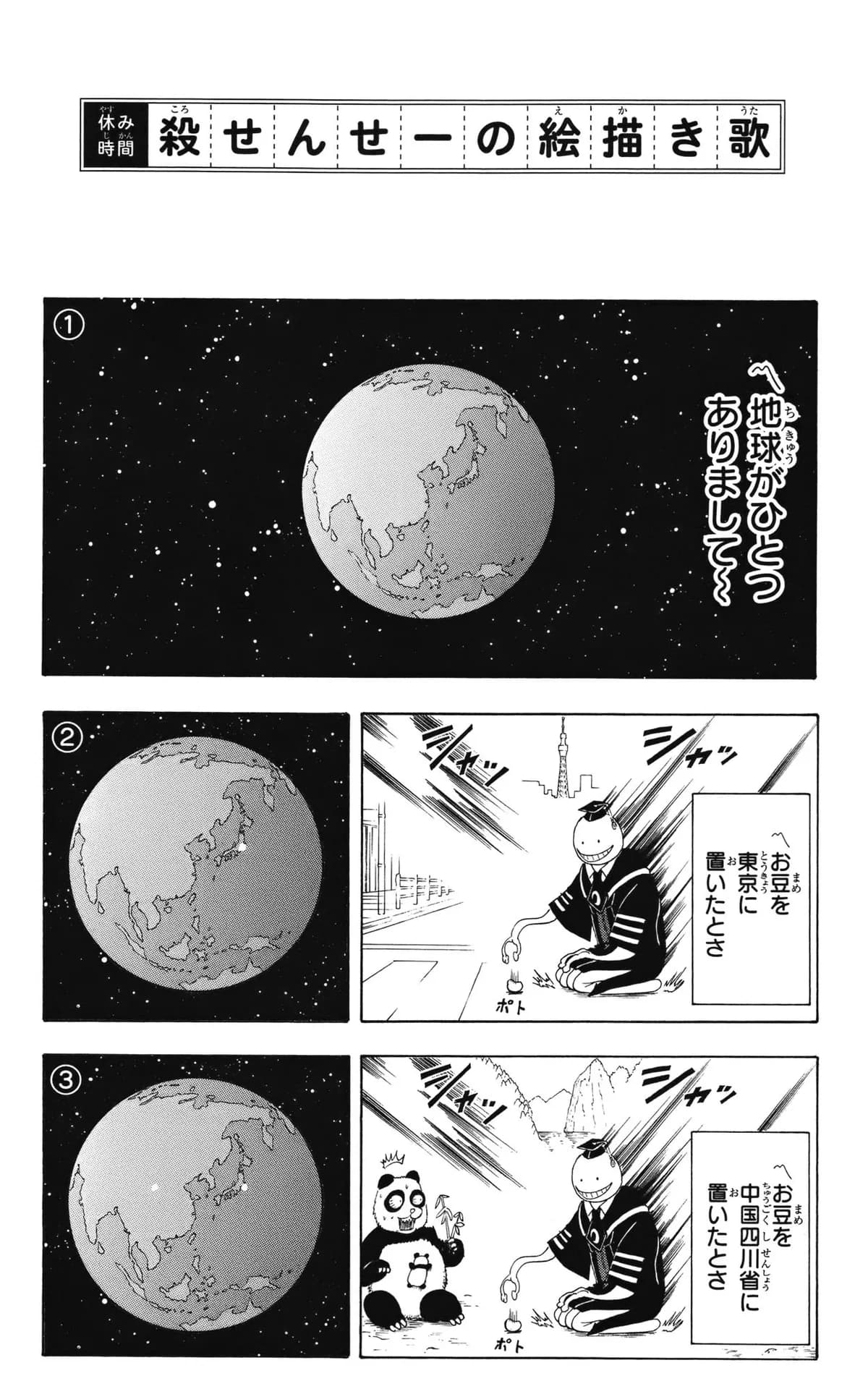
Korosensei's Drawing Song
Manga ChapterA two-page extra chapter in which Korosensei performs a homemade drawing song, mapping his grinning face across the globe from Tokyo to Sichuan, Dubai, Hawaii, and the Philippines, then dares Class 3-E to draw it for real. First run in Jump NEXT! Summer 2012, it was later adapted in Episode 43 of the anime.
Main Characters (1)
Summary
In this brief extra, Korosensei performs a homemade drawing song that sketches his smiling face across the surface of the Earth using geography. He begins by dropping a bean over Tokyo, then places a second one in China's Sichuan province. From there the route runs from Dubai to Hawaii at Mach 20, tracing contours before the vapor trail fades, doubling back through the southern hemisphere over the Philippines, returning once more toward Dubai, and finally drawing lines of latitude at twenty-five degree spacing between Dubai and Hawaii. Once the picture is complete, he invites class 3-E to carry it out for real, and the students dismiss the ridiculous expectation.

Key Events
Korosensei uses the song as a teaching device, turning a lesson on how to draw his face into a tour of global landmarks from Tokyo to Sichuan, Dubai, Hawaii, and the Philippines. The gag closes with the class flatly refusing to attempt the absurd worldwide sketch he lays out.
Related Reading
See all
Naruto vs Luffy: Does the Fight Change if Luffy Tickles Hinata?
Naruto vs Luffy with the twist nobody asked for: Luffy tickled Hinata on date night, and she kind of liked it. We break down the whole fight and commit to a winner....
Namek Has No Women, and Piccolo Pulls Anyway
There are no women on Namek. That isn't an oversight, it's the biology. Why we handed Piccolo the one thing his own species rules out, and why it had to be trap soul....
Notes
This two-page extra first ran in the Summer 2012 issue of Jump NEXT! and was later adapted, appearing in episode 43 of the anime and tied to season one's eighth installment. The sequence also served as the basis for Korosensei's Victory Burst attack in the crossover game J-Stars Victory Vs.
Frequently Asked Questions
What is Korosensei's Drawing Song about?
Korosensei's Drawing Song is a short extra chapter of Assassination Classroom in which Korosensei performs a drawing song that sketches his own grinning face across a map of the Earth, then challenges class 3-E to recreate the picture in real life.
What locations does Korosensei use in his drawing song?
Korosensei's route runs from Tokyo and Sichuan province in China to Dubai, Hawaii, and the Philippines, tracing contours between them at Mach 20 to complete the picture of his face.
How did class 3-E react to Korosensei's drawing challenge?
After Korosensei completed his global drawing song, he invited class 3-E to actually perform the feat themselves, and the students dismissed the idea as ridiculous.
When was Korosensei's Drawing Song first published?
Korosensei's Drawing Song is a two-page extra that first ran in the Summer 2012 issue of Jump NEXT!, and it was later adapted into episode 43 of the anime.
Did Korosensei's Drawing Song influence anything outside the manga?
Yes. The drawing song sequence also served as the basis for Korosensei's Victory Burst attack in the crossover fighting game J-Stars Victory Vs.
Sources & Information
Looking for more on Korosensei's Drawing Song? The Assassination Classroom Wiki on Fandom has a dedicated page with community notes.
View on FandomThis content is original writing by Daddy Jim Headquarters based on the Assassination Classroom anime series, manga, and official materials. Assassination Classroom was created by Yusei Matsui, published by Shueisha, and animated by Lerche. All rights to Assassination Classroom and its characters belong to their respective owners. Episode and chapter references are cited where applicable.
Rights holders
- Created byYusei Matsui
- Published byShueisha
- Animated byLerche
All rights belong to their respective owners.
Character and scene imagery on this site is original artwork by Daddy Jim Headquarters, not screenshots or licensed imagery. Official cover art is used on three types of pages for editorial commentary:
- Movie pages: theatrical posters and key visuals, credited to Lerche and Shueisha.
- Game pages: official box art, credited to the game's respective publishers.
- Manga chapter pages: volume covers, credited to Shueisha and Yusei Matsui.
Official resources:
Help Us Keep This Wiki Accurate
Daddy Jim Headquarters maintains this encyclopedia. If you spot an error, a translation issue, or something that doesn't look right, let us know.