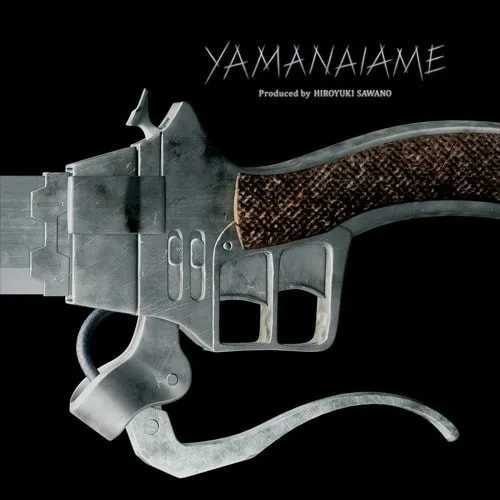
YAMANAIAME (Song)
MovieIts Japanese title meaning rain that does not stop, YAMANAIAME closes the first Attack on Titan compilation film over the ending credits. Three vocalists share Hiroyuki Sawano's elegy for soldiers who traded toys for guns, and its ostinato, chorus, and bridge seeded a whole family of later remixes.
Overview
The song serves as the ending theme of the anime film Attack on Titan Part 1: Guren no Yumiya. It debuted as the opening track of the YAMANAIAME album on November 19, 2014, then closed the film's own original soundtrack in a shortened 2:46 cut on March 18, 2015, and finally appeared eighth on disc one of the "Attack on Titan" Season 2 Original Soundtrack on June 7, 2017. The full version runs about four and a half minutes.
Benjamin and mpi wrote the lyrics, and three singers, Mica Caldito, mpi, and Mika Kobayashi, share the vocal. Hiroyuki Sawano composed and arranged it, as he did every piece of the score before The Final Season, playing piano, keyboards, and all remaining instruments with YU "Masshoi" Yamauchi on drums, Toshino Tanabe on bass, and Hiroshi Iimuro on guitars.
Plot
The title comes from the Japanese 止まない雨 (Yamanai ame), the rain that never lets up. The lyrics follow a soldier training recruits so young they have only just set down their toys for guns and kissed their lullabies goodbye. Between questions about what all the fighting was for, the chorus urges chasing the light and refusing to give up, even while crawling through the grass and losing oneself. The final verses mourn a comrade who returned to help, only to end up lying dead on the ground, left to stand the endless rain while the singer regrets not doing more the day before the death.
Few tracks in the score spawned as many descendants. Four remixes exist: ymniam-orch, EMAymniam, ymniam-MKorch, and YAMANAIAME FMv. Beyond full remixes, the opening ostinato, the chorus, and the bridge each reappear as independent motifs inside EMAymniam.

Reception
Within the film itself the song has a single placement, rolling over the ending credits of Guren no Yumiya. Its wider footprint comes through its offspring, with EMAymniam and the other remixes carrying its melodies into the television series.
The three album appearances differ slightly in length: the original 4:25 cut on the YAMANAIAME album, the trimmed 2:46 edit on the film soundtrack, and a 4:26 version on the Season 2 release. The parent album also includes a separate movie edit as its fourth track.
Related Reading
See all
Naruto vs Luffy: Does the Fight Change if Luffy Tickles Hinata?
Naruto vs Luffy with the twist nobody asked for: Luffy tickled Hinata on date night, and she kind of liked it. We break down the whole fight and commit to a winner....
Piccolo Gets the Namek Hoes: Namek Has No Women, and He Pulls Anyway
There are no women on Namek. That isn't an oversight, it's the biology. Why we handed Piccolo the one thing his own species rules out, and why it had to be trap soul....
Frequently Asked Questions
What is "YAMANAIAME (Song)" and where does it appear in Attack on Titan?
"YAMANAIAME (Song)" is the ending theme of the anime film Attack on Titan Part 1: Guren no Yumiya, playing over the credits at the close of that movie.
What does the title "YAMANAIAME" mean?
The title comes from the Japanese phrase "止まない雨" (Yamanai ame), meaning the rain that never lets up, which reflects the song's mournful lyrics.
Who wrote and performed "YAMANAIAME (Song)"?
Hiroyuki Sawano composed and arranged "YAMANAIAME (Song)," with lyrics by Benjamin and mpi, and vocals shared by Mica Caldito, mpi, and Mika Kobayashi.
What are the lyrics of "YAMANAIAME (Song)" about?
The lyrics of "YAMANAIAME (Song)" follow a soldier training recruits barely old enough to trade their toys for guns, urging listeners to chase the light and never give up, before mourning a comrade who returns to help only to end up dead on the ground.
Are there remixes of "YAMANAIAME (Song)"?
"YAMANAIAME (Song)" spawned four remixes, ymniam-orch, EMAymniam, ymniam-MKorch, and YAMANAIAME FMv, and its ostinato, chorus, and bridge reappear as separate motifs within EMAymniam.
Sources & Information
Looking for more on YAMANAIAME (Song)? The Dragon Ball Wiki on Fandom has a dedicated page with community notes.
View on FandomThis content is original writing by Daddy Jim Headquarters based on the Dragon Ball anime series, manga, and official materials. Episode and chapter references are cited where applicable.
Character and scene imagery on this site is original artwork by Daddy Jim Headquarters, not screenshots or licensed imagery. Official cover art is used on three types of pages for editorial commentary:
- Movie pages: theatrical posters and key visuals, credited to Toei Animation and Shueisha.
- Game pages: official box art, credited to Bandai Namco, Atari, and other publishers.
- Manga chapter pages: Jump Comics volume covers, credited to Shueisha and Akira Toriyama.
Official resources:
Help Us Keep This Wiki Accurate
Daddy Jim Headquarters maintains this encyclopedia. If you spot an error, a translation issue, or something that doesn't look right, let us know.