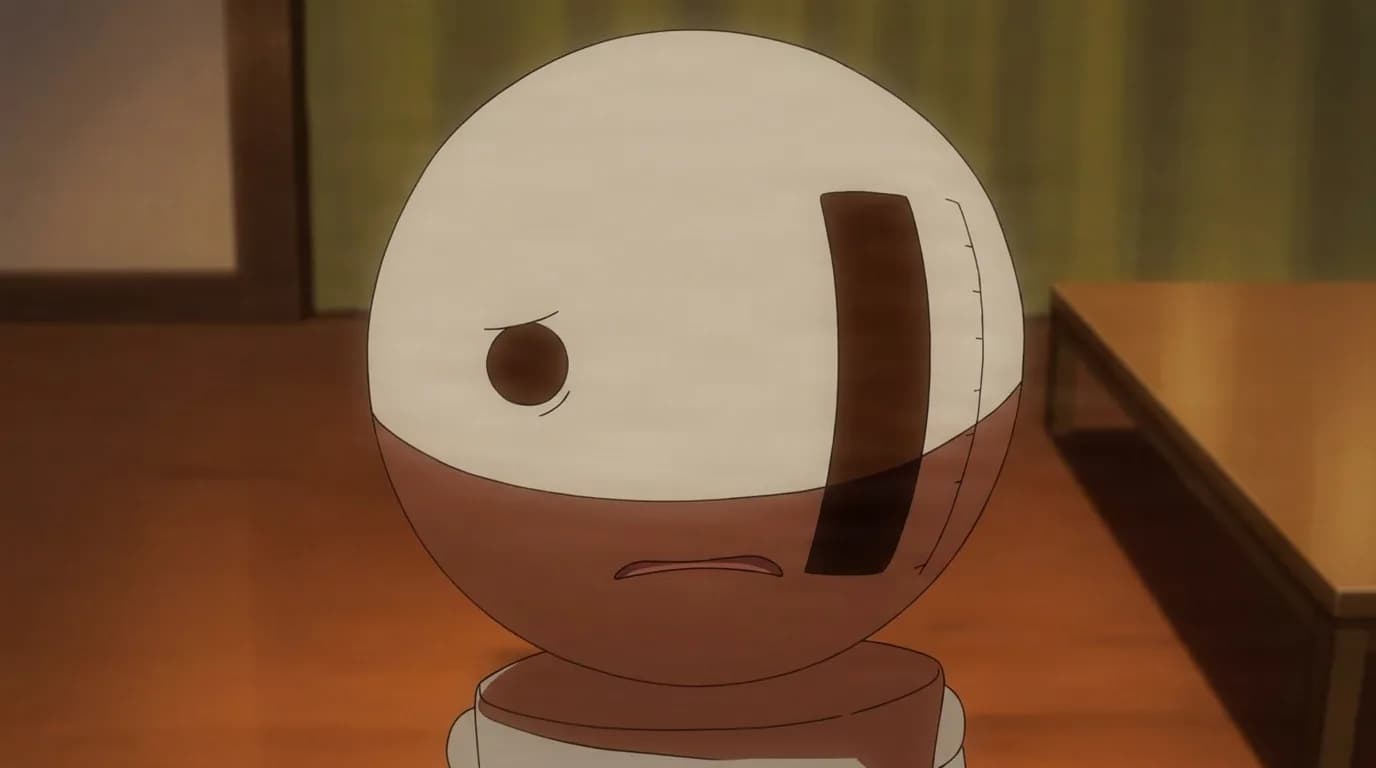
Hisagomaru
CharacterHisagomaru is the manifested spirit of Hanatarō Yamada's healing Zanpakutō, appearing only in the anime's Zanpakutō Rebellion storyline. A skittish little robot-like being, he hides in the sewers convinced his master has cast him aside.
Appearance
In manifested form Hisagomaru resembles a small white automaton, its body a cylindrical trunk topped by a rounded head. Thin limbs end in flat hands and feet, a plain rectangular slot serves as a mouth, and a single black circle stands in for his right eye. Where a left eye would sit, a tall vertical gauge lined with measurement marks stretches down most of his face.

Personality
Hisagomaru is deeply shy, dwelling in the tunnels beneath the Seireitei and bolting at the sight of others. He apologizes almost compulsively, flustering through questions rather than answering them, and he flatly refuses to kill any creature for food. That timidity gives way to bravery when it truly counts, and he single-handedly brings down the Tentacle Tōjū after the other fighters have fallen. He harbors no grudge against Hanatarō Yamada, having tried again and again to slip back into his sword before wrongly concluding he had been abandoned.
Related Reading
See all
The Bleach Female Characters Nobody Can Agree On, Settled
Five Bleach female characters, ranked and settled. Yoruichi sits at number five, the spot nobody expects, and our number one is an Arrancar with a soft heart....
Naruto vs Luffy: Does the Fight Change if Luffy Tickles Hinata?
Naruto vs Luffy with the twist nobody asked for: Luffy tickled Hinata on date night, and she kind of liked it. We break down the whole fight and commit to a winner....
History
Forcibly given a body during the anime-only Beast Swords conflict, Hisagomaru struggles in vain to return to his blade and, believing Hanatarō has rejected him, withdraws to live alone in the waterways. Loneliness eventually drives him to pilfer things from the surface, including chickens Hanatarō is raising, which draws Soul Society's attention. When Hanatarō, Ikkaku Madarame, Hōzukimaru, and Nanao Ise track him down, the arrival of the Tentacle Tōjū prompts him to reveal his identity and crush the threat with his cannon. He is overjoyed to learn his master never forsook him, and once Renji Abarai defeats the final Tōjū, the fading energy sustaining the spirits returns Hisagomaru permanently to his sword.
His weapon heals rather than harms, filling the gauges on both the blade and his own face as it works. At capacity it becomes Akeiro Hisagomaru, whose chest splits open into a massive cannon that gathers every healed wound into one crimson blast, unleashed at the command to infuse.
Frequently Asked Questions
Who is Hisagomaru in Bleach?
Hisagomaru is the manifested spirit of Hanataro Yamada's healing Zanpakuto, appearing only during the anime's Zanpakuto Rebellion storyline as a shy, robot like being.
What does Hisagomaru look like?
In manifested form, Hisagomaru resembles a small white automaton with a cylindrical trunk, a rounded head, thin limbs, a rectangular slot for a mouth, and a single black circle for a right eye, while a vertical measurement gauge takes the place of his left eye.
Why does Hisagomaru hide in the sewers?
Hisagomaru hides in the tunnels beneath the Seireitei because he wrongly believes his master, Hanataro Yamada, has abandoned him after repeatedly failing to slip back into his sword.
How is Hisagomaru reunited with Hanataro?
After Hisagomaru single handedly defeats the Tentacle Tojū and Renji Abarai defeats the final Tojū, the fading energy sustaining the spirits returns Hisagomaru permanently to Hanataro Yamada's sword.
What does Hisagomaru become at full power?
Once its healing gauge fills completely, Hisagomaru's blade form becomes Akeiro Hisagomaru, whose chest splits open into a massive cannon that unleashes every healed wound as one crimson blast.
Sources & Information
Looking for more on Hisagomaru? The Bleach Wiki on Fandom has a dedicated page with community notes.
View on FandomThis content is original writing by Daddy Jim Headquarters based on the Bleach anime series, manga, and official materials. Episode and chapter references are cited where applicable.
Rights holders
- Created byTite Kubo
- Published byShueisha
- Animated byStudio Pierrot
All rights belong to their respective owners.
Character and scene imagery on this site is original artwork by Daddy Jim Headquarters, not screenshots or licensed imagery. Official cover art is used on three types of pages for editorial commentary:
- Movie pages: theatrical posters and key visuals, credited to Studio Pierrot and the production committee.
- Game pages: official box art for the Bleach console and mobile games, credited to Bandai Namco and other publishers.
- Manga chapter pages: Jump Comics volume covers, credited to Shueisha and Tite Kubo.
Official resources:
Help Us Keep This Wiki Accurate
Daddy Jim Headquarters maintains this encyclopedia. If you spot an error, a translation issue, or something that doesn't look right, let us know.