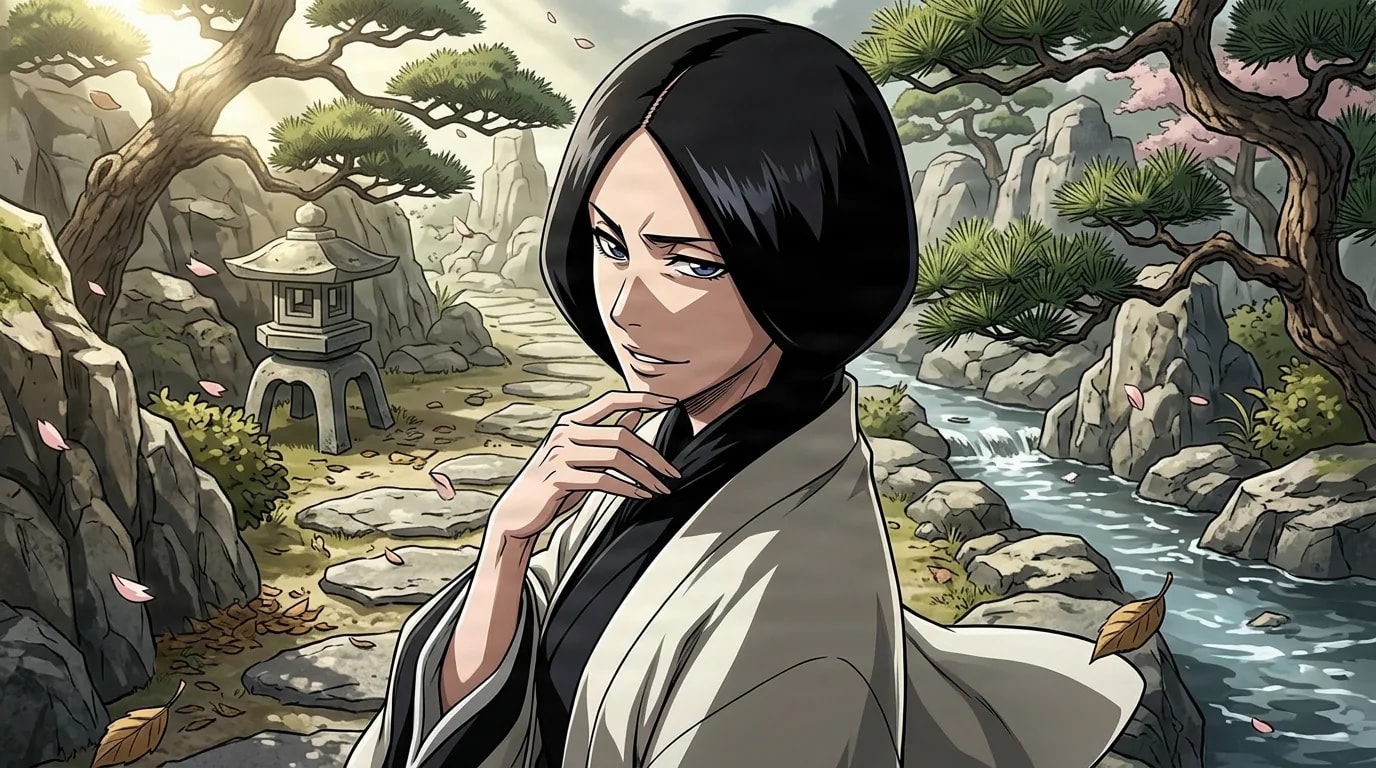
Retsu Unohana
CharacterRetsu Unohana leads the Gotei 13's fourth company and reigns as the finest healer in all of Soul Society, yet that serene bedside manner conceals a bloody secret: she was the very first Kenpachi and the most fearsome killer the Soul Society ever produced.
Appearance
Youthful and slim in build, Unohana carries herself with blue eyes and dark hair that she binds into a single thick plait hanging along the front of her torso. She dresses in the captain's black robes but fastens them with an obi in place of the customary sash. In centuries past she let the braid hang loose as a ponytail instead, and during her duel with Kenpachi Zaraki she finally frees her hair completely, baring an old scar across her collarbone that he carved into her as a boy. Rather than tuck her sword through her belt, she slings it over one shoulder on a cord or entrusts it to her lieutenant, Isane Kotetsu.
Personality
Everything about her outward manner soothes: she speaks softly, addresses even enemies with courtesy, and rarely lets panic or worry show. Her devotion to duty is absolute, yet it never stops her from mending almost anyone who bleeds before her, allies and adversaries alike, which is why she counts the Visored among those she will save. That gentleness is precisely what unsettles others, for members of the eleventh company and her fellow captains alike quietly dread her. Once her buried history as the founding Kenpachi resurfaces, the calm falls away to reveal her original self: a woman thrilled by the crossing of swords and willing to win by any trick, hidden blades included. In her rare idle hours she hikes the outlying districts to gather medicinal herbs, favors boldly flavored food, and presides over her division's flower-arranging club.
History
Long ago she took the name Yachiru and was reputed to be the most monstrous criminal the Soul Society had ever known, having mastered every school of swordsmanship in existence. Genryūsai Yamamoto came looking for her, and she became one of the thirteen companies' founding captains, personally shaping what would grow into the eleventh division and holding the title of Kenpachi before anyone else. To keep her opponents alive and prolong the fights she craved, she learned the healing arts from Tenjirō Kirinji, a discipline that would eventually make her the greatest medic in the whole of Soul Society. Roughly a millennium before her death she stood with Yamamoto against Yhwach's invading Quincy.
Her love of battle had all but faded when she stumbled upon a feral child destined to become Kenpachi Zaraki. He wounded her on sight and rekindled the joy she had lost, and though she was left standing, she understood he was the stronger of the two and better fit to carry her old title. She later stepped down from the eleventh company to lead the fourth, and across the long conflicts that followed, from Aizen's betrayal to the war against the Wandenreich, she served as the Gotei's steady healer, tending the fallen through her Zanpakutō, Minazuki, a colossal one-eyed ray that swallows the injured to cure them.
When Shunsui Kyōraku called on her to forge Zaraki into a weapon strong enough to face the Quincy, Unohana led him into the prison's deepest vault and embraced her forgotten savagery once more. Again and again she cut him down and healed the wounds, deliberately stripping away the limits he had unknowingly placed on himself, unveiling the offensive form of Minazuki, whose blade dissolves into a blood-like fluid, to press him further. She fell only once he grew strong enough to end her life, dying with a smile, satisfied that she had drawn out his true self at last. Twelve years on, a rite meant to lay her remains to rest instead cast her down into Hell, where she took up the name Death Sword.
Related Reading
See all
The Bleach Female Characters Nobody Can Agree On, Settled
Five Bleach female characters, ranked and settled. Yoruichi sits at number five, the spot nobody expects, and our number one is an Arrancar with a soft heart....
Super Saiyan Pubes: The Song About Where Super Saiyan Hair Actually Goes
The transformation everyone knows, the follow-up question nobody would touch. Why we made a smooth R&B track about the golden glow Dragon Ball never talks about....
Frequently Asked Questions
Are Yachiru Unohana and Retsu Unohana the same person?
Yes, Retsu Unohana was originally known as Yachiru Unohana before taking the name Retsu; she was the Soul Society's most infamous killer long before becoming captain of the fourth company.
Why was Unohana killed off in Bleach?
Retsu Unohana died in a duel with Kenpachi Zaraki that she orchestrated herself, deliberately drawing out his hidden strength by repeatedly wounding and healing him until he grew powerful enough to finally strike her down.
Is Retsu Unohana a villain in Bleach?
Retsu Unohana is not a villain; she is the compassionate captain of the fourth company and Soul Society's greatest healer, though her calm exterior hides her true identity as the first Kenpachi and the most fearsome killer the Soul Society ever produced.
Why is Unohana so feared?
Unohana is feared because her outward gentleness conceals a woman who was once the Soul Society's deadliest killer and its original Kenpachi, a history that quietly unsettles even the eleventh company and her fellow captains.
What is Retsu Unohana's Zanpakuto?
Unohana's Zanpakuto is Minazuki, a colossal one eyed ray whose sealed form swallows the injured to heal them, while its offensive released form dissolves the blade into a blood like fluid.
Sources & Information
Looking for more on Retsu Unohana? The Bleach Wiki on Fandom has a dedicated page with community notes.
View on FandomThis content is original writing by Daddy Jim Headquarters based on the Bleach anime series, manga, and official materials. Episode and chapter references are cited where applicable.
Character and scene imagery on this site is original artwork by Daddy Jim Headquarters, not screenshots or licensed imagery. Official cover art is used on three types of pages for editorial commentary:
- Movie pages: theatrical posters and key visuals, credited to Studio Pierrot and the production committee.
- Game pages: official box art for the Bleach console and mobile games, credited to Bandai Namco and other publishers.
- Manga chapter pages: Jump Comics volume covers, credited to Shueisha and Tite Kubo.
Official resources:
Help Us Keep This Wiki Accurate
Daddy Jim Headquarters maintains this encyclopedia. If you spot an error, a translation issue, or something that doesn't look right, let us know.