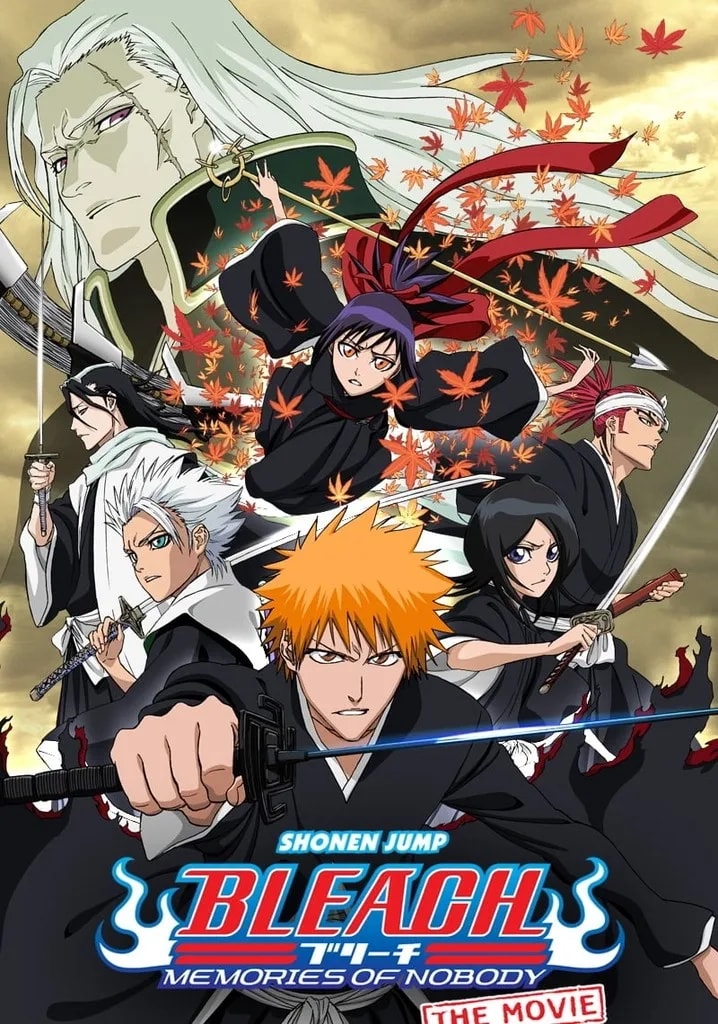
Bleach: Memories of Nobody
MovieThe first Bleach feature introduces Senna, a cheerful Shinigami with no memory of her past, and a rogue exiled clan whose plan to collide the living world with Soul Society hinges on the mysterious entity she has unknowingly become.
Overview
The debut theatrical outing for the franchise premiered in Japan on December 16, 2006, directed by Noriyuki Abe with a screenplay by Masashi Sogo. Aqua Timez performed the theme, Sen no Yoru wo Koete. To build anticipation, several television episodes borrowed footage from the movie for their credits sequences. The story stands apart from the main continuity as a self-contained tale.
A limited two-night run brought it to United States theaters in June 2008 ahead of a home-video release that October, followed by a broadcast on Adult Swim the next year. It later became available across streaming platforms including Prime Video, Apple TV, and Vudu.
Plot
Strange white figures called Blanks flood a train station, and a cheerful Shinigami named Senna scatters them with a tornado released from her sword. Ichigo Kurosaki and Rukia Kuchiki cannot place her in any division roster, and Kisuke Urahara explains that a new dimension, the Valley of Screams, has formed inside the Dangai, bridging the two worlds. Within it, souls stripped of their memories become Blanks, while those memories merge into a single object known as the Shinenju.
As Ichigo trails the playful Senna through Karakura Town, she begins recalling fragments of a human life and even finds what appears to be her own grave. An armored clan called the Dark Ones, led by Ganryu, ambushes her, revealing that she is the Shinenju itself, condemned records of a girl lost to the Dangai a century earlier. Ganryu abducts her to the Valley of Screams, intending to force the living world and Soul Society into a catastrophic collision using her power.
Refusing to abandon her, Ichigo locates an entrance in the human world and dives in alone, later joined by Rukia, Renji, and a squad of captains and lieutenants who dispatch the Dark Ones one by one. Ichigo cuts down Ganryu and frees Senna, but the reaction has already begun to fuse the realms. Senna sacrifices herself, channeling the Blanks' energy to restore both worlds. At a graveyard, Ichigo carries her to a headstone and gently tells her that her name is written there, and she fades away content. Though everyone will forget she ever existed, Ichigo later glimpses a girl who resembles her drifting past, her red ribbon caught in the wind.
Reception
The film's promotional campaign leaned on the anime, with episodes 106 through 109 recycling its animation for their opening and closing credits. Its taglines emphasized a ticking clock, warning that only one hour remained before the world's collapse.
A notable inconsistency appears in Suzumebachi's depicted power: because Kubo had not yet shown the technique's true effect in the manga at the time, the movie portrays its second strike as bisecting the victim rather than destroying them with a butterfly-shaped crest.
Related Reading
See all
The Bleach Female Characters Nobody Can Agree On, Settled
Five Bleach female characters, ranked and settled. Yoruichi sits at number five, the spot nobody expects, and our number one is an Arrancar with a soft heart....
Super Saiyan Pubes: The Song About Where Super Saiyan Hair Actually Goes
The transformation everyone knows, the follow-up question nobody would touch. Why we made a smooth R&B track about the golden glow Dragon Ball never talks about....
Frequently Asked Questions
Is Bleach: Memories of Nobody canon?
Bleach: Memories of Nobody stands apart from the main continuity as a self-contained tale, told outside the main storyline. It was the franchise's debut theatrical outing rather than an adaptation of the manga.
What is Bleach: Memories of Nobody?
Bleach: Memories of Nobody is the first Bleach feature film, which premiered in Japan on December 16, 2006. It introduces Senna, a cheerful Shinigami with no memory of her past, and a rogue exiled clan whose plan to collide the living world with Soul Society hinges on what she has unknowingly become.
Who is Senna in Bleach: Memories of Nobody?
Senna is a cheerful Shinigami who scatters white figures called Blanks and cannot be placed in any division roster. She is revealed to be the Shinenju itself, the condensed records of a girl lost to the Dangai a century earlier, and she ultimately sacrifices herself to restore both worlds.
When was Bleach: Memories of Nobody released?
The film premiered in Japan on December 16, 2006, directed by Noriyuki Abe with a screenplay by Masashi Sogo. A limited two-night run brought it to United States theaters in June 2008 ahead of a home-video release that October.
Who is the antagonist in Bleach: Memories of Nobody?
The antagonist is Ganryu, leader of an armored clan called the Dark Ones. He abducts Senna to the Valley of Screams, intending to force the living world and Soul Society into a catastrophic collision using her power, before Ichigo cuts him down.
Sources & Information
Looking for more on Bleach: Memories of Nobody? The Bleach Wiki on Fandom has a dedicated page with community notes.
View on FandomThis content is original writing by Daddy Jim Headquarters based on the Bleach anime series, manga, and official materials. Episode and chapter references are cited where applicable.
Character and scene imagery on this site is original artwork by Daddy Jim Headquarters, not screenshots or licensed imagery. Official cover art is used on three types of pages for editorial commentary:
- Movie pages: theatrical posters and key visuals, credited to Studio Pierrot and the production committee.
- Game pages: official box art for the Bleach console and mobile games, credited to Bandai Namco and other publishers.
- Manga chapter pages: Jump Comics volume covers, credited to Shueisha and Tite Kubo.
Official resources:
Help Us Keep This Wiki Accurate
Daddy Jim Headquarters maintains this encyclopedia. If you spot an error, a translation issue, or something that doesn't look right, let us know.