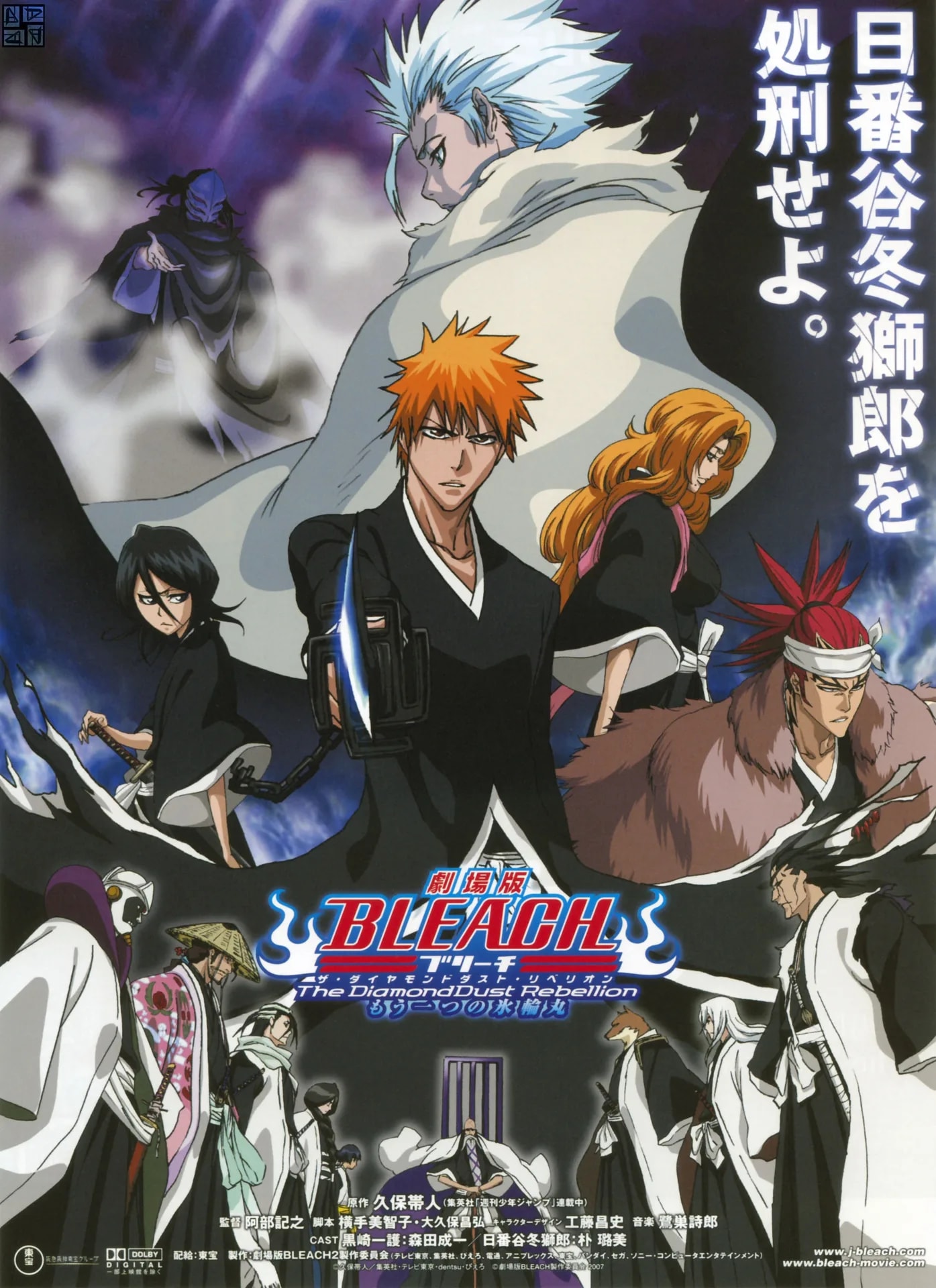
Bleach: The DiamondDust Rebellion
MovieWhen a royal treasure is stolen and Toshiro Hitsugaya vanishes in pursuit, he is branded a traitor, and Ichigo uncovers a buried tragedy involving a friend Hitsugaya was once forced to kill for the sake of a shared sword.
Overview
The second animated feature reached Japanese theaters on December 22, 2007, again directed by Noriyuki Abe, with a screenplay co-written by Michiko Yokote and Masahiro Okubo. Sambomaster's Hikari no Rock served as its theme. Alongside the release, Tite Kubo produced a short manga chapter delving into Hitsugaya's history, and anime episodes borrowed the film's footage for their credits.
Carrying the tagline demanding Hitsugaya's execution, the movie centers on the tenth division captain and a secret from his student days. It opened in North America in September 2009 and later became available for streaming on Prime Video, Apple TV, and Vudu.


Plot
A royal procession transporting a sacred artifact called the Oin is ambushed by two Arrancar, Yin and Yang, alongside a masked assailant. Hitsugaya chases the masked figure and then disappears, leading Soul Society to confine his division and treat him as a deserter. Ichigo finds the wounded captain and learns he is pursuing someone named Kusaka, a name that unlocks a painful past: as academy students, Hitsugaya and Sojiro Kusaka both wielded the same spirit, Hyorinmaru, and Central 46 decreed that only one could keep it, ordering a duel to the death that ended with Kusaka slain.
Kusaka, resurrected in Hueco Mundo by the Oin's power, now schemes to seize control of Soul Society and take revenge on the Seireitei that discarded him. Ichigo, guided by a vision of the past that his own Zanpakuto reveals, comes to understand that Hitsugaya has shouldered the guilt alone, deserting his post to settle the matter himself even at the cost of being condemned. Investigators including Shunsui, Nanao, and Byakuya gradually piece together the impossible truth of a doubled Zanpakuto.
Kusaka transports himself and Hitsugaya to Sokyoku Hill, cuts the Oin in two, and swells into a monstrous dragon of purple ice whose power threatens to consume the entire Seireitei. With Ichigo urging Hitsugaya to stop carrying the burden by himself, the captains, Kenpachi, and Ichigo assault the towering form until Ichigo pierces its head. In a final one-on-one clash, Hitsugaya strikes down the fading Kusaka, who thanks him for reaffirming that they were always friends before dispersing. The Oin reforms, and Hitsugaya lays Kusaka's broken sword before a grave.
Reception
The promotional push mirrored earlier films, with anime episodes 151 through 154 using footage from the movie in their opening and closing sequences, supplemented by Kubo's tie-in manga chapter about Hitsugaya's youth.
An error slipped into the English dub, in which Rukia mistakenly names Ichigo's Bankai as Tensho Zangetsu rather than Tensa Zangetsu.
Related Reading
See all
The Bleach Female Characters Nobody Can Agree On, Settled
Five Bleach female characters, ranked and settled. Yoruichi sits at number five, the spot nobody expects, and our number one is an Arrancar with a soft heart....
Super Saiyan Pubes: The Song About Where Super Saiyan Hair Actually Goes
The transformation everyone knows, the follow-up question nobody would touch. Why we made a smooth R&B track about the golden glow Dragon Ball never talks about....
Frequently Asked Questions
What is Bleach: The DiamondDust Rebellion about?
Bleach: The DiamondDust Rebellion follows Toshiro Hitsugaya, who vanishes while pursuing thieves of a royal treasure called the Oin and is branded a traitor. Ichigo uncovers a buried tragedy involving Sojiro Kusaka, a friend Hitsugaya was once forced to kill because the two shared the same spirit, Hyorinmaru.
Who is Sojiro Kusaka in the film?
Sojiro Kusaka was Hitsugaya's fellow academy student, and both wielded the same spirit, Hyorinmaru. Central 46 decreed that only one could keep it and ordered a duel to the death that left Kusaka slain, until the Oin's power resurrects him in Hueco Mundo, bent on revenge against the Seireitei.
Why is Hitsugaya branded a traitor in the film?
After a royal procession carrying the Oin is ambushed, Hitsugaya chases the masked attacker and then disappears. Soul Society confines his division and treats him as a deserter, unaware that he has left his post to settle the matter with Kusaka alone, shouldering the guilt by himself.
When was Bleach: The DiamondDust Rebellion released?
The second Bleach animated feature reached Japanese theaters on December 22, 2007, directed by Noriyuki Abe. It opened in North America in September 2009 and later became available for streaming on Prime Video, Apple TV, and Vudu.
What is the Oin in Bleach: The DiamondDust Rebellion?
The Oin is a sacred royal artifact whose theft sets the film in motion. Kusaka later cuts the Oin in two and swells into a monstrous dragon of purple ice whose power threatens to consume the entire Seireitei, though the Oin reforms after his defeat.
Sources & Information
Looking for more on Bleach: The DiamondDust Rebellion? The Bleach Wiki on Fandom has a dedicated page with community notes.
View on FandomThis content is original writing by Daddy Jim Headquarters based on the Bleach anime series, manga, and official materials. Episode and chapter references are cited where applicable.
Character and scene imagery on this site is original artwork by Daddy Jim Headquarters, not screenshots or licensed imagery. Official cover art is used on three types of pages for editorial commentary:
- Movie pages: theatrical posters and key visuals, credited to Studio Pierrot and the production committee.
- Game pages: official box art for the Bleach console and mobile games, credited to Bandai Namco and other publishers.
- Manga chapter pages: Jump Comics volume covers, credited to Shueisha and Tite Kubo.
Official resources:
Help Us Keep This Wiki Accurate
Daddy Jim Headquarters maintains this encyclopedia. If you spot an error, a translation issue, or something that doesn't look right, let us know.