About-Face
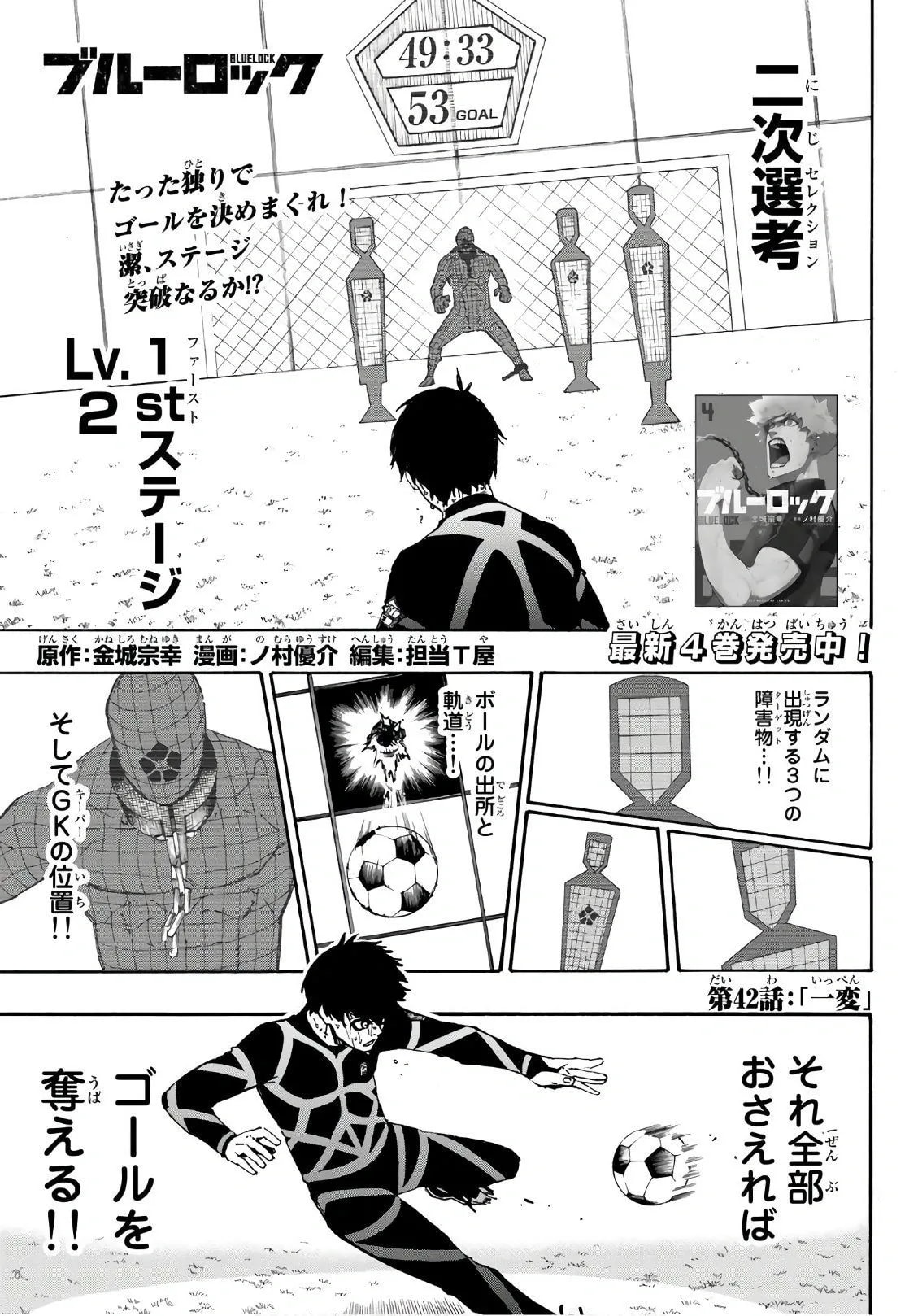
Manga ChapterPushed to the maximum level of the first stage, Isagi finally understands why he crumbles without his teammates and forges a personal scoring formula, clearing the trial just as a new team-based challenge is announced.
Summary
The stage's second level begins, and by carefully reading the holograms and the incoming ball, Isagi scores and grows confident he can clear it, with the board demanding fifty-two more goals in just over forty-eight minutes. In the monitoring room Anri praises how quickly the players are improving, but Ego warns her not to be too impressed since the real test has barely started. After Isagi bags twelve goals in six minutes, the system jumps to its maximum setting: the defensive targets begin moving and the balls arrive as slow, spinless deliveries that throw off his rhythm. Ego explains that this level drills world-class passing scenarios of erratic speed and direction, weeding out anyone lacking finishing precision, stamina, and constant awareness.
Struggling to convert, Isagi realizes his trouble stems from a lifetime of comfortable service. Bachira always fed him tidy passes, Kunigami shielded him like a wall, and Chigiri waited to bail him out, so he never truly battled alone. Refusing to keep depending on others, he resolves to win on his own gifts. He surveys the targets and keeper, races to the shooting spot, and fires, only for the keeper to block it because the ball strayed from the line he had imagined. Accepting he must strike with real accuracy, he tries again, catching the ball at its impact point with such pace that the keeper cannot react, and the goal drops.
That finish crystallizes his formula: pairing his spatial reading with a direct shot struck at the impact point lets him score entirely by himself. As Anri marvels at the surge, Ego observes that people naturally chase what suits them and that Isagi must be trembling at his own growth. The counter hits zero, clearing the first stage, and Isagi heads to the waiting area, where a message instructs the players to advance in groups of three.

Key Events
Isagi recognizes that his past success relied entirely on Bachira, Kunigami, and Chigiri, and commits to fighting alone. He locks in his scoring formula by combining spatial awareness with a precisely timed direct shot. Clearing the first stage, he learns the next round requires three-player teams, with Reo and Nagi shown to have cleared as well.
Related Reading
See all
Super Saiyan Pubes: The Song About Where Super Saiyan Hair Actually Goes
The transformation everyone knows, the follow-up question nobody would touch. Why we made a smooth R&B track about the golden glow Dragon Ball never talks about....

The Bleach Female Characters Nobody Can Agree On, Settled
Five Bleach female characters, ranked and settled. Yoruichi sits at number five, the spot nobody expects, and our number one is an Arrancar with a soft heart....

Frequently Asked Questions
Why does Isagi struggle in the second level of the first stage in Chapter 42?
Isagi struggles because the system jumps to its maximum setting, sending the ball as slow, spinless deliveries while the defensive targets begin moving, disrupting the rhythm he relied on and exposing that he had never truly scored without help from his old teammates.
What realization helps Isagi break through in Chapter 42?
Isagi realizes his past success depended entirely on Bachira's passing, Kunigami's protection, and Chigiri's speed, and he resolves to stop depending on others and win using only his own ability.
What is Isagi's scoring formula in Blue Lock?
Isagi's formula combines his spatial reading of the ball and keeper with a direct shot struck precisely at the ball's impact point, a technique that lets him score entirely on his own.
What happens after Isagi clears the first stage in Chapter 42?
After clearing the first stage, Isagi reaches the waiting area, where a message instructs the surviving players to advance in groups of three for the next round.
Who else clears the first stage alongside Isagi in Chapter 42?
Chapter 42 shows that Reo and Nagi also clear the first stage, confirming they remain in contention as the Second Selection moves into its team based rounds.
Sources & Information
Looking for more on About-Face? The Blue Lock Wiki on Fandom has a dedicated page with community notes.
View on FandomThis content is original writing by Daddy Jim Headquarters based on the Blue Lock anime series, manga, and official materials. Episode and chapter references are cited where applicable.
Character and scene imagery on this site is original artwork by Daddy Jim Headquarters, not screenshots or licensed imagery. Official cover art is used on three types of pages for editorial commentary:
- Movie pages: theatrical key visuals for Blue Lock: Episode Nagi, credited to Eight Bit and the production committee.
- Game pages: official artwork for Blue Lock: Project World Champion, credited to Kodansha and Rudel.
- Manga chapter pages: Kodansha Comics volume covers, credited to Kodansha, Muneyuki Kaneshiro, and Yusuke Nomura.
Official resources:
Help Us Keep This Wiki Accurate
Daddy Jim Headquarters maintains this encyclopedia. If you spot an error, a translation issue, or something that doesn't look right, let us know.