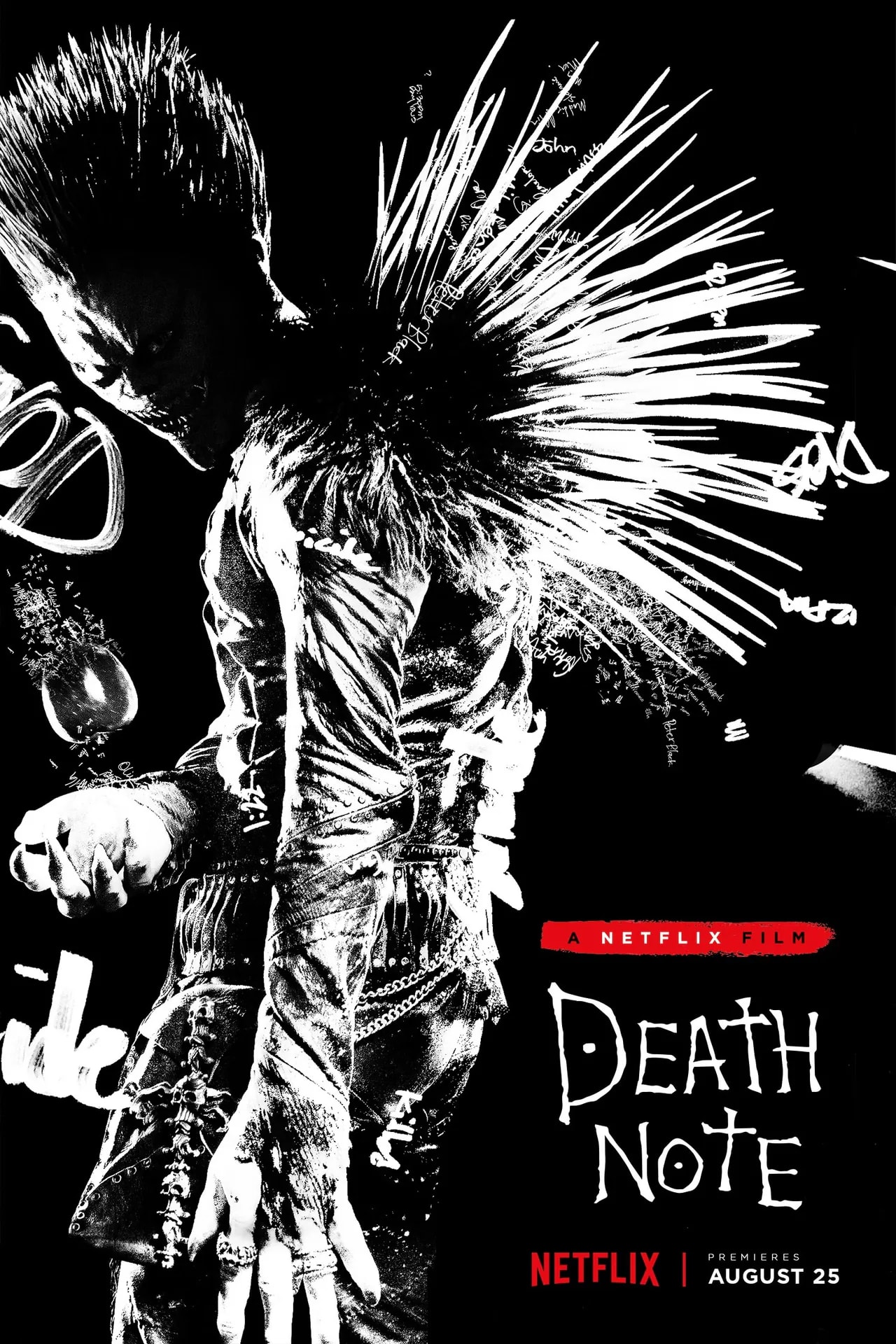
Death Note (2017 film)
MovieDeath Note is an American film adaptation that began streaming on Netflix on August 25, 2017, relocating the supernatural notebook story to Seattle. Directed by Adam Wingard and fronted by Nat Wolff, with Margaret Qualley and Keith Stanfield in support, it diverged sharply from its manga roots and drew heavy criticism.
Overview
Netflix took control of the project in 2016 after Warner Brothers stepped away, then commissioned director Adam Wingard to mount a loose retelling of the manga for streaming. The studio set its budget between forty and fifty million dollars and cast Nat Wolff as its lead, with Margaret Qualley and Keith Stanfield alongside him. Rather than Tokyo, the action unfolds in Seattle, and the picture leans into horror, with killings staged far more graphically than the source ever allowed. Several rules governing the book were rewritten for this version: a writer may steer a victim for only two days, and burning the relevant page can call off a death entirely, something impossible in the original.



Plot
High schooler Light Turner discovers a notebook in Seattle and meets Ryuk, a death god who explains that writing a name while picturing the person's face ends their life. Goaded into a trial run, Light watches a bully die in a grotesque accident, then targets the hit-and-run driver who killed his mother. A classmate named Mia Sutton learns his secret and pushes him to purge the world of criminals alongside her. The pair invent a godlike alias, Kira, and coerce victims into broadcasting the name, winning public adoration even as the body count climbs.
An eccentric investigator known only as L narrows Kira's source to Seattle's police records and arrives with his guardian Watari to consult Light's father, the police chief James Turner. After a televised taunt fails to provoke a strike, L grows convinced that Light is responsible. Mia secretly murders the FBI agents tailing them, and as L closes in, Light forces Watari to dig up the detective's true name. Mia then turns on Light, seizing Watari's stolen page and entering Light's own name into the book.
The confrontation peaks atop the Seattle Great Wheel. Mia takes the notebook only to learn Light had already doomed her, and Ryuk topples the ride. She plummets to her death while Light drops into the water below, his death page drifting into a burning barrel as L looks on. Light survives in a coma, having engineered the entire sequence to clear himself. When he wakes, his father admits he knows the truth. L, pulled off the case, uncovers Mia's page bearing the agents' names and wavers over whether to write a name of his own.
Reception
The casting choices triggered sustained accusations of whitewashing once the leads were announced, a backlash that flared again when the first trailer arrived in March 2017 and that outlets kept citing in later debates about Hollywood adaptations of Japanese material. A separate uproar followed in 2019 when viewers recognized real footage from a fatal 2010 Belgian train collision used within the film; survivors objected, and Netflix eventually swapped the clip and apologized. Critical opinion landed mostly unfavorable, with a 37 percent critics' score on Rotten Tomatoes, a 43 out of 100 on Metacritic, and a 4.5 rating on IMDb, though IGN was warmer at seven out of ten. On Netflix's own platform, more than sixty percent of raters handed it a single star.
Related Reading
See all
Super Saiyan Pubes: The Song About Where Super Saiyan Hair Actually Goes
The transformation everyone knows, the follow-up question nobody would touch. Why we made a smooth R&B track about the golden glow Dragon Ball never talks about....

The Bleach Female Characters Nobody Can Agree On, Settled
Five Bleach female characters, ranked and settled. Yoruichi sits at number five, the spot nobody expects, and our number one is an Arrancar with a soft heart....

Frequently Asked Questions
What is the 2017 Death Note film?
The 2017 Death Note film is an American adaptation that began streaming on Netflix on August 25, 2017, relocating the supernatural notebook story to Seattle. Directed by Adam Wingard and starring Nat Wolff, it is a loose retelling that diverges sharply from the manga.
When was the 2017 Death Note film released?
The 2017 Death Note film began streaming worldwide on Netflix on August 25, 2017. Netflix had taken control of the project in 2016 after Warner Brothers stepped away.
Why was the 2017 Death Note film controversial?
The 2017 Death Note film drew sustained accusations of whitewashing once its leads were announced, a backlash that flared again with the first trailer in March 2017. A separate uproar followed in 2019 when viewers recognized real footage from a fatal 2010 Belgian train collision in the film, prompting Netflix to swap the clip and apologize.
How does the 2017 Death Note film differ from the original manga?
The 2017 Death Note film moves the action from Tokyo to Seattle, leans heavily into horror with far more graphic killings, and rewrites several notebook rules: a writer can steer a victim for only two days, and burning the relevant page can call off a death entirely.
How was the 2017 Death Note film received?
The 2017 Death Note film landed mostly unfavorable reviews, holding a 37 percent critics' score on Rotten Tomatoes, a 43 out of 100 on Metacritic, and a 4.5 on IMDb. On Netflix's own platform, more than sixty percent of raters gave it a single star.
Sources & Information
Looking for more on Death Note (2017 film)? The Death Note Wiki on Fandom has a dedicated page with community notes.
View on FandomThis content is original writing by Daddy Jim Headquarters based on the Death Note anime series, manga, and official materials. Episode and chapter references are cited where applicable.
Character and scene imagery on this site is original artwork by Daddy Jim Headquarters, not screenshots or licensed imagery. Official cover art is used on three types of pages for editorial commentary:
- Movie pages: theatrical posters and key visuals, credited to Nippon Television and Warner Bros. Japan.
- Game pages: official box art, credited to Konami and other publishers.
- Manga chapter pages: Jump Comics volume covers, credited to Shueisha, Tsugumi Ohba, and Takeshi Obata.
Official resources:
Help Us Keep This Wiki Accurate
Daddy Jim Headquarters maintains this encyclopedia. If you spot an error, a translation issue, or something that doesn't look right, let us know.