Zenitsu Agatsuma
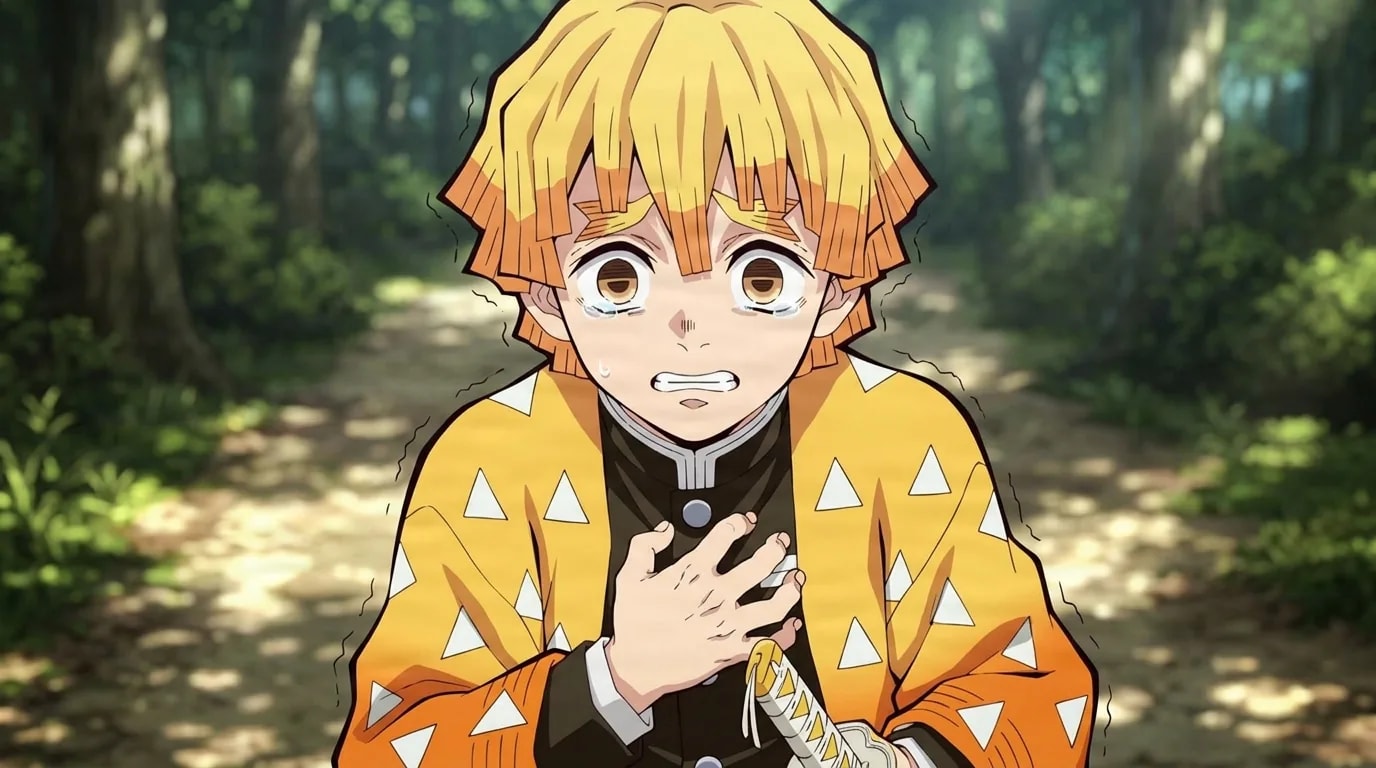
CharacterZenitsu Agatsuma is a central figure of the series, a slayer who travels alongside Tanjiro, Nezuko, and Inosuke. Despite crippling cowardice, he wields Thunder Breathing with deadly precision while unconscious from fright.
Appearance
Of typical height and lean yet toned, Zenitsu has fair skin and anxious, downturned eyes whose soft brown shade brightens into gold, framed by forked brows that warm into orange. His short hair sits at uneven lengths, ending in a squared cut that darkens toward orange and tumbles across his face in messy bangs reminiscent of a bowl cut. Black originally, it changed to its present hue after a lightning strike struck him in training. Following the clash at Mount Natagumo, poison from one of the spider demons shrank his limbs for a time, though medicine made by Shinobu Kocho restored them.
His outfit is a golden-brown take on the standard corps attire: a stand-collared button jacket with silver fastenings and a breast pocket, bearing the kanji for destroy on the back. A white collared undershirt sits beneath, with a white belt holding matching tattsuke-hakama wrapped at the calves by his bright yellow-to-orange leg guards, tied in front with three white bows in the same triangle motif as his haori. He completes the look with golden-brown tabi, white zori, and his trademark gradient haori patterned with repeating white triangles. As a grown man he imagined himself tall and mustachioed, but in truth he grew plump and barely managed any facial hair.


Personality
Timid, gloomy, and riddled with insecurity, Zenitsu often laments that his perilous work leaves him little time to live. His self-worth runs low even though he possesses genuine talent and might, and he frequently brands himself worthless. That mindset showed when, unable to accept that he had killed a demon, he convinced himself the slain figure was actually Shoichi, a powerless child. Perpetually frightened, he bolts at the first hint of peril and pines for an ordinary, quiet existence rather than a slayer's life, all while screaming and wailing at length.
Abilities
Zenitsu practices Thunder Breathing, the discipline taught to him by Jigoro Kuwajima. Although panic regularly overwhelms his waking mind, he fights with extraordinary skill once he loses consciousness from fear, his reflexes and speed sharpening dramatically. His mastery centers on the first form, which he refined to an exceptional degree before later developing a technique entirely his own.
Related Reading
See all
Demon Slayer Infinity Castle Is the Biggest Anime Movie Ever but It Still Lost in Japan
Demon Slayer: Infinity Castle earned $778 million globally and nearly 40 billion yen in Japan, but it still couldn't top Mugen Train's domestic record. Here's why that barely matters....
Super Saiyan Pubes: The Song About Where Super Saiyan Hair Actually Goes
The transformation everyone knows, the follow-up question nobody would touch. Why we made a smooth R&B track about the golden glow Dragon Ball never talks about....

Frequently Asked Questions
Is Zenitsu Agatsuma dead or alive?
Zenitsu Agatsuma is active before the timeskip but is listed as deceased afterward. He served as a member of the Demon Slayer Corps.
Who has Zenitsu Agatsuma killed?
Zenitsu Agatsuma has killed a demon, though he was unable to accept it. He convinced himself the slain figure was actually Shoichi, a powerless child.
How old is Zenitsu Agatsuma?
Zenitsu Agatsuma is 16 years old. He is a human and a member of the Demon Slayer Corps.
What breathing style does Zenitsu Agatsuma use?
Zenitsu Agatsuma practices Thunder Breathing, the discipline taught to him by Jigoro Kuwajima. His mastery centers on the first form, which he refined to an exceptional degree before developing a technique entirely his own.
How does Zenitsu Agatsuma fight while unconscious?
Although panic regularly overwhelms his waking mind, Zenitsu Agatsuma fights with extraordinary skill once he loses consciousness from fear. His reflexes and speed sharpen dramatically, allowing him to wield Thunder Breathing with deadly precision.
Sources & Information
Looking for more on Zenitsu Agatsuma? The Demon Slayer Wiki on Fandom has a dedicated page with community notes.
View on FandomThis content is original writing by Daddy Jim Headquarters based on the Demon Slayer anime series, manga, and official materials. Episode and chapter references are cited where applicable.
Character and scene imagery on this site is original artwork by Daddy Jim Headquarters, not screenshots or licensed imagery. Official cover art is used on three types of pages for editorial commentary:
- Movie pages: theatrical posters and key visuals, credited to ufotable and Aniplex.
- Game pages: official box art, credited to Sega, Aniplex, and other publishers.
- Manga chapter pages: Jump Comics volume covers, credited to Shueisha and Koyoharu Gotouge.
Official resources:
Help Us Keep This Wiki Accurate
Daddy Jim Headquarters maintains this encyclopedia. If you spot an error, a translation issue, or something that doesn't look right, let us know.