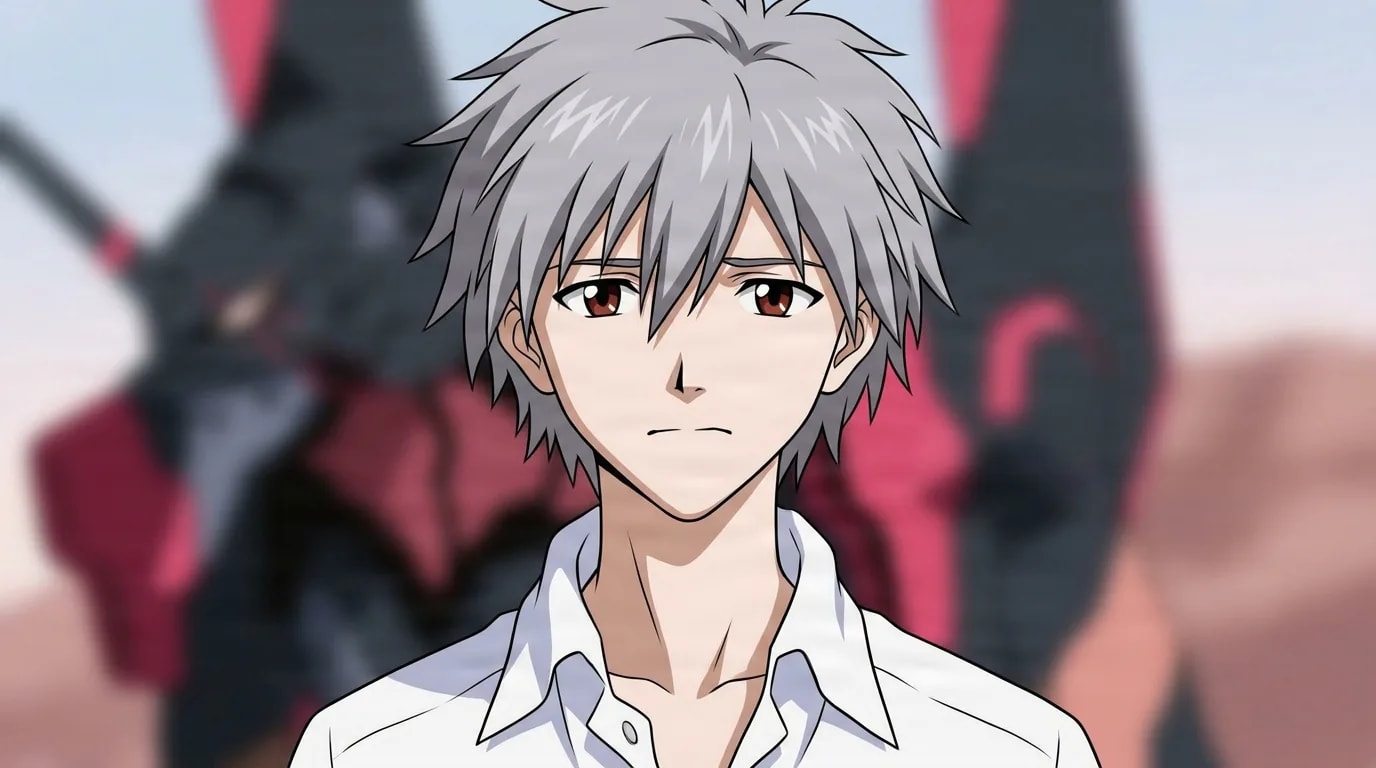
Kaworu Nagisa
CharacterKaworu Nagisa walks into a broken Shinji's life as the Fifth Child and wins his trust within a single day, then descends into Terminal Dogma as Tabris, the seventeenth and final Angel. The vessel for Adam's salvaged soul, he ends his war by asking his only friend to kill him.
Appearance
Nothing in Kaworu's build betrays his nature at a glance. He inhabits a Lilin body shaped like any teenager's, and only the details give him away: skin drained of nearly all color, hair a pale ash grey, and irises the color of blood. Born on 13 September 2000, the day of Second Impact, he presents as a boy of fifteen.
He is also the only Angel who dresses like a person. His usual outfit pairs a plain white shirt with high-waisted trousers in the style Shinji favors, finished with white high-top sneakers. Whether a core or an S² Engine hides somewhere within him has never been established, though his flesh is presumed to share the particle-wave matter composing Rei and the other Angels.
Personality
Where Rei seems unsettled by her own existence, Kaworu wears his identity easily. He is warm, curious, and startlingly direct, yet he hovers outside human convention, speaking in sweeping universal terms and calling humanity "the Lilin" as though narrating a species he does not belong to. Music fascinates him: he hums the choral movement of Beethoven's Ninth Symphony, which becomes his personal leitmotif, and he names song the finest thing Lilin civilization has produced.
Supplemental material styles him the Angel of free will. Though SEELE sends him with a mission, he follows an agenda of his own, and his indifference to social boundaries proves strangely disarming; he carries no defensive walls himself, so he slides past other people's without noticing they exist. His philosophy weighs living and dying equally, and he calls a death chosen freely the single absolute freedom available to anyone.
History
Kaworu's body originates in the Contact Experiment, when genetic material from an unidentified human donor merged with Adam's flesh. SEELE later recovered Adam's disembodied soul and sealed it inside him, making him in effect the First Angel reborn in human shape, and he spends the years before the series under the committee's watch. Once Asuka can no longer pilot, SEELE hands him over as the replacement Fifth Child, and he stuns NERV's staff by posting whatever synchronization score he pleases with Unit-02, whose resident soul has withdrawn.
He finds Shinji at his lowest, alone by a lake after the battle with Armisael, and friendship follows with unnatural speed: a shared bath, an open declaration of liking him, a night spent talking in his apartment. The next day, alarms flag Unit-02 moving without a pilot while Kaworu descends toward Terminal Dogma, and NERV identifies him as the seventeenth Angel. Shinji gives chase in Unit-01, forced to fight the hijacked Unit-02 on the way down. At the bottom, Kaworu discovers that the crucified giant is Lilith rather than Adam, understands his purpose has collapsed, and surrenders. Held in Unit-01's fist, he tells Shinji that meeting him gave his life meaning, then asks to die. After a long, motionless silence, Shinji complies.
In The End of Evangelion, dummy plugs stamped KAWORU drive SEELE's Mass Production Evas, implying he was cloned much as Rei was. During Instrumentality he appears beside Rei to ask Shinji whether humanity should accept the merging of all souls; Shinji chooses imperfect reality instead. Sadamoto's manga states his origin outright and plays him as comic yet unsettling: ignorant of taboos, he kills a stray kitten out of pragmatic mercy, pilots Unit-02 beside Rei against Armisael, weeps on feeling Rei's love for Shinji through the Angel's connection, and dies by Shinji's hand in a scene close to the anime's. Spin-offs from Gakuen Datenroku to Angelic Days keep recasting him, usually as a mysterious transfer student whose bond with Shinji ends in sacrifice. Early drafts imagined him very differently, as a boy puppeted by an Angelic pet cat, before the character was compressed into a single episode.
Related Reading
See all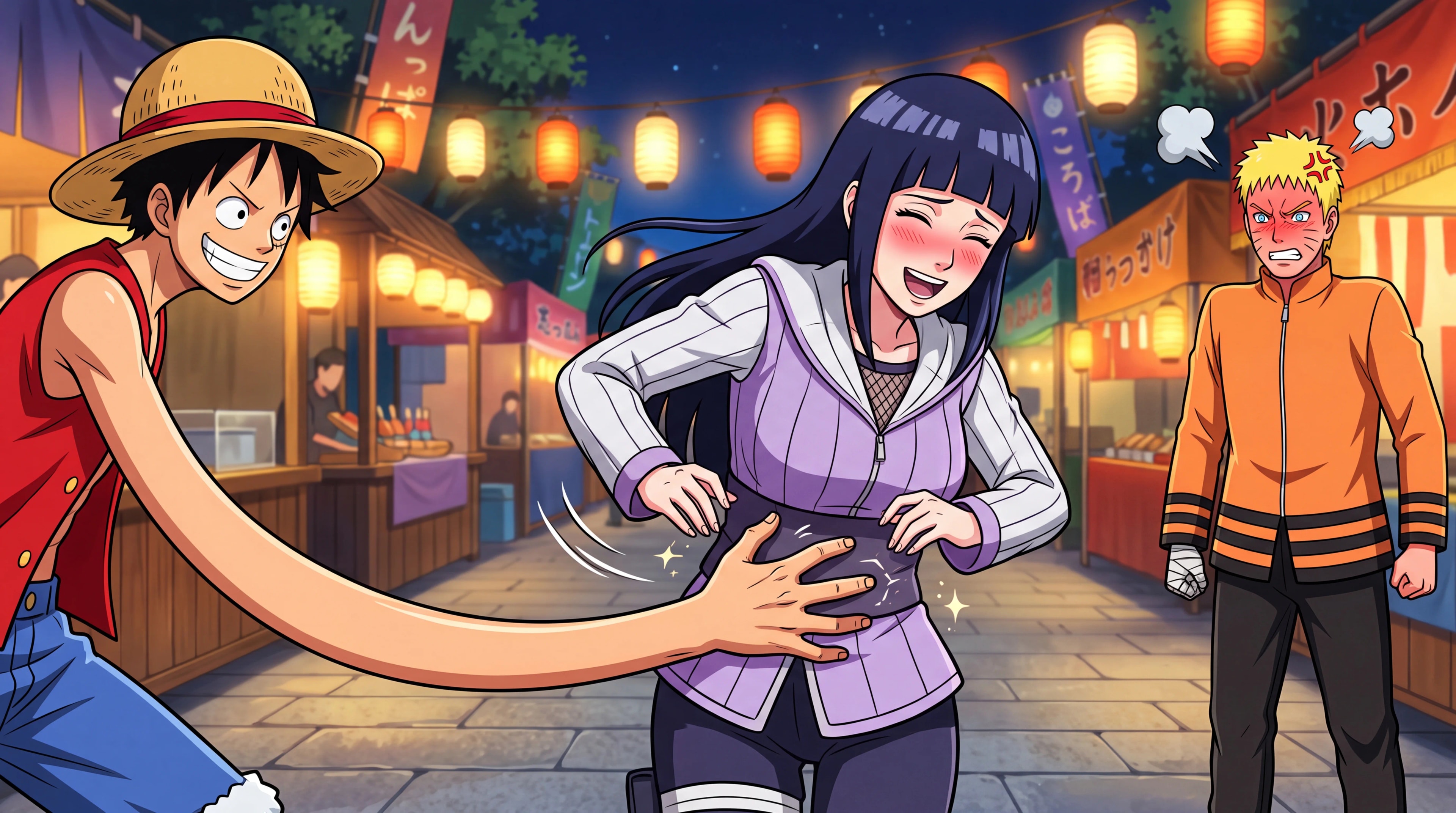
Naruto vs Luffy: Does the Fight Change if Luffy Tickles Hinata?
Naruto vs Luffy with the twist nobody asked for: Luffy tickled Hinata on date night, and she kind of liked it. We break down the whole fight and commit to a winner....
Piccolo Gets the Namek Hoes: Namek Has No Women, and He Pulls Anyway
There are no women on Namek. That isn't an oversight, it's the biology. Why we handed Piccolo the one thing his own species rules out, and why it had to be trap soul....
Frequently Asked Questions
Is Kaworu Nagisa in love with Shinji?
Kaworu Nagisa grows close to Shinji Ikari with unusual speed in Neon Genesis Evangelion, sharing a bath, openly telling Shinji he likes him, and spending a night talking together, and their bond is widely read as romantic. Kaworu later tells Shinji that meeting him gave his life meaning.
Is Kaworu Nagisa in The End of Evangelion?
Kaworu Nagisa appears in The End of Evangelion, where dummy plugs stamped with his name drive SEELE's Mass Production Evangelions, suggesting he was cloned like Rei Ayanami. During Instrumentality he also appears beside Rei to ask Shinji whether humanity should accept the merging of all souls.
What is Kaworu Nagisa's true identity in Evangelion?
Kaworu Nagisa is Tabris, the seventeenth and final Angel, whose Lilin body was created in the Contact Experiment and later used by SEELE to house Adam's recovered soul. He is sent to NERV as the replacement Fifth Child to pilot Unit-02.
Why does Shinji kill Kaworu Nagisa?
After descending into Terminal Dogma, Kaworu Nagisa discovers the crucified giant there is Lilith rather than Adam and realizes his mission has collapsed, so he surrenders and asks Shinji Ikari to kill him. Held in Unit-01's fist, Shinji complies after a long silence.
What music does Kaworu Nagisa like in Evangelion?
Kaworu Nagisa is fascinated by music and hums the choral movement of Beethoven's Ninth Symphony, which becomes his personal leitmotif. He calls song the finest thing that Lilin, his term for humanity, has ever produced.
Sources & Information
Looking for more on Kaworu Nagisa? The Dragon Ball Wiki on Fandom has a dedicated page with community notes.
View on FandomThis content is original writing by Daddy Jim Headquarters based on the Dragon Ball anime series, manga, and official materials. Episode and chapter references are cited where applicable.
Character and scene imagery on this site is original artwork by Daddy Jim Headquarters, not screenshots or licensed imagery. Official cover art is used on three types of pages for editorial commentary:
- Movie pages: theatrical posters and key visuals, credited to Toei Animation and Shueisha.
- Game pages: official box art, credited to Bandai Namco, Atari, and other publishers.
- Manga chapter pages: Jump Comics volume covers, credited to Shueisha and Akira Toriyama.
Official resources:
Help Us Keep This Wiki Accurate
Daddy Jim Headquarters maintains this encyclopedia. If you spot an error, a translation issue, or something that doesn't look right, let us know.