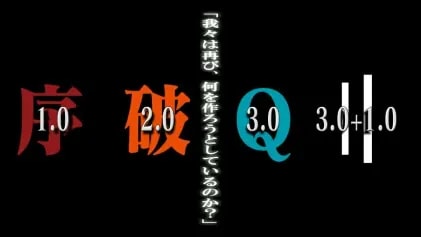
Rebuild of Evangelion
MovieA four film cinematic reimagining of Neon Genesis Evangelion, running from 2007 to 2021 in its own separate continuity. Familiar battles return with new staging while fresh faces, new settings, and an entirely original ending steer the story away from the television series it revisits.
Overview
Rebuild of Evangelion, officially titled Evangelion: New Theatrical Edition, comprises four anime features made by the team behind the original series. The tetralogy stands apart from the continuity of the television show and its 1990s films. Planning starts in late 2002, and the official Evangelion website announces the project on 05 October 2006 with working titles, returning staff, and a pitch promising familiar material rebuilt through 3DCG and current digital techniques alongside completely new story elements.
Hideaki Anno writes and oversees the whole project as chief director, working outside GAINAX through a production company and studio he founds for the purpose. In a statement displayed as a poster in 50 Japanese cinemas on 17 February 2007, he frames the undertaking as a push against stagnation in the anime industry, an attempt to reach the young viewers who drift away from the medium, and a retelling of a story about a boy who keeps standing back up. Kazuya Tsurumaki, Masayuki, Mahiro Maeda, and Katsuichi Nakayama direct individual entries; Yoshiyuki Sadamoto, Atsushi Nishigori, Hidenori Matsubara, and Moyoco Anno contribute character designs; Ikuto Yamashita and Takeshi Honda supply the mechanical work; Shinji Higuchi and Tomoki Kyoda storyboard the first film.
Plot
The first three entries present an alternate telling of the television storyline, and the finale delivers a wholly new ending. Evangelion: 1.0 You Are (Not) Alone (2007) runs through Operation Yashima, the assault on Ramiel that closed the show's introductory arc. Evangelion: 2.0 You Can (Not) Advance (2009) reaches the confrontation with Zeruel, though its story has already diverged sharply from the original by that point. Evangelion: 3.0 You Can (Not) Redo follows in 2012, and Evangelion: 3.0+1.0 Thrice Upon A Time concludes the series on 08 March 2021.
Two structural changes mark the retelling. Kaworu Nagisa, held back until the closing stretch of the television series, appears from the very first film. Mari Makinami Illustrious, a pilot created for these movies, joins the cast in the second entry. The line also includes two short prequels to the third film, EVANGELION 3.0 (-120 min.), a one-shot manga later adapted as an OVA, and the OVA EVANGELION: 3.0 (-46h), both released to home video on 08 March 2023.


Reception
The first three Japanese titles swap the usual katakana spelling of Evangelion for the archaic characters we and wo, a change with no effect on pronunciation, and style each numeral zero as the empty set symbol, a mark the ancient Romans also used for dead gladiators on mosaics. The fourth film restores the standard spelling and prefixes a katakana "Shin" whose meaning stays deliberately ambiguous: it can read as "new", as "true", or as something else entirely. In mainland China, trademark law leads the official distributor to keep the classic series name for the film series, producing a fused title for the finale that joins the old and new brandings.
In November 2025, khara's official X account reveals how modest the first concept was: a compilation re-edit of the television series that would alter only the ending, from Episode 20 onward. The earliest rough outline builds toward a duel between Kaworu's Eva and Shinji's, in which Shinji kills Kaworu after Kaworu has slain Gendo Ikari, who had fused with Asuka and Adam along with Unit-02.
Related Reading
See all
Naruto vs Luffy: Does the Fight Change if Luffy Tickles Hinata?
Naruto vs Luffy with the twist nobody asked for: Luffy tickled Hinata on date night, and she kind of liked it. We break down the whole fight and commit to a winner....
Piccolo Gets the Namek Hoes: Namek Has No Women, and He Pulls Anyway
There are no women on Namek. That isn't an oversight, it's the biology. Why we handed Piccolo the one thing his own species rules out, and why it had to be trap soul....
Frequently Asked Questions
What's the difference between Neon Genesis Evangelion and Rebuild?
Rebuild of Evangelion retells the story of Neon Genesis Evangelion in its own separate continuity rather than continuing the original timeline. The first three films retell the television storyline with new staging while introducing Kaworu Nagisa from the very first entry and adding pilot Mari Makinami Illustrious, and the fourth film delivers a wholly new ending instead of adapting the show's finale.
What is the point of Evangelion rebuilds?
Hideaki Anno created Rebuild of Evangelion as a push against stagnation in the anime industry and an attempt to reach young viewers drifting away from the medium. He described it as a retelling of a story about a boy who keeps standing back up, rebuilt with 3DCG and modern digital techniques alongside new story elements.
Is it necessary to watch Rebuild of Evangelion?
Rebuild of Evangelion stands apart from the continuity of the original television series and its 1990s films, telling its own separate story. It can be watched on its own, though the first three entries revisit events and characters familiar from the original series.
Is Rebuild a reboot or a sequel?
Rebuild of Evangelion functions as a reboot rather than a sequel. It exists in its own continuity apart from the television series, retelling early story beats before its fourth film, Evangelion: 3.0+1.0 Thrice Upon A Time, closes with an entirely original ending.
How many films make up Rebuild of Evangelion?
Rebuild of Evangelion consists of four films released between 2007 and 2021: Evangelion: 1.0 You Are (Not) Alone, 2.0 You Can (Not) Advance, 3.0 You Can (Not) Redo, and 3.0+1.0 Thrice Upon A Time. Two short prequels to the third film were also released to home video in 2023.
Sources & Information
Looking for more on Rebuild of Evangelion? The Dragon Ball Wiki on Fandom has a dedicated page with community notes.
View on FandomThis content is original writing by Daddy Jim Headquarters based on the Dragon Ball anime series, manga, and official materials. Episode and chapter references are cited where applicable.
Character and scene imagery on this site is original artwork by Daddy Jim Headquarters, not screenshots or licensed imagery. Official cover art is used on three types of pages for editorial commentary:
- Movie pages: theatrical posters and key visuals, credited to Toei Animation and Shueisha.
- Game pages: official box art, credited to Bandai Namco, Atari, and other publishers.
- Manga chapter pages: Jump Comics volume covers, credited to Shueisha and Akira Toriyama.
Official resources:
Help Us Keep This Wiki Accurate
Daddy Jim Headquarters maintains this encyclopedia. If you spot an error, a translation issue, or something that doesn't look right, let us know.