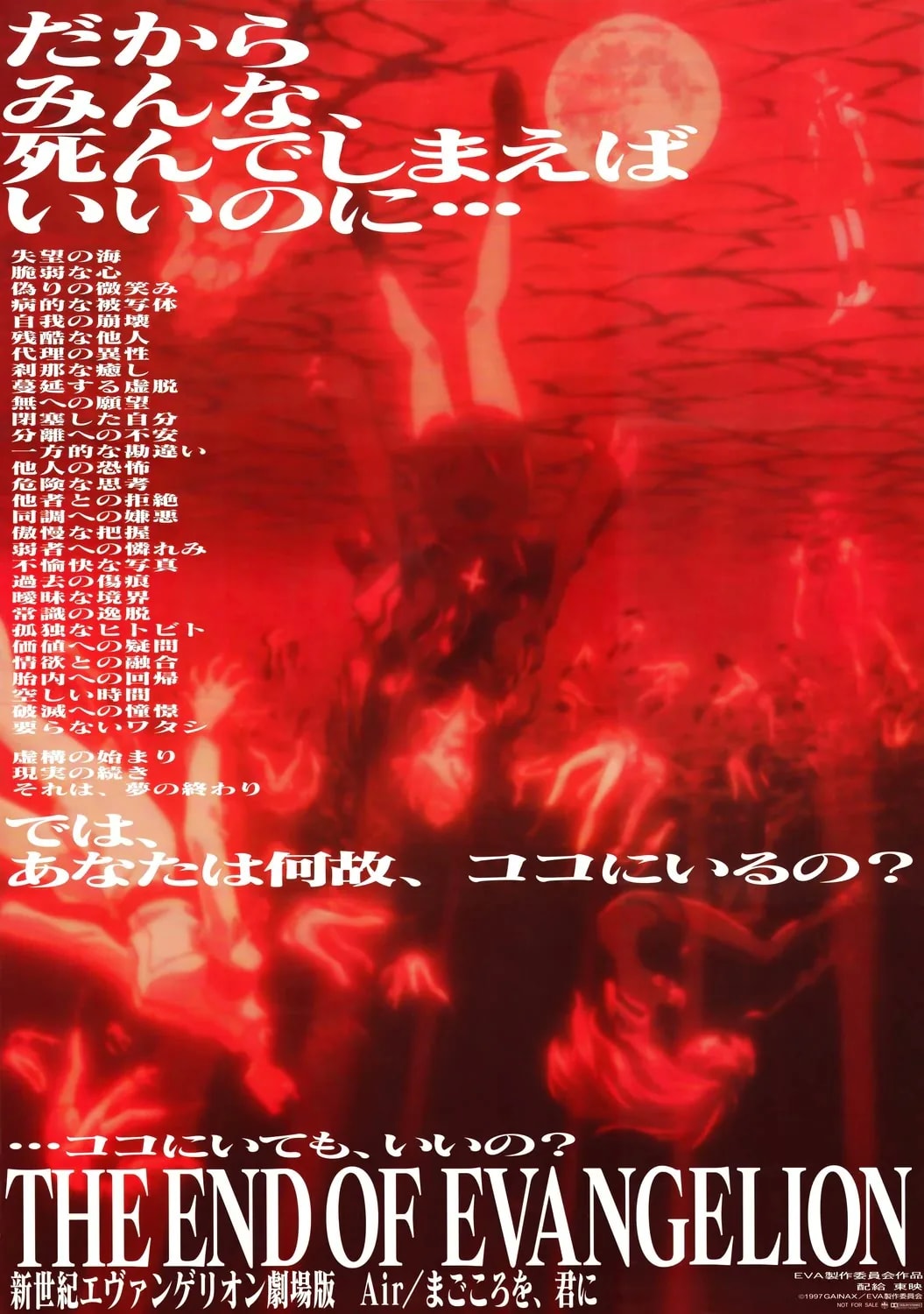
The End of Evangelion
MovieThe 1997 finale that gives the television series a cataclysmic alternate ending, following Episode 24 with the siege of NERV and the beginning of Instrumentality. Praised for its animation and emotional force, it grosses 2.47 billion yen and endures as one of the most celebrated animated films ever made.
Overview
The End of Evangelion arrives in Japanese theaters on 19 July 1997 as the second film in the franchise and the last new Evangelion animation until the Rebuild tetralogy. Written by Hideaki Anno, scored by Shirō Sagisu, and produced by GAINAX with Production I.G, the 87 minute feature picks up after Episode 24 and supplies the television series with an alternate conclusion. Its structure mirrors the show: two segments of roughly 45 minutes each, "Episode 25': Air" directed by Kazuya Tsurumaki and "Episode 26': Sincerely Yours" directed by Anno, each carrying a secondary English title in the tradition of the broadcast episodes. The producers regard the film either as a replacement ending or as a grounded external account of the finale the show staged almost entirely inside its characters' minds, an approach shaped in large part by the original production's time and budget limits.
Plot
In the first segment, SEELE launches its endgame and JSSDF troops storm NERV headquarters. Asuka, shaken out of her despair, meets the Mass Production Eva series in a fight to the death. The second segment brings Shinji before Lilith, where the destiny of the world hangs on a single decision, and his private torments shape the choice he makes.
The project grows out of Evangelion: Death and Rebirth, released four months earlier, whose REBIRTH half was meant to be the complete ending but could not be finished in time. "Air" builds on the script first written for the television version of Episode 25, and the finished film later becomes the back half of Revival of Evangelion. A persistent legend paints the movie as Anno's revenge on fans angry about the broadcast ending; in reality it sits closer to the conclusion originally conceived for the show, which budget and censorship pressures pushed aside, and the threatening letters flashed on screen were written by staff for legal reasons, most of them modeled on praise rather than hostility. Asuka's closing line, "Kimochi warui", emerges from a blunt exchange between Anno and actress Yuko Miyamura after he rejected every reading of a very different scripted line; to capture the strained delivery, Shinji's actress Megumi Ogata choked Miyamura by mutual agreement and accidentally knocked her down, producing the coarse final take. A far longer live action sequence, set ten years on and featuring the actresses as their characters in a world without Shinji, was shot but cut, surviving only in the theatrical trailer. Anno also wrote a second English language song, "Everything You've Ever Dreamed", centered on Shinji and Asuka's relationship, which went unused in favor of "Komm, süsser Tod".

Reception
The film takes in 2.47 billion yen and finishes as the fourth biggest Japanese feature of 1997, with distributor rentals around 1.5 billion yen, roughly 12 million dollars at the time. Critics single out its animation, direction, editing, screenplay, soundtrack, emotional power, and themes. It holds a 92 percent approval rating on Rotten Tomatoes, an 8.2 on IMDb, and a 4.4 out of 5 on Letterboxd, where it has stood as the top rated animated film since March 2024 while ranking 23rd on the site's Top 250. Honors include the 1997 Animage Anime Grand Prix and a Japan Academy Prize recognizing the year's biggest public sensation. Cut magazine places it third among films, writer Patrick Macias also names it third in history and calls it the key anime film of the 1990s, Paste lists it 46th among anime movies, and Slant Magazine ranks it 42nd among science fiction films. GKIDS gives it a first ever United States theatrical run in March 2024, and it currently streams on Netflix with digital purchase options across major platforms.
Related Reading
See all
Naruto vs Luffy: Does the Fight Change if Luffy Tickles Hinata?
Naruto vs Luffy with the twist nobody asked for: Luffy tickled Hinata on date night, and she kind of liked it. We break down the whole fight and commit to a winner....
Piccolo Gets the Namek Hoes: Namek Has No Women, and He Pulls Anyway
There are no women on Namek. That isn't an oversight, it's the biology. Why we handed Piccolo the one thing his own species rules out, and why it had to be trap soul....
Frequently Asked Questions
What's the difference between Neon Genesis Evangelion and End of Evangelion?
The End of Evangelion gives the Neon Genesis Evangelion television series a different, more violent conclusion, picking up after Episode 24 with the siege of NERV and the start of Instrumentality. Where the TV finale played out almost entirely inside its characters' minds due to time and budget limits, the film stages the same climax as a grounded, external catastrophe.
Do you need to watch Evangelion before The End of Evangelion?
Yes, The End of Evangelion picks up directly after Episode 24 of the Neon Genesis Evangelion television series and serves as an alternate conclusion to that story. Watching the series first is needed to follow Shinji, Asuka, and NERV's situation going into the film.
Why did Asuka say disgusting?
Asuka's closing line in The End of Evangelion, Kimochi warui, meaning something like how disgusting, came about after Hideaki Anno rejected every reading of the original scripted line. To get the harsh delivery he wanted, actress Megumi Ogata choked co-star Yuko Miyamura by mutual agreement during recording and accidentally knocked her down, producing the raw final take used in the film.
Why is the ending of Neon Genesis Evangelion so controversial?
The original Neon Genesis Evangelion finale played out almost entirely inside its characters' minds, an abstract approach shaped largely by the production's time and budget limits, which left many fans frustrated. The End of Evangelion was made partly to give the story a more grounded, external conclusion, though a persistent legend wrongly frames it as Hideaki Anno's revenge on angry fans.
Is The End of Evangelion the actual ending?
The End of Evangelion is presented as an alternate ending to the television series rather than a direct continuation. Its producers describe it as either a replacement conclusion or a more grounded, externalized version of the finale the show depicted inside its characters' minds.
Sources & Information
Looking for more on The End of Evangelion? The Dragon Ball Wiki on Fandom has a dedicated page with community notes.
View on FandomThis content is original writing by Daddy Jim Headquarters based on the Dragon Ball anime series, manga, and official materials. Episode and chapter references are cited where applicable.
Character and scene imagery on this site is original artwork by Daddy Jim Headquarters, not screenshots or licensed imagery. Official cover art is used on three types of pages for editorial commentary:
- Movie pages: theatrical posters and key visuals, credited to Toei Animation and Shueisha.
- Game pages: official box art, credited to Bandai Namco, Atari, and other publishers.
- Manga chapter pages: Jump Comics volume covers, credited to Shueisha and Akira Toriyama.
Official resources:
Help Us Keep This Wiki Accurate
Daddy Jim Headquarters maintains this encyclopedia. If you spot an error, a translation issue, or something that doesn't look right, let us know.