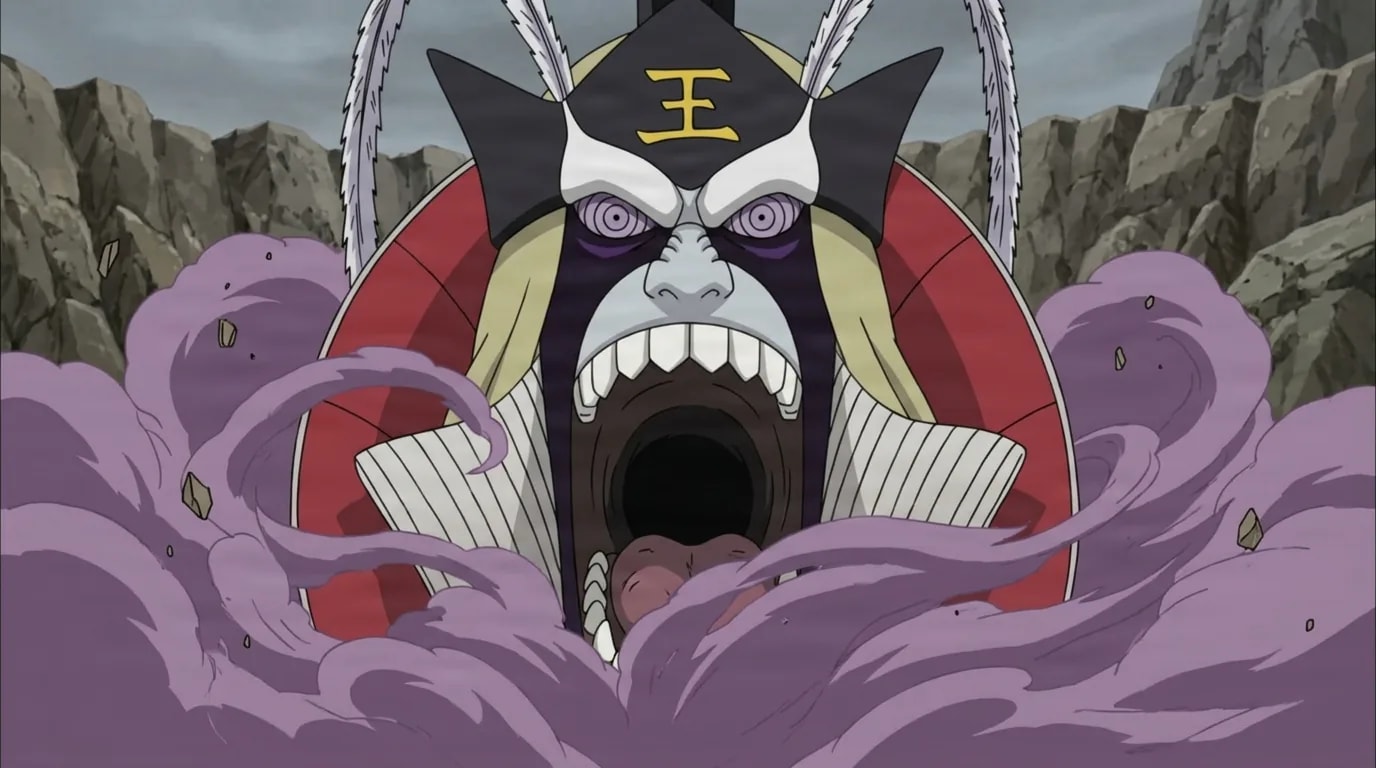
King of Hell
CharacterThe King of Hell is a deity of life and death that Rinnegan wielders can call upon through the power of the Six Paths. By way of the Naraka Path it judges truth from lies, mends the Six Paths of Pain, and stows away souls, drawing on the myth of Enma.
Appearance
The King of Hell manifests as a massive head that rises from the ground wreathed in dark fire, black like Amaterasu's flames in the manga and purple in the anime. The kanji for king sits upon its brow, and its own eyes bear the Rinnegan, so that whoever calls it can see through its gaze. Its tongue can divide into a pair of grasping arms.
Personality
More force than character, the deity acts as an arbiter of the dead, weighing honesty against deceit. It draws directly on Yama, the Buddhist judge of the dead known in Japan as Enma, who decides whether a soul is reborn into fortune or torment. Its habit of tearing out the tongues of liars nods to the old warning told to children, that Lord Enma will pull out the tongue of anyone who lies.
Abilities
A Rinnegan user calls the deity forth through the Naraka Path. Seizing a target and posing a question, the wielder draws the person's soul out as a long tongue, which the King of Hell catches with its own forked tongue to pass judgement: a lie sees the soul torn free and swallowed, while an honest answer wins its release. Used this way, both the deity and the souls it holds stay hidden from all but the caster and the victim.
The Naraka Path can also mend the Six Paths of Pain, the King of Hell consuming a broken body so that it re-emerges whole, once even clad in a fresh Akatsuki cloak. Paired with the Human Path, it can swallow and store a body and soul together to be moved and revived elsewhere. When put to these ends it becomes visible to others, as Naruto witnessed and Itachi proved by blinding its eyes with kunai. It serves a final role in the Outer Path technique Samsara of Heavenly Life, rising up to pour the souls of the dead from its mouth and return them to their bodies.
Related Reading
See all
The Most Popular Women of Naruto
We ranked the six most popular women of Naruto from worst to first, and our number one is going to start a fight. The official poll got it wrong....
Super Saiyan Pubes: The Song About Where Super Saiyan Hair Actually Goes
The transformation everyone knows, the follow-up question nobody would touch. Why we made a smooth R&B track about the golden glow Dragon Ball never talks about....
Frequently Asked Questions
What is the King of Hell in Naruto?
The King of Hell is a deity of life and death that users of the Rinnegan can summon through the power of the Six Paths, primarily by way of the Naraka Path.
How does a Rinnegan user summon the King of Hell?
A Rinnegan user calls forth the King of Hell through the Naraka Path, seizing a target and posing a question that draws the person's soul out as a long tongue for the deity to judge.
What happens when the King of Hell judges someone a liar?
If the King of Hell catches a lie, it tears the soul free and swallows it, while an honest answer wins the soul's release.
What real world figure is the King of Hell based on?
The King of Hell is based on Yama, the Buddhist judge of the dead known in Japan as Enma, who decides whether a soul is reborn into fortune or torment.
How does the King of Hell help heal the Six Paths of Pain?
Through the Naraka Path, the King of Hell can consume the broken body of one of the Six Paths of Pain and cause it to re-emerge whole, mending its wounds.
Sources & Information
Looking for more on King of Hell? The Naruto Wiki on Fandom has a dedicated page with community notes.
View on FandomThis content is original writing by Daddy Jim Headquarters based on the Naruto anime series, manga, and official materials. Episode and chapter references are cited where applicable.
Character and scene imagery on this site is original artwork by Daddy Jim Headquarters, not screenshots or licensed imagery. Official cover art is used on three types of pages for editorial commentary:
- Movie pages: theatrical posters and key visuals, credited to Studio Pierrot and Toho.
- Game pages: official box art for the Naruto: Ultimate Ninja Storm games, credited to Bandai Namco.
- Manga chapter pages: Jump Comics volume covers, credited to Shueisha and Masashi Kishimoto.
Official resources:
Help Us Keep This Wiki Accurate
Daddy Jim Headquarters maintains this encyclopedia. If you spot an error, a translation issue, or something that doesn't look right, let us know.