Izumi Curtis
CharacterIzumi Curtis is the fearsome master alchemist of Dublith who takes Edward and Alphonse Elric as her apprentices. A butcher's wife who calls herself a simple housewife, she hides staggering strength, circle-free alchemy, and a private grief that shaped her every teaching.
Appearance
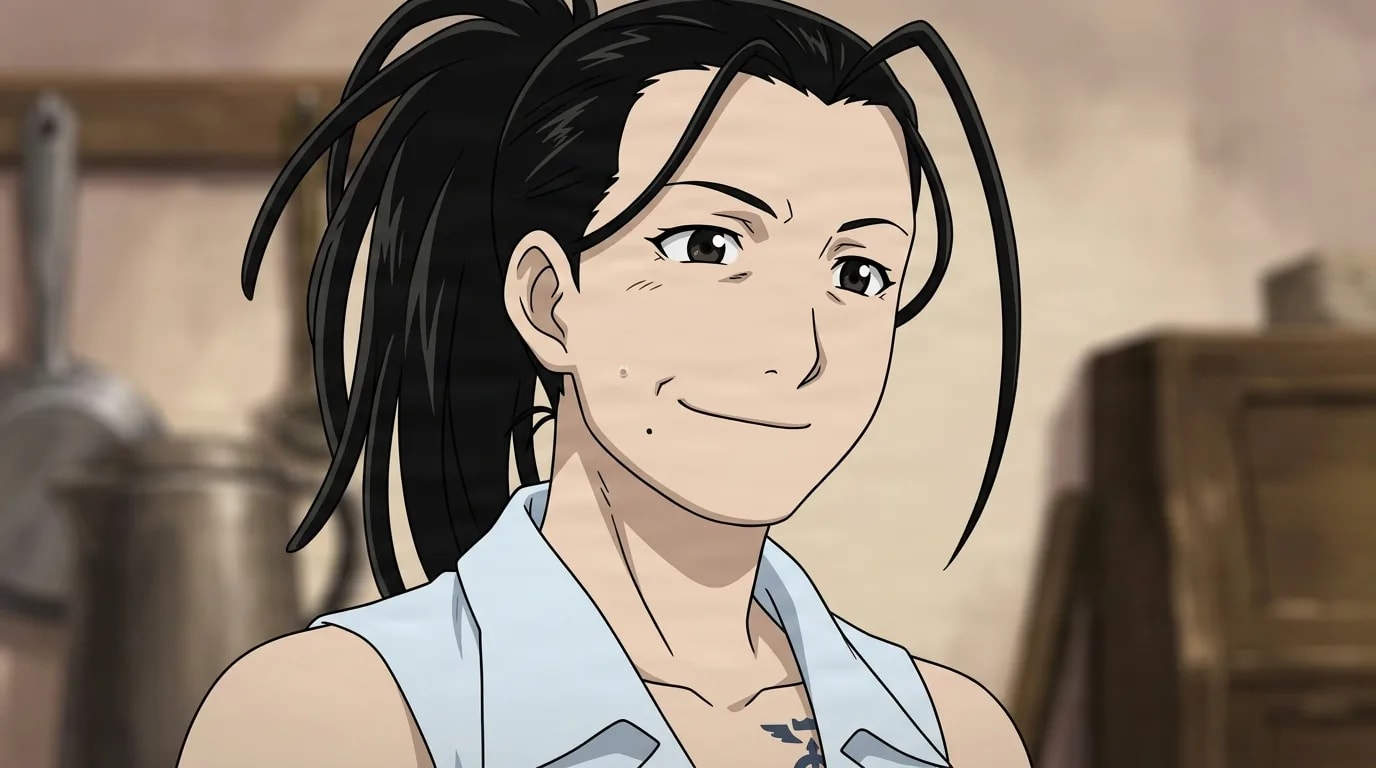
Tall and toned with a curved, athletic figure, Izumi keeps her fair skin and sharp dark eyes looking far younger than her middle years would suggest, a fact she guards fiercely against anyone who dares call her old. Her black hair falls to her upper back, worn in box braids gathered into a ponytail, and a Flamel emblem is inked above her left breast. Day to day she favors a white collared blouse left open at the neck, snug grey trousers cut to the ankle, and open-toed sandals stamped with the letters W.C.


Personality
Izumi loves to present herself as nothing more than a gentle, ordinary housewife, an image that sits at odds with the terror she inspires in her students. The Elric brothers dread setting her off, and a careless word, especially about her age, can earn a swift and painful reminder, often preceded by the crack of her knuckles. For all her power, she insists that alchemy is no substitute for honest labor and reserves it for tasks that hands alone cannot manage, reminding others that alchemists are only human.
Curious and broad-minded, she reads meaning into difference rather than dismissing it, a habit that gave rise to her creed that one is all and all is one. Beneath the aggression she is deeply warm, drawn especially to children and always ready to lift up those who have the will to help themselves but not yet the means.



History
Born in western Amestris, Izumi left home at eighteen to seek out a renowned alchemist in the far north and was told she would only be accepted if she lasted a month alone on the brutal Briggs mountains armed with nothing but a machete. She barely survived the cold, the wildlife, and the Briggs patrols who took her for a Drachman spy as she raided their supplies, and it was there she worked out her guiding idea that one is all and all is one. Returning to claim her place, she learned the man before her was Gold Steiner, brother of the late alchemist she had sought and a fighter rather than a scholar; enraged, she flattened him and set out to teach herself. Around the same time she crossed paths with Sig Curtis while hauling a freshly killed bear, a meeting both called love at first sight. The two married and settled in Dublith.
Her longing for a child ended in tragedy when her baby died at birth, and grief drove her to attempt human transmutation to bring it back. The Truth claimed several of her internal organs as the toll, leaving her chronically anemic, prone to coughing up blood, and unable to conceive again. Years later, passing through Resembool during a flood, she raised an earthen dam to spare the village, and there two orphaned boys, Edward and Alphonse Elric, begged to become her students. She set them the same kind of ordeal she had endured, a month surviving on Yock Island while puzzling out her creed, then trained them in alchemy and martial arts for six months.
That failed transmutation also made her one of the rare few able to work alchemy with no circle at all, simply by bringing her palms together and letting her will stand in for the runes, which makes her transmutations instant and endlessly adaptable in a fight. She is likewise among the physically strongest people in the series, hurling opponents, overpowering bears, and knocking back the homunculus Sloth, and she favors conjuring metal spears and spikes in combat. When the brothers later visit Dublith and reveal their own human transmutation, she expels them from her tutelage yet keeps guiding them as fellow alchemists. King Bradley personally offers her a State Alchemist post, which she flatly declines. Later Van Hohenheim rearranges her ruined organs into a healthier configuration, easing her condition. On the Promised Day she storms Central with the Briggs forces, helps bring down Sloth alongside the Armstrong siblings, and is then dragged underground to be forced, with the other human sacrifices, into opening the Gate for Father. She survives the ensuing blast thanks to Hohenheim shielding her, adds her strength to the final assault, and is there to welcome Alphonse home once he reclaims his body.
Related Reading
See all
Naruto vs Luffy: Does the Fight Change if Luffy Tickles Hinata?
Naruto vs Luffy with the twist nobody asked for: Luffy tickled Hinata on date night, and she kind of liked it. We break down the whole fight and commit to a winner....
Piccolo Gets the Namek Hoes: Namek Has No Women, and He Pulls Anyway
There are no women on Namek. That isn't an oversight, it's the biology. Why we handed Piccolo the one thing his own species rules out, and why it had to be trap soul....

Frequently Asked Questions
What happens to Izumi Curtis in Fullmetal Alchemist?
Izumi Curtis loses several internal organs as the toll for a failed attempt at human transmutation, leaving her chronically ill. She survives to fight in the Promised Day battle, helps bring down the homunculus Sloth, and is there to welcome Alphonse home at the end.
Why is Izumi Curtis so strong?
Izumi Curtis survived a brutal month alone on the Briggs mountains as a teenager and trained relentlessly in alchemy and martial arts afterward. She is among the physically strongest people in the series, able to overpower bears and even knock back a homunculus.
What happened to Izumi Curtis's baby?
Izumi Curtis's baby died at birth, and her grief drove her to attempt human transmutation to bring the child back. The attempt failed, and the Gate claimed several of her internal organs as payment.
Does Izumi Curtis get her organs back?
Not fully. Izumi Curtis never regains what the Gate took, but Van Hohenheim later rearranges her damaged organs into a healthier configuration, easing her chronic anemia and other symptoms.
Does Izumi Curtis have dreadlocks?
No. Izumi Curtis wears her black hair in box braids gathered into a ponytail, not dreadlocks.
Sources & Information
Looking for more on Izumi Curtis? The Dragon Ball Wiki on Fandom has a dedicated page with community notes.
View on FandomThis content is original writing by Daddy Jim Headquarters based on the Dragon Ball anime series, manga, and official materials. Episode and chapter references are cited where applicable.
Character and scene imagery on this site is original artwork by Daddy Jim Headquarters, not screenshots or licensed imagery. Official cover art is used on three types of pages for editorial commentary:
- Movie pages: theatrical posters and key visuals, credited to Toei Animation and Shueisha.
- Game pages: official box art, credited to Bandai Namco, Atari, and other publishers.
- Manga chapter pages: Jump Comics volume covers, credited to Shueisha and Akira Toriyama.
Official resources:
Help Us Keep This Wiki Accurate
Daddy Jim Headquarters maintains this encyclopedia. If you spot an error, a translation issue, or something that doesn't look right, let us know.