Nina Tucker
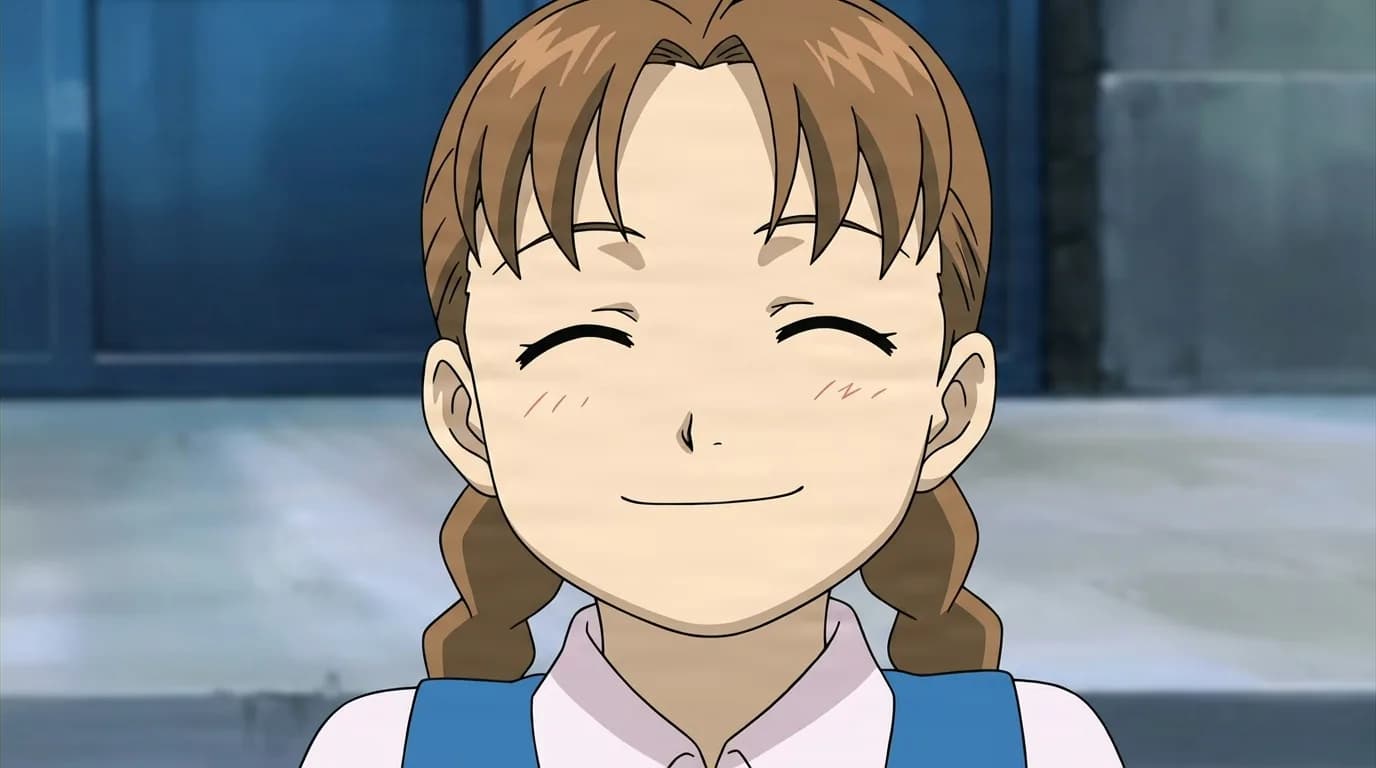
CharacterNina Tucker is the gentle young daughter of the State Alchemist Shou Tucker, whose brief friendship with the Elric brothers ends in one of the franchise's most infamous tragedies. Fused with the family dog into a speaking chimera, her fate becomes a lasting source of grief and resolve for Edward.
Appearance
Nina is a small child whose long hair falls into braids that reach past her waist. The manga's rare colored artwork gives her blonde hair and a green pinafore over a creamy shirt, while both anime adaptations, along with the Webtoon, recolor her with brown hair and blue eyes, the 2003 version using a lighter brown than Brotherhood's. Her wardrobe shifts between tellings, from a blue dress and clogs in the earlier anime to pale green and short-sleeved layers modeled on the manga in the later one.
After her father transmutes her together with the family dog Alexander, Nina takes on the shape of a dog-like beast crowned by a mane the color of her former hair. The creature keeps the power of speech, and its fur trades Alexander's white fluff for a peach or grey coat with a strange carpet of hair down its back. In the 2003 anime alone, Tucker later tries to clone her, producing a hollow, doll-like body draped only in long hair, its eyes left vacant.

Personality
Nina comes across as a bright, playful girl brimming with energy, most often found romping with or hugging her enormous pet. Loneliness sits beneath that cheer, since her mother's absence and her father's retreat into his work leave her starved for company. She adores her father without reservation and never abandons her faith in him, even as that trust is betrayed. Tellingly, she is one of the very few characters who can call Edward small without setting off his usual fury.
Related Reading
See all
Naruto vs Luffy: Does the Fight Change if Luffy Tickles Hinata?
Naruto vs Luffy with the twist nobody asked for: Luffy tickled Hinata on date night, and she kind of liked it. We break down the whole fight and commit to a winner....
Namek Has No Women, and Piccolo Pulls Anyway
There are no women on Namek. That isn't an oversight, it's the biology. Why we handed Piccolo the one thing his own species rules out, and why it had to be trap soul....
History
Nina first crosses paths with Edward and Alphonse Elric when they arrive to study bio-alchemy under her father in East City. The lonely girl quickly wins the brothers over, and the days that follow fill with play alongside her and Alexander. She confides that her mother left two years earlier, unaware of the darker truth: the woman had not walked out but died as an unwilling subject in Shou Tucker's chimera experiments. As Tucker's yearly evaluation looms and his license hangs in the balance, he repeats that horror, merging Nina and Alexander into a single speaking creature.
Edward grasps what has happened only when the chimera addresses him in Nina's innocent voice. Unable to undo the transmutation, the brothers report Tucker to Colonel Mustang, but before justice can proceed the killer Scar reaches the house and murders Tucker, then ends Nina's suffering with a swift, prayerful mercy-killing, judging that her altered existence could hold nothing but pain. Her death haunts Edward long afterward, returning in nightmares and in his final reckoning with Truth, and Alphonse names her as a driving reason the two keep searching for ways alchemy might heal rather than harm.
The 2003 anime reshapes the details around the same core loss. There Nina shares extra adventures with the boys before being seized by Basque Grand to fuel chimera-soldier research, escapes with Edward's help, and is torn apart by Scar in an alley, her remains far grislier than the manga's quiet end. That continuity later has a surviving Tucker attempt to revive her, managing only a soulless doll even with a Philosopher's Stone at hand.
Frequently Asked Questions
What happened to Nina Tucker in Fullmetal Alchemist?
Nina Tucker was fused with her family's dog, Alexander, by her own father in an alchemical transmutation, and after Edward and Alphonse Elric could not reverse it, she was killed by Scar in a mercy killing meant to end her suffering.
Why did Tucker turn Nina into a chimera?
Shou Tucker transmuted his daughter Nina into a chimera because his State Alchemist license was up for its yearly evaluation and he needed to produce another talking chimera to keep his title, having already used his wife as an unwitting subject for a previous one.
Does Nina Tucker turn back into a human?
No, Nina Tucker never turns back into a human; Edward and Alphonse Elric are unable to reverse the transmutation that fused her with the dog Alexander, and she is later killed by Scar to end her suffering.
Who is Nina Tucker's father?
Nina Tucker's father is Shou Tucker, a State Alchemist whose bio-alchemy experiments on his own family lead to one of the series' most infamous tragedies.
How does Nina Tucker's death affect Edward Elric?
Nina Tucker's death haunts Edward Elric long afterward, resurfacing in his nightmares and in his final reckoning with Truth, and Alphonse names her as a major reason the brothers keep searching for ways alchemy might heal rather than harm.
Sources & Information
Looking for more on Nina Tucker? The Fullmetal Alchemist Wiki on Fandom has a dedicated page with community notes.
View on FandomThis content is original writing by Daddy Jim Headquarters based on the Fullmetal Alchemist anime series, manga, and official materials. Fullmetal Alchemist was created by Hiromu Arakawa, published by Square Enix, and animated by Bones. All rights to Fullmetal Alchemist and its characters belong to their respective owners. Episode and chapter references are cited where applicable.
Rights holders
- Created byHiromu Arakawa
- Published bySquare Enix
- Animated byBones
All rights belong to their respective owners.
Character and scene imagery on this site is original artwork by Daddy Jim Headquarters, not screenshots or licensed imagery. Official cover art is used on three types of pages for editorial commentary:
- Movie pages: theatrical posters and key visuals, credited to Bones and Square Enix.
- Game pages: official box art, credited to the game's respective publishers.
- Manga chapter pages: volume covers, credited to Square Enix and Hiromu Arakawa.
Official resources:
Help Us Keep This Wiki Accurate
Daddy Jim Headquarters maintains this encyclopedia. If you spot an error, a translation issue, or something that doesn't look right, let us know.