Kamina
CharacterKamina storms out of Giha Village with a stolen sword, an inherited cape, and a conviction that the surface belongs to humanity. Founder of Team Gurren and the man who forges it into Team Dai-Gurren, he dies only eight episodes into the story, yet his fire fuels every victory that follows.
Appearance
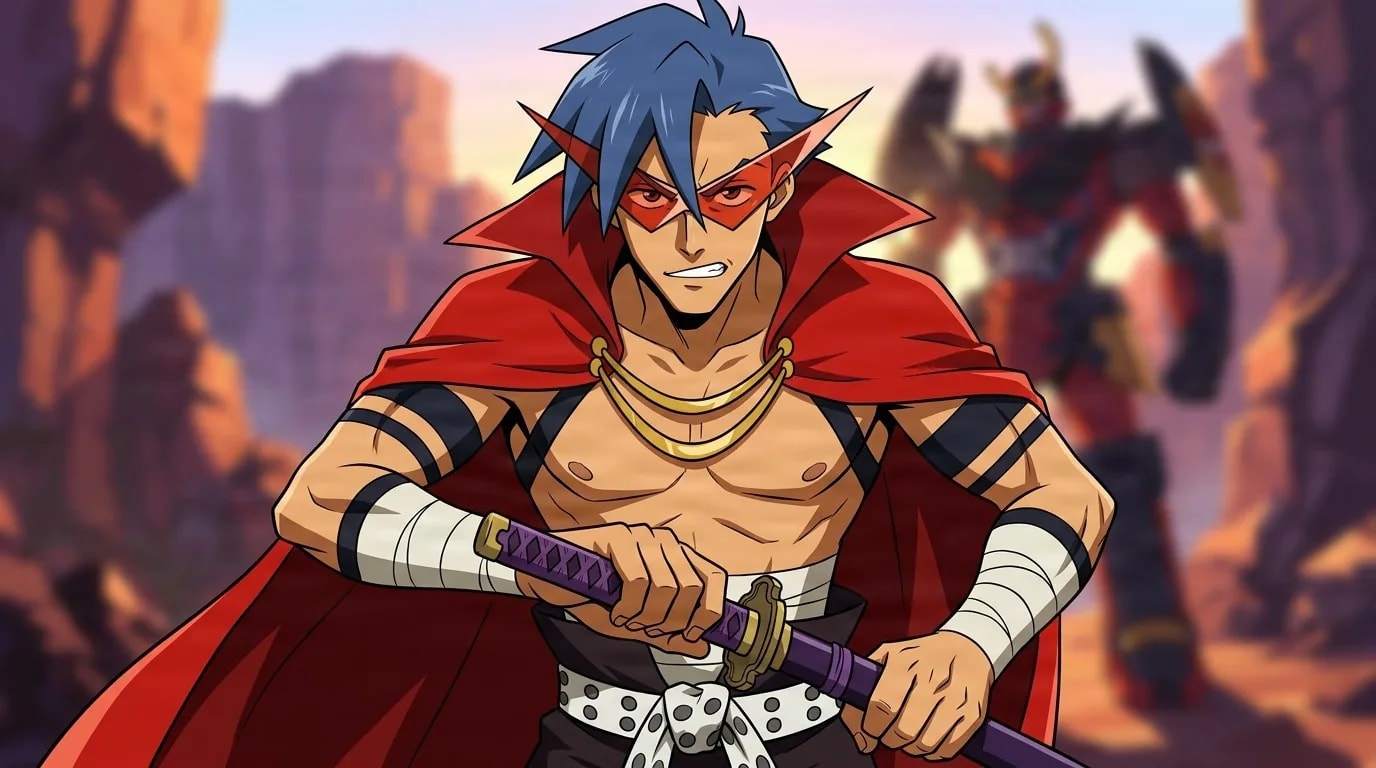
Everything about Kamina's look announces him before he speaks. He stands tall on a hard athletic frame, tanned, blue hair spiking upward, red eyes hidden behind pointed crimson shades he almost never removes. Bluish tattoos run the length of both arms and continue over his shoulders onto his upper back. The nodachi he carries serves as his banner of defiance.
His clothing is simple but loud: long dark-brown pants ringed twice in red at the ankles, a double-grommet belt, sandals, and traditional sarashi wrappings binding his stomach and forearms. He eventually adds the red and orange cape his father once wore, stitching the Team Dai-Gurren emblem onto it. The famous sunglasses are smashed to pieces during Thymilph's final assault.
Personality
On the surface Kamina is all noise: hotheaded, swaggering, hungry for recognition, prone to announcing himself as the Mighty Kamina. His idealism shades into willful ignorance, enough that Yoko brands him a man of unlimited stupidity, and he cheerfully insists that ogling beautiful women defines manhood.
Underneath runs something sturdier. Nothing keeps him down for long, not even learning his father has died, which costs him only a night or two of visible grief. He fights hardest for the people he loves, and in battle his charisma becomes a weapon in its own right, lifting even the timid Simon toward feats neither could manage alone and laying the foundation of Team Dai-Gurren almost single-handed.
The bravado, by his own admission, is a mask. He confesses that his fearlessness is a device for hiding his worries and propping others up, and that people like Simon are the genuine heroes. His war on the Beastmen was never about glory or revenge; he wants the next generation to inherit a world with nothing left to fear. Flashes of tactical sense surface too. The idiot act conceals a far more complicated man.
History
Kamina's father reaches the surface during his childhood and invites the boy along, but fear wins and Kamina stays underground with only a promise of reunion. Years later a cave-in traps him, Simon, and others in an unfinished tunnel; Kamina keeps morale alive while Simon drills everyone free. From that day he swears to match Simon's persistence, bury his own terror, and back the younger boy no matter what.
His bid for the sky begins with Team Gurren, a two-man outfit built around a failed plan to bore through the village ceiling. Jailed for the disturbance, he is broken out by Simon, who wants to show him a strange artifact unearthed in the digs. A Gunman crashing through the cavern roof interrupts them, followed by the sharpshooter Yoko Littner. Piloting the excavated machine, which Kamina names Lagann, the three destroy the invader and ride the fight to open sky.
On the surface, Team Gurren swells from two members into a full resistance army, renamed Team Dai-Gurren, with Kamina at its head. Its defining operation targets the Dai-Gunzan, a walking fortress commanded by the general Thymilph. The capture succeeds at a terrible price: Thymilph runs Kamina through and follows with a beam blast. Kamina rises once more, merges Gurren with Lagann into Gurren Lagann, and destroys the general with the first Giga Drill Break before dying in the cockpit, his parting words steering Simon away from borrowed faith and toward belief in himself. His grave is the battlefield itself, his nodachi driven into the earth with his cloak knotted to the sheath.
Death does not remove him from the story. The city raised on Teppelin's ruins takes the name Kamina City and centers on a giant statue of him, later torn down when the public turns on the government over the Human Annihilation System. Inside the Anti-Spirals' dream labyrinth, the true Kamina appears to a broken Simon, reminds him the drill he carries is his soul, and sends him back to gather the team for the last battle, sharing a final laugh over how much taller Simon has grown. He also appears briefly to Yoko before she rejoins the fight.
Related Reading
See all
Naruto vs Luffy: Does the Fight Change if Luffy Tickles Hinata?
Naruto vs Luffy with the twist nobody asked for: Luffy tickled Hinata on date night, and she kind of liked it. We break down the whole fight and commit to a winner....
Piccolo Gets the Namek Hoes: Namek Has No Women, and He Pulls Anyway
There are no women on Namek. That isn't an oversight, it's the biology. Why we handed Piccolo the one thing his own species rules out, and why it had to be trap soul....
Frequently Asked Questions
Why was Kamina killed off?
Kamina dies during the battle for the Dai-Gunzan when General Thymilph runs him through and finishes with a beam blast. He rises one last time to fuse Gurren with Lagann and destroy Thymilph with the first Giga Drill Break before dying in the cockpit, a sacrifice that pushes Simon to find his own courage and carry Team Dai-Gurren forward.
Does Kamina come back after he dies?
Kamina does not return to life, but he appears as a vision inside the Anti-Spirals' dream labyrinth to remind a broken Simon that the drill he carries is his soul, and he briefly appears to Yoko Littner as well before the final battle.
What is the meaning of Kamina's name?
Kamina's name references kami, meaning above, which reflects his lifelong drive to reach the surface; the word can also be read as god.
Who is Kamina's girlfriend in Gurren Lagann?
Kamina's listed love interest is Yoko Littner, the sharpshooter who joins him and Simon in Team Gurren, though his death only eight episodes into the story cuts the relationship short.
How does Kamina help form Team Dai-Gurren?
Kamina founds the two-man Team Gurren with Simon and grows it into the full resistance army Team Dai-Gurren after reaching the surface, leading the operation that captures the walking fortress Dai-Gunzan.
Sources & Information
Looking for more on Kamina? The Dragon Ball Wiki on Fandom has a dedicated page with community notes.
View on FandomThis content is original writing by Daddy Jim Headquarters based on the Dragon Ball anime series, manga, and official materials. Episode and chapter references are cited where applicable.
Character and scene imagery on this site is original artwork by Daddy Jim Headquarters, not screenshots or licensed imagery. Official cover art is used on three types of pages for editorial commentary:
- Movie pages: theatrical posters and key visuals, credited to Toei Animation and Shueisha.
- Game pages: official box art, credited to Bandai Namco, Atari, and other publishers.
- Manga chapter pages: Jump Comics volume covers, credited to Shueisha and Akira Toriyama.
Official resources:
Help Us Keep This Wiki Accurate
Daddy Jim Headquarters maintains this encyclopedia. If you spot an error, a translation issue, or something that doesn't look right, let us know.