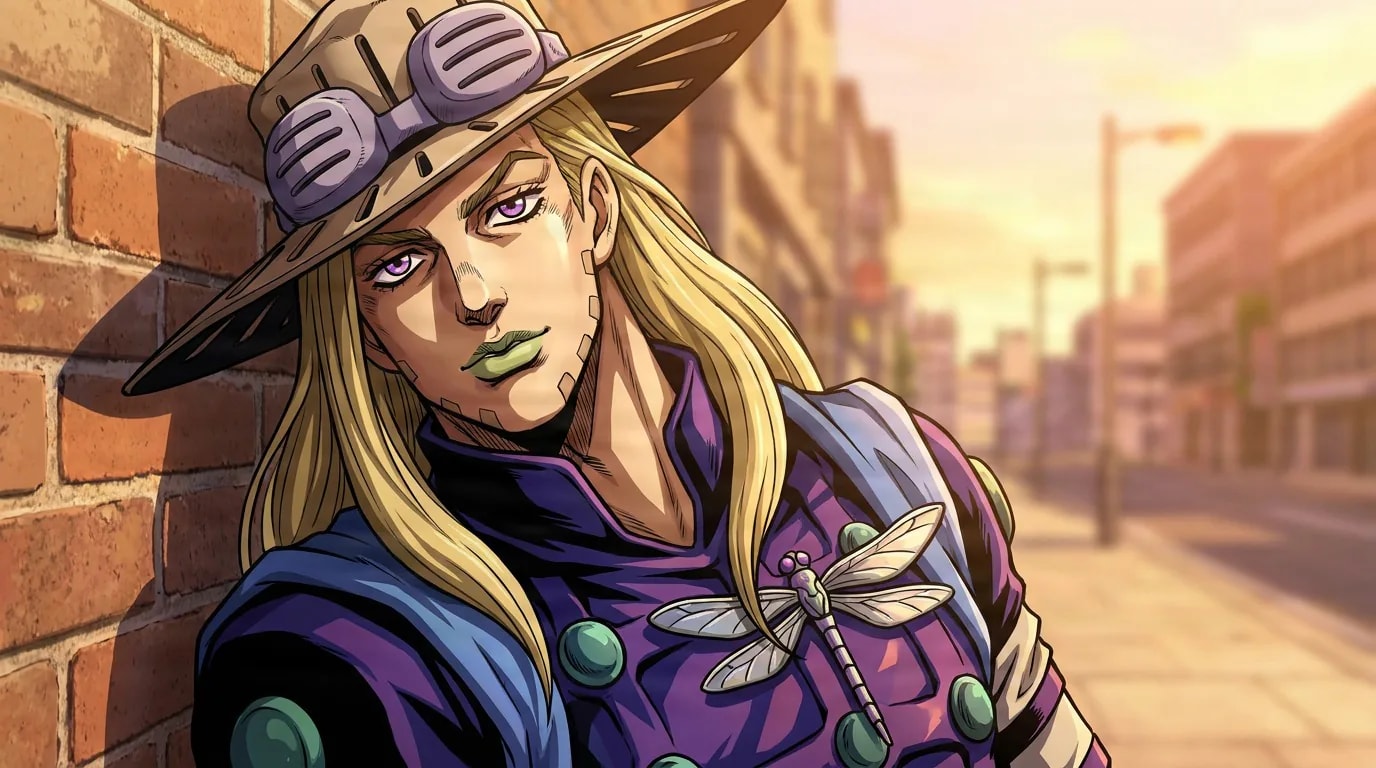
Gyro Zeppeli
CharacterGyro Zeppeli is a Neapolitan executioner and one of the twin heroes of Steel Ball Run. A master of his family's Spin technique and its lethal Steel Balls, he enters the transcontinental horse race hoping the resulting glory will earn a pardon for a condemned boy, and along the way he mentors Johnny Joestar and unlocks the Stand Ball Breaker.
Appearance
Built solid and athletic, Gyro keeps his hair long enough to fall to mid-back and frames his jaw with squared patches of stubble, while illustrations often give him painted lips. His most striking feature is his teeth, either capped with grills or carved to spell out 'GO! GO! ZEPPELI.' He dresses like a gunless gunfighter, in a studded short-sleeved leather coat, leather trousers, and cowboy boots, with a belt buckle of two hands pointing downward and paired holsters at his hips that cradle his Steel Balls rather than pistols. A broad, slitted hat vented for light and air sits on his head, a set of narrow goggles wrapped around its crown, and in rough weather he adds a scarf.
Personality
Gyro comes across as brash, flashy, and hardened by a rough life. He races to seize first place by any means, charging to the front and shoving aside anyone who challenges him, and he thinks nothing of taking reckless shortcuts. His tongue is sharp, and he needles nearly everyone he meets, sparing not even Johnny, whom he first dismissed and only respected once the paralyzed jockey proved impossibly stubborn. The lone figure he truly reveres is his stern father, Gregorio.
For all his rudeness, a genuine kindness runs underneath: he aids those in need, teaches Johnny the Spin, and shoulders Marco's cause. Early on he lacked a selfish, personal hunger, having inherited his skill rather than earned it through suffering, and only after his duel with Ringo Roadagain did he adopt a real, self-driven reason to win. Offbeat and theatrical, Gyro loves terrible puns, absurd gags, grand declarations, and flashing his metal grin, and he leans on his father's fatalistic 'tennis ball over the net' outlook, trusting that a virtuous path can carry him through even when a miracle is required.
History
Born around 1866 into the distinguished Zeppeli line of the Kingdom of Naples, Gyro grew up in comfort as his family served the crown as both doctors and executioners. His father trained him in the Spin from late childhood, and by thirteen he was secretly learning the executioner's trade while apprenticing as a surgeon. His path bent when a nine-year-old named Marco was condemned for treason on false grounds. Unable to overturn the sentence on appeal, Gyro learned that a grand national achievement, like taking first in a celebrated cross-country race, might earn the child amnesty, so against Gregorio's wishes he signed on to the Steel Ball Run.
Reaching America ahead of the race, he crossed paths with the paralyzed Johnny Joestar, whose legs twitched at the touch of a spinning Steel Ball; that spark drew Johnny into the race to learn the Spin. Across the transcontinental stages Gyro alternately dominated and stumbled, tangling with rivals like Diego Brando, Pocoloco, and Ringo Roadagain while a growing hunt for the Saint's Corpse parts turned every leg into a battlefield. After binding with the Corpse's right eye he gained Scan, letting his Steel Balls act as remote, X-ray-like eyes, and he steadily pushed the Spin toward its ultimate expression.
In the final confrontation with Funny Valentine, Gyro summons the Golden Spin and its cavalry variant, manifesting the Stand Ball Breaker, whose force can pierce dimensional barriers. The technique wounds Valentine but cannot finish him before Gyro succumbs to his own injuries. With his dying breath he delivers one last lesson that pushes Johnny's Tusk to ACT 4, then bids his friend farewell as a spirit and ascends.
Related Reading
See all
Naruto vs Luffy: Does the Fight Change if Luffy Tickles Hinata?
Naruto vs Luffy with the twist nobody asked for: Luffy tickled Hinata on date night, and she kind of liked it. We break down the whole fight and commit to a winner....
Piccolo Gets the Namek Hoes: Namek Has No Women, and He Pulls Anyway
There are no women on Namek. That isn't an oversight, it's the biology. Why we handed Piccolo the one thing his own species rules out, and why it had to be trap soul....
Frequently Asked Questions
Does Gyro actually have a Stand?
Yes, though for most of Steel Ball Run Gyro fights using the Spin technique rather than a Stand; he awakens his Stand, Ball Breaker, only in the final battle against Funny Valentine.
Is Gyro Zeppeli a good person?
Despite his brash, rude exterior, Gyro Zeppeli is fundamentally kind, aiding those in need, teaching Johnny Joestar the Spin technique, and risking his life to save a wrongly condemned boy named Marco.
Why does Gyro Zeppeli enter the Steel Ball Run race?
Gyro Zeppeli enters the Steel Ball Run hoping that winning the transcontinental race will earn amnesty for Marco, a nine-year-old boy wrongly condemned for treason.
How does Gyro Zeppeli die?
Gyro Zeppeli dies from injuries suffered while battling Funny Valentine in the final Steel Ball Run confrontation, succumbing shortly after using his newly awakened Stand, Ball Breaker, to wound his opponent.
What is Gyro Zeppeli's birth name?
Gyro Zeppeli was born Julius Caesar Zeppeli into the distinguished Zeppeli family of the Kingdom of Naples.
Sources & Information
Looking for more on Gyro Zeppeli? The Dragon Ball Wiki on Fandom has a dedicated page with community notes.
View on FandomThis content is original writing by Daddy Jim Headquarters based on the Dragon Ball anime series, manga, and official materials. Episode and chapter references are cited where applicable.
Character and scene imagery on this site is original artwork by Daddy Jim Headquarters, not screenshots or licensed imagery. Official cover art is used on three types of pages for editorial commentary:
- Movie pages: theatrical posters and key visuals, credited to Toei Animation and Shueisha.
- Game pages: official box art, credited to Bandai Namco, Atari, and other publishers.
- Manga chapter pages: Jump Comics volume covers, credited to Shueisha and Akira Toriyama.
Official resources:
Help Us Keep This Wiki Accurate
Daddy Jim Headquarters maintains this encyclopedia. If you spot an error, a translation issue, or something that doesn't look right, let us know.