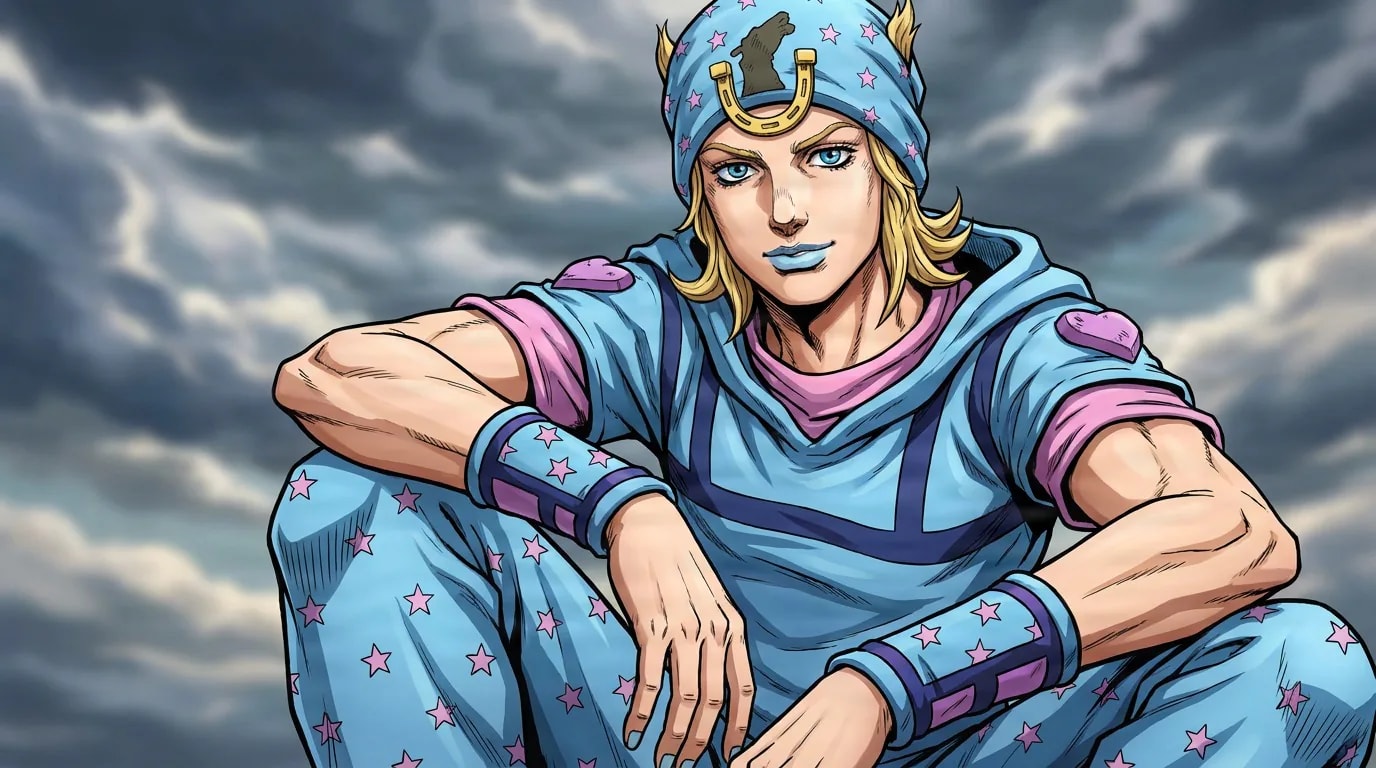
Johnny Joestar
CharacterJohnny Joestar co-headlines Steel Ball Run as the seventh JoJo in the saga. A gifted jockey left paraplegic by a gunshot, he enters the transcontinental race to unlock the secret of Gyro Zeppeli's Steel Balls, his one hope of walking again, and awakens the Stand Tusk.
Appearance
Slight of frame and shorter than average, Johnny has pale eyes and light hair that falls to his shoulders and curls up at the tips. His signature is a star-speckled knit cap, its top pierced so that two tufts of hair poke out like small horns and a horseshoe framing a rearing horse's silhouette hangs at the front. He wears equally star-patterned trousers fitted with spurs and a pale hooded short-sleeved top marked with harness-like lines, later gaining heart-shaped patches at the shoulders, while a long feather trails out from behind his collar, and star-and-stripe cuffs ring his wrists.
As the story advances his look softens toward realism, his hair wavier and his build a little fuller. Paralyzed from the waist down, he relies on a wheelchair before the race and rides his horse Slow Dancer throughout it.
Personality
Johnny begins Steel Ball Run as a bitter, depressive former jockey, a young man whose brilliant career ended when a stranger, provoked by Johnny's own arrogance, shot him in the spine. What he lacks in hope he makes up for in an almost frightening resolve his allies call dark determination, a single-minded fixation on regaining his legs, first through the Spin and then through the Saint's Corpse. He shrugs off horrific wounds to chase that goal and shows no hesitation about maiming or killing rivals for Corpse Parts, yet he is not wholly heartless, refusing to drag the defenseless Lucy Steel into the fight and, years later, taking the Rock Disease onto himself to spare his son.
His bleakness has deep roots. As a timid but gentle boy he adopted a wild mouse he named Danny and idolized his older brother Nicholas, and when Nicholas died in a riding accident blamed on a white mouse, Johnny came to believe he should have died instead and that fate was forever punishing him. That is why he fixates on the Corpse's blessing, which he imagines can reset his cursed negative existence back to zero. His outlook only brightens after he meets Gyro Zeppeli, whose kindness and steady encouragement pull him out of his despair step by step, a recovery mirrored in the successive ACTs of his Stand Tusk. Though Gyro dies, Johnny carries that hard-won hope into a later life married to Rina.
History
Born in 1872 to a fallen aristocratic family in Danville, Kentucky, Johnny is the second son of George Joestar, a celebrated horse trainer with seven Triple Crown titles. He climbs into a saddle at five and is hailed a natural, though his stern father plainly favors his elder brother Nicholas. A defining wound comes early. Ordered to drown his pet mouse Danny as punishment, Johnny cannot do it and frees the animal on Nicholas's advice, and when Nicholas is later killed by a fall blamed on a white mouse, Johnny convinces himself the tragedy is his own fault.
He nonetheless rises into fame as a gifted young racer, taking the Kentucky Derby at sixteen, but never earns his father's respect, and a bitter quarrel ends with George declaring that God took the wrong son and casting him out. Not long after, Johnny bribes his way to the front of a theater line, and the youth he displaces shoots him through the spine, leaving him paralyzed and abandoned in a hospital where he is mistreated and forgotten.
His path turns when he sees Gyro Zeppeli's spinning Steel Ball briefly stir his dead legs. He chases Gyro into the Steel Ball Run race, breaks and bonds with the horse Slow Dancer, and over the long course becomes both a Spin user and the Stand user of Tusk. The journey remakes him, and he ultimately reclaims the use of his legs, though his story closes years later in Japan, where he dies in 1901 after his head is crushed by a boulder.
Related Reading
See all
Naruto vs Luffy: Does the Fight Change if Luffy Tickles Hinata?
Naruto vs Luffy with the twist nobody asked for: Luffy tickled Hinata on date night, and she kind of liked it. We break down the whole fight and commit to a winner....
Piccolo Gets the Namek Hoes: Namek Has No Women, and He Pulls Anyway
There are no women on Namek. That isn't an oversight, it's the biology. Why we handed Piccolo the one thing his own species rules out, and why it had to be trap soul....
Frequently Asked Questions
Why was Johnny Joestar killed off?
Johnny Joestar dies on November 11, 1901, in Japan, years after the events of Steel Ball Run, when his head is crushed by a boulder.
Who did Johnny Joestar marry?
Johnny Joestar marries Rina Higashikata, and the couple's son George Joestar III continues the Joestar line.
Was Johnny Joestar ever called JoJo?
Yes, Johnny Joestar is recognized in the story as the seventh JoJo, the nickname carried by the protagonist of each generation in the saga.
Why is Johnny Joestar disabled in JoJo?
Johnny Joestar is left paraplegic after bribing his way to the front of a theater line; the young man he displaced shoots him through the spine, leaving him paralyzed and abandoned in a hospital.
Is Johnny Joestar supposed to be Jonathan Joestar?
Johnny Joestar is not the same character as Jonathan Joestar; his birth name is Jonathan Joestar and he is named after the original JoJo, but he is a distinct person born generations later in Steel Ball Run.
Sources & Information
Looking for more on Johnny Joestar? The Dragon Ball Wiki on Fandom has a dedicated page with community notes.
View on FandomThis content is original writing by Daddy Jim Headquarters based on the Dragon Ball anime series, manga, and official materials. Episode and chapter references are cited where applicable.
Character and scene imagery on this site is original artwork by Daddy Jim Headquarters, not screenshots or licensed imagery. Official cover art is used on three types of pages for editorial commentary:
- Movie pages: theatrical posters and key visuals, credited to Toei Animation and Shueisha.
- Game pages: official box art, credited to Bandai Namco, Atari, and other publishers.
- Manga chapter pages: Jump Comics volume covers, credited to Shueisha and Akira Toriyama.
Official resources:
Help Us Keep This Wiki Accurate
Daddy Jim Headquarters maintains this encyclopedia. If you spot an error, a translation issue, or something that doesn't look right, let us know.