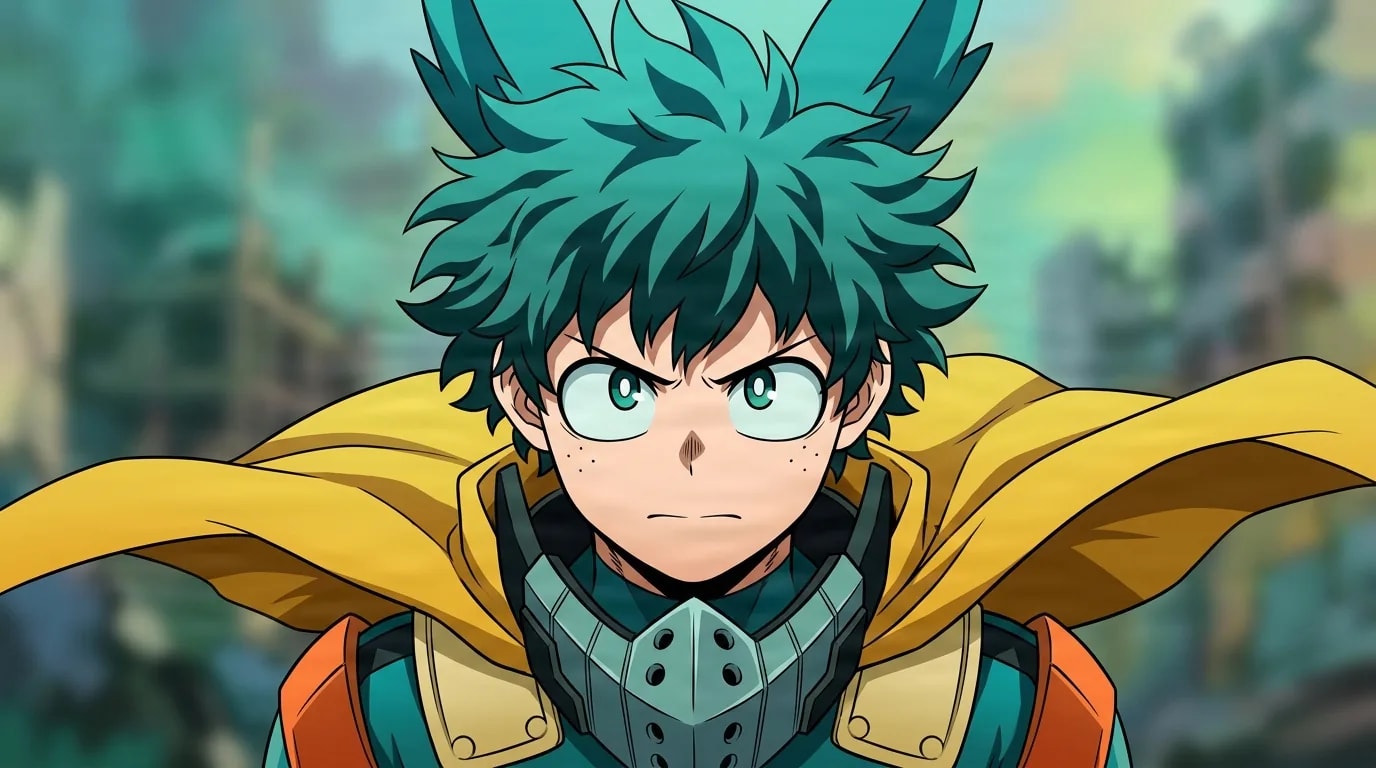
Izuku Midoriya
CharacterBorn without a Quirk in a world where nearly everyone has one, Izuku Midoriya talks his way into hero work on nerve and note-taking alone. All Might hands him One For All, and the ninth holder of that borrowed power spends a lifetime proving that wanting to save people was always the real qualification.
Appearance
Strangers keep calling him plain, and the reading is not unfair. He is on the short side, round-faced, topped with a mop of dark green hair that curls at stubborn angles and casts heavy shadows over itself. Four freckles sit in a diamond on each cheek. His eyes are wide, round, frequently wet, and the same green as the hair above them.
Ten months of brutal conditioning under All Might replaced a scrawny frame with real muscle, and the years keep adding to it. Injury has left its own record. The bout with Shoto Todoroki warped the fingers of his right hand, Muscular scarred that arm badly enough to require a compression sleeve, and the Final War added a mark above his right eye running down to his chin, along with a shaved undercut while he healed.
His costumes run the Greek alphabet. Alpha, sewn by his mother, was a green jumpsuit under a cowl shaped like All Might's hair and a respirator painted into a grin. Later versions went darker and sturdier, gained iron soles for his kicking style, support gloves from Mei Hatsume, and Gran Torino's cape. By the Final War the whole thing read as feral: filthy, torn, trailing Blackwhip tendrils. Eight years on he teaches in a black suit and green tie, and carries a nanomachine costume that folds into an armored briefcase marked 18, his old seat number.
Personality
Timid, formal, and quick to overreact, Izuku spent childhood shrinking from Katsuki Bakugo, who never let him forget he had no Quirk. U.A. corrected that slowly. Friends, and a first honest fight with Katsuki, drew out a leader whose passion and planning made him a fixture of Class 1-A.
His obsession is documentary. He fills notebooks titled Hero Analysis for the Future, mutters observations aloud until classmates find it unsettling, and assembles battle plans in seconds out of what he has recorded about everyone's powers, allies and enemies alike. All Might is the axis of all of it. Izuku collects the merchandise, knows the smallest rescues, and carries the weight of following the Symbol of Peace.
He runs toward danger on reflex, often with no regard for surviving it, and Katsuki suspects the bullying taught him his own life was worth less. He also meddles, lecturing people through private troubles on the theory that a hero should. The habit won over Shoto, Tenya Ida, Kota Izumi, Hitoshi Shinso and Sir Nighteye, and eventually even Stain and Lady Nagant. After the Paranormal Liberation War he turned cold and solitary, skipping food and sleep to keep everyone at arm's length, until his classmates dragged him back. Underneath is a stubborn wish to understand villains rather than bury them, Tomura Shigaraki most of all.
Abilities
Before any Quirk, his edge was research: years of studying professionals, applied under pressure. That is what drove him at the Sludge Villain to save Katsuki, and what convinced All Might to choose him.
One For All handed him a stockpile of force he could not survive using. Early on, a full punch shattered whichever limb threw it. Gran Torino's training produced Full Cowl, spreading the power thinly through his body for speed and strength without the wreckage, and from there he built Shoot Style to spare his ruined arms. Muscular and Overhaul still forced him to trade his body for output. Six inherited Quirks surfaced as the power matured: Blackwhip, Danger Sense, Float, Smokescreen, Fa Jin, and Gearshift.
By the Paranormal Liberation War he fought beside Endeavor and Eraser Head and held the line against Tomura. In the Final War he matched Tomura for speed and strength, then, paralyzed by Gearshift's recoil, used Blackwhip to puppet his own body and force every Quirk, One For All included, into his enemy, aiming at the hatred rather than the man. His final smash destroyed the body All For One had claimed and cleared the storm over Japan and North America for a week. It also cost him the Quirk. He taught history at U.A. until technology let him return to the field, ranked the No. 4 Hero.
Related Reading
See all
Naruto vs Luffy: Does the Fight Change if Luffy Tickles Hinata?
Naruto vs Luffy with the twist nobody asked for: Luffy tickled Hinata on date night, and she kind of liked it. We break down the whole fight and commit to a winner....
Piccolo Gets the Namek Hoes: Namek Has No Women, and He Pulls Anyway
There are no women on Namek. That isn't an oversight, it's the biology. Why we handed Piccolo the one thing his own species rules out, and why it had to be trap soul....
Frequently Asked Questions
What happened to Izuku Midoriya (Deku) in the end?
By the end of the story, Izuku Midoriya loses One For All after his final battle against Tomura Shigaraki and All For One, becoming Quirkless again. He teaches history at U.A. for a time before support technology allows him to return to hero work, eventually ranked the No. 4 Hero.
Is Izuku Midoriya's Quirk permanently gone?
Yes, Izuku Midoriya's One For All Quirk is permanently destroyed. His final smash, which ends the war and clears the storm over Japan and North America, costs him the power for good, and he returns to hero fieldwork years later using support technology rather than a Quirk.
How old is Izuku Midoriya at the end of the series?
Izuku Midoriya is 24 years old in the story's present-day timeline, eight years after the Final War, when he works as a teacher and later returns to hero work.
What is Izuku Midoriya's Quirk?
Izuku Midoriya's Quirk is One For All, a stockpile of accumulated power passed down from All Might that also grants him six inherited Quirks over time: Blackwhip, Danger Sense, Float, Smokescreen, Fa Jin and Gearshift.
How did Izuku Midoriya get One For All?
Izuku Midoriya inherits One For All from All Might, who chooses him as his successor after watching him run in to save Katsuki Bakugo from the Sludge Villain despite having no Quirk of his own.
Sources & Information
Looking for more on Izuku Midoriya? The Dragon Ball Wiki on Fandom has a dedicated page with community notes.
View on FandomThis content is original writing by Daddy Jim Headquarters based on the Dragon Ball anime series, manga, and official materials. Episode and chapter references are cited where applicable.
Character and scene imagery on this site is original artwork by Daddy Jim Headquarters, not screenshots or licensed imagery. Official cover art is used on three types of pages for editorial commentary:
- Movie pages: theatrical posters and key visuals, credited to Toei Animation and Shueisha.
- Game pages: official box art, credited to Bandai Namco, Atari, and other publishers.
- Manga chapter pages: Jump Comics volume covers, credited to Shueisha and Akira Toriyama.
Official resources:
Help Us Keep This Wiki Accurate
Daddy Jim Headquarters maintains this encyclopedia. If you spot an error, a translation issue, or something that doesn't look right, let us know.
