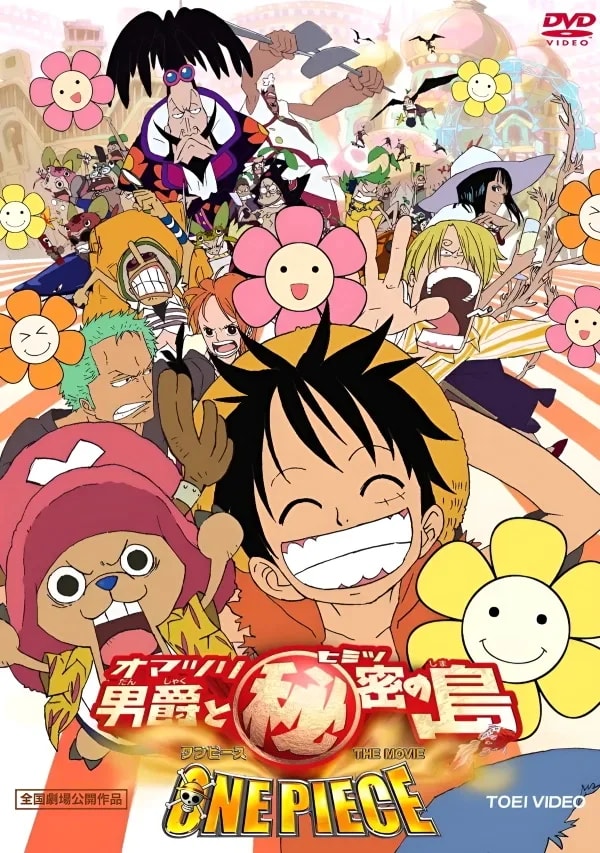
Baron Omatsuri and the Secret Island
MovieThe sixth One Piece feature, directed by Mamoru Hosoda, sends the Straw Hats to a resort island whose host turns their bonds against them. Darker and more stylized than its predecessors, it follows Luffy's struggle to save his crew from a flower that feeds on broken friendships.
Overview
Released in 2005 as the franchise's sixth theatrical film, this 91-minute feature was helmed by Mamoru Hosoda and written by Masahiro Itō. Its premise is deceptively cheerful: a message in a bottle lures the Straw Hats to Omatsuri Island, advertised as a paradise of spas, fine food, and welcome for strong pirates. Luffy, eager to prove his crew are pirates of the highest order, accepts on the spot. What begins as a holiday quickly curdles, as the island's smiling Baron sets a series of cruel games that pry the crew apart one bond at a time, while Robin chases the mystery of the island's strange flower, the Lily Carnation.
Plot
The crew arrives to find a dazzling resort run by Baron Omatsuri, a hulking man with a tiny talking flower on his shoulder. He invites them into a competition styled after the Davy Back Fight, beginning with a goldfish-catching contest against a monstrous armored fish. The Straw Hats narrowly win thanks to Chopper, which only infuriates the Baron into demanding more rounds. A ring-toss race through the canals follows, where the team's quarrels with one another start to fester even as they scrape out a victory.
Wandering the island, Chopper meets a frightened pirate family and uncovers rows of tombstones, while Luffy encounters Brief, a lone captain who warns that the Baron exists to shatter crews. Brief reveals that the Baron once led the Red Arrows Pirates and that the island's residents do not age, sustained by something sinister. As trust among the Straw Hats collapses under the games, the crew members vanish one by one, drawn into the Lily Carnation, a flower of false reincarnation that devours people to keep the Baron's long-dead friends alive in stasis.
Stripped of his entire crew before his eyes, a broken Luffy is dug out and tended by Brief and the pirate family, whose daughter Daisy can hear the trapped Straw Hats still calling for him. Refusing to surrender, Luffy fights through a storm of arrows to reach the Baron. When the flower reveals its true monstrous form built from his absorbed friends, it is the cowardly Papa who finds the courage to fire the Baron's own bow, blasting the Lily Carnation apart. With the flower destroyed, the absorbed crew is restored, and Luffy lands a final punch as the Baron at last makes peace with the friends he lost. The Straw Hats wake unharmed, remembering nothing, and reunite beneath the rising sun.
Reception
The film opened third at the Japanese box office in its first week, behind Lorelei and Shark Tale, before slipping to fourth the following week. It drew notably mixed reactions for its departure from the series' usual look, with shading and artwork frequently likened to the second Digimon movie, and many sequences leaning on computer-generated imagery to heighten the visuals. A trailer placed Buggy and Bentham among the theater audience despite their absence from the story, and Chopper's Guard Point form was drawn far larger here than in the contemporaneous anime.
Related Reading
See all
The Most Popular Women of One Piece: A Fan's Journey Through Anime's Greatest Female Characters...
When I first decided to commit to watching One Piece seriously, I knew I was embarking on one of anime's longest and most beloved series. With over 100...
Super Saiyan Pubes: The Song About Where Super Saiyan Hair Actually Goes
The transformation everyone knows, the follow-up question nobody would touch. Why we made a smooth R&B track about the golden glow Dragon Ball never talks about....
Frequently Asked Questions
Why is One Piece: Baron Omatsuri and the Secret Island so dark?
Baron Omatsuri and the Secret Island is considered one of the darkest One Piece films because its cheerful host, the Baron, sets cruel games that tear the crew's bonds apart and feed them one by one into the Lily Carnation, a flower of false reincarnation, all rendered in artwork and shading noticeably different from the series' usual style.
What happens in Baron Omatsuri and the Secret Island?
In Baron Omatsuri and the Secret Island, the Straw Hats are lured to a resort island where Baron Omatsuri's games strip away their trust and feed crew members into the Lily Carnation; Luffy fights through to reach the Baron, and the cowardly Papa fires the Baron's own bow to destroy the flower and restore everyone.
Is Baron Omatsuri and the Secret Island a good movie?
Reception to Baron Omatsuri and the Secret Island was mixed; it opened third at the Japanese box office in its first week, and its shift in art style, often compared to the second Digimon movie, drew notably divided reactions from viewers.
Who directed Baron Omatsuri and the Secret Island?
Baron Omatsuri and the Secret Island was directed by Mamoru Hosoda and written by Masahiro Ito, released in Japan on March 5, 2005 as the sixth One Piece film.
What is the Lily Carnation in Baron Omatsuri and the Secret Island?
The Lily Carnation is a flower of false reincarnation in Baron Omatsuri and the Secret Island that absorbs people to keep the Baron's long-dead friends preserved in stasis, and it consumes the Straw Hats one by one as the film's central threat.
Sources & Information
Looking for more on Baron Omatsuri and the Secret Island? The One Piece Wiki on Fandom has a dedicated page with community notes.
View on FandomThis content is original writing by Daddy Jim Headquarters based on the One Piece anime series, manga, and official materials. Episode and chapter references are cited where applicable.
Character and scene imagery on this site is original artwork by Daddy Jim Headquarters, not screenshots or licensed imagery. Official cover art is used on three types of pages for editorial commentary:
- Movie pages: theatrical posters and key visuals, credited to Toei Animation and Toei Company.
- Game pages: official box art for the One Piece console and mobile games, credited to Bandai Namco.
- Manga chapter pages: Jump Comics volume covers, credited to Shueisha and Eiichiro Oda.
Official resources:
Help Us Keep This Wiki Accurate
Daddy Jim Headquarters maintains this encyclopedia. If you spot an error, a translation issue, or something that doesn't look right, let us know.