Crablante
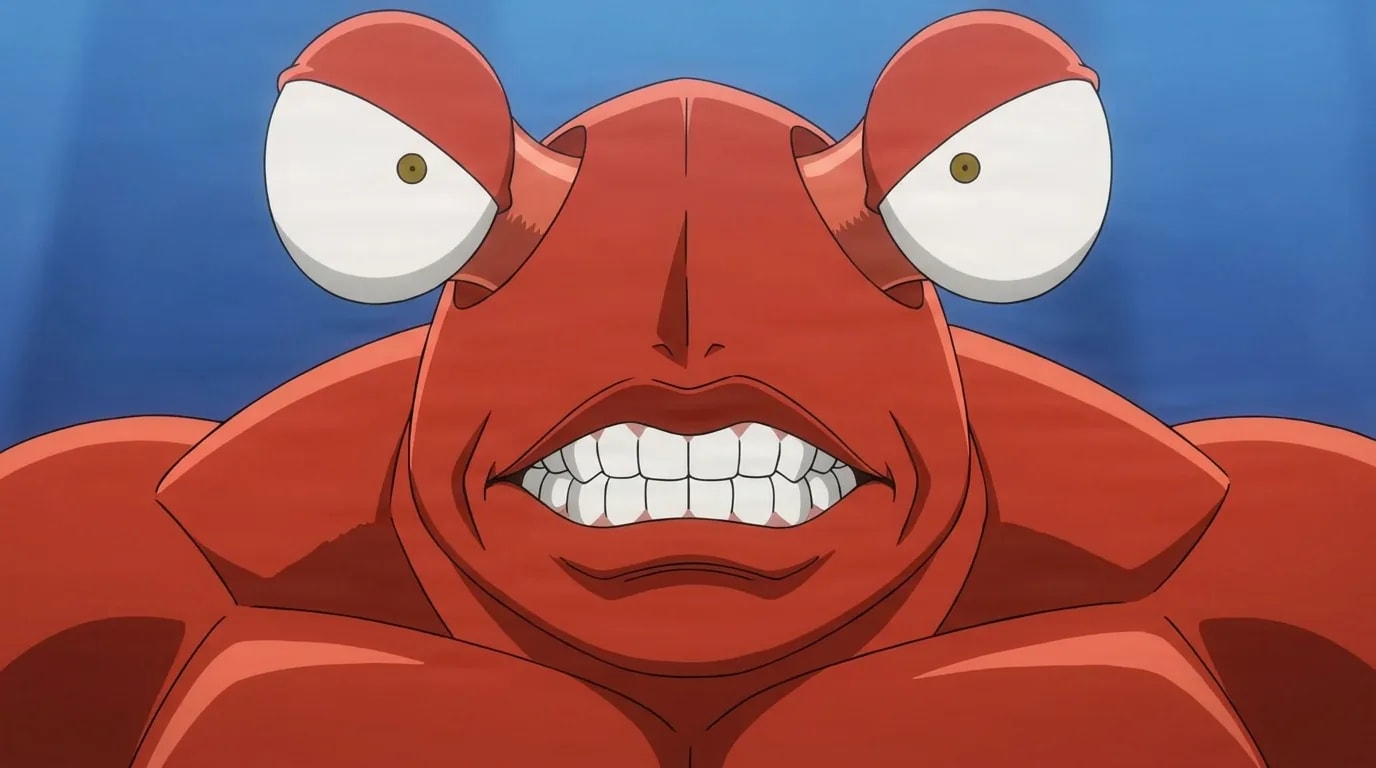
CharacterCrablante was a Tiger-level Mysterious Being, a regular man whose overindulgence in crab warped him into a monstrous crustacean. His rampage brought him face to face with a jobless, pre-training Saitama, who ended his life.
Appearance
Crablante was a hulking crab-like humanoid. Everything above the waist read as crustacean: a vivid red shell, hefty pincers, a broad mouth set beside two nostrils, and eyestalks jutting from either side of his head that ended in big oval eyes with tiny pupils. From the waist down he stayed a brawny, bare human male wearing only white briefs. In the manga a yellow tint colored his chest, echoing the shade seen on certain real crabs.
Personality
After the change, Crablante turned savage and bloodthirsty, cutting down bystanders as he hunted the boy who had defaced him. He prized what he called his beautiful body and grew furious the moment anyone marred or mocked it. Even so, he spared the gloomy, pre-training Saitama out of a flicker of pity, unwilling to hurt someone whose eyes looked as lifeless as his own. A verbal tic ran through his speech, which he tended to top and tail with noises like Blubblub and lol.


History
Three years ahead of the main story, Crablante ran into a young Saitama on a city street, and everyone but the jobless man scattered in panic. Asked why he wasn't fleeing, Saitama flatly said nothing mattered to him anymore. The monster laughed, and because Saitama's dead-eyed stare mirrored his own, he chose to let him live, explaining he was after someone else entirely. That someone was a ball-chinned boy who, while he slept in a park, had drawn a pair of nipples onto his skin in permanent ink. As Crablante closed in on the child, Saitama charged in to save him, and his buried dream of becoming a hero who topples villains in a single punch stirred back to life. The scuffle was brief but savage, ending when Saitama ripped out an eyestalk together with the monster's guts, gutting him.
Rated a Tiger-level threat, Crablante swung enough power to fracture pavement and split the ground with his pincers, and his Scissor Punch could shatter the earth outright, though those eyestalks tied to his organs served as a fatal weak spot. His attempt on the boy's life is what pushed Saitama into his grueling training, and the same incident handed Agoni the notion that became the Hero Association.
Related Reading
See all
Naruto vs Luffy: Does the Fight Change if Luffy Tickles Hinata?
Naruto vs Luffy with the twist nobody asked for: Luffy tickled Hinata on date night, and she kind of liked it. We break down the whole fight and commit to a winner....
Piccolo Gets the Namek Hoes: Namek Has No Women, and He Pulls Anyway
There are no women on Namek. That isn't an oversight, it's the biology. Why we handed Piccolo the one thing his own species rules out, and why it had to be trap soul....
Frequently Asked Questions
Who killed Crablante?
Crablante was killed by Saitama. Three years before the main story, Crablante attacked a young Saitama and the boy he was trying to protect, and Saitama tore out one of the monster's eyestalks along with his guts, ending his life instantly.
Is Crablante evil?
Crablante turned savage and bloodthirsty after his transformation, cutting down bystanders while hunting a boy who had drawn on him. Even so, he spared the gloomy, pre-training Saitama out of a flicker of pity because Saitama's dead-eyed stare mirrored his own.
How did Crablante become a monster?
Crablante was once an ordinary man who turned into a monstrous crustacean after overindulging in eating crab. The transformation left him with a red shell, giant pincers, and eyestalks, while his lower body stayed human.
Who voices Crablante?
Crablante is voiced by Yukitoshi Tokumoto in the Japanese version of One Punch Man and by Tom Fahn in the English dub.
What is Crablante's disaster level?
Crablante is rated a Tiger-level threat, strong enough to fracture pavement and split the ground with his pincers, with a Scissor Punch that could shatter the earth outright.
Sources & Information
Looking for more on Crablante? The Dragon Ball Wiki on Fandom has a dedicated page with community notes.
View on FandomThis content is original writing by Daddy Jim Headquarters based on the Dragon Ball anime series, manga, and official materials. Episode and chapter references are cited where applicable.
Character and scene imagery on this site is original artwork by Daddy Jim Headquarters, not screenshots or licensed imagery. Official cover art is used on three types of pages for editorial commentary:
- Movie pages: theatrical posters and key visuals, credited to Toei Animation and Shueisha.
- Game pages: official box art, credited to Bandai Namco, Atari, and other publishers.
- Manga chapter pages: Jump Comics volume covers, credited to Shueisha and Akira Toriyama.
Official resources:
Help Us Keep This Wiki Accurate
Daddy Jim Headquarters maintains this encyclopedia. If you spot an error, a translation issue, or something that doesn't look right, let us know.