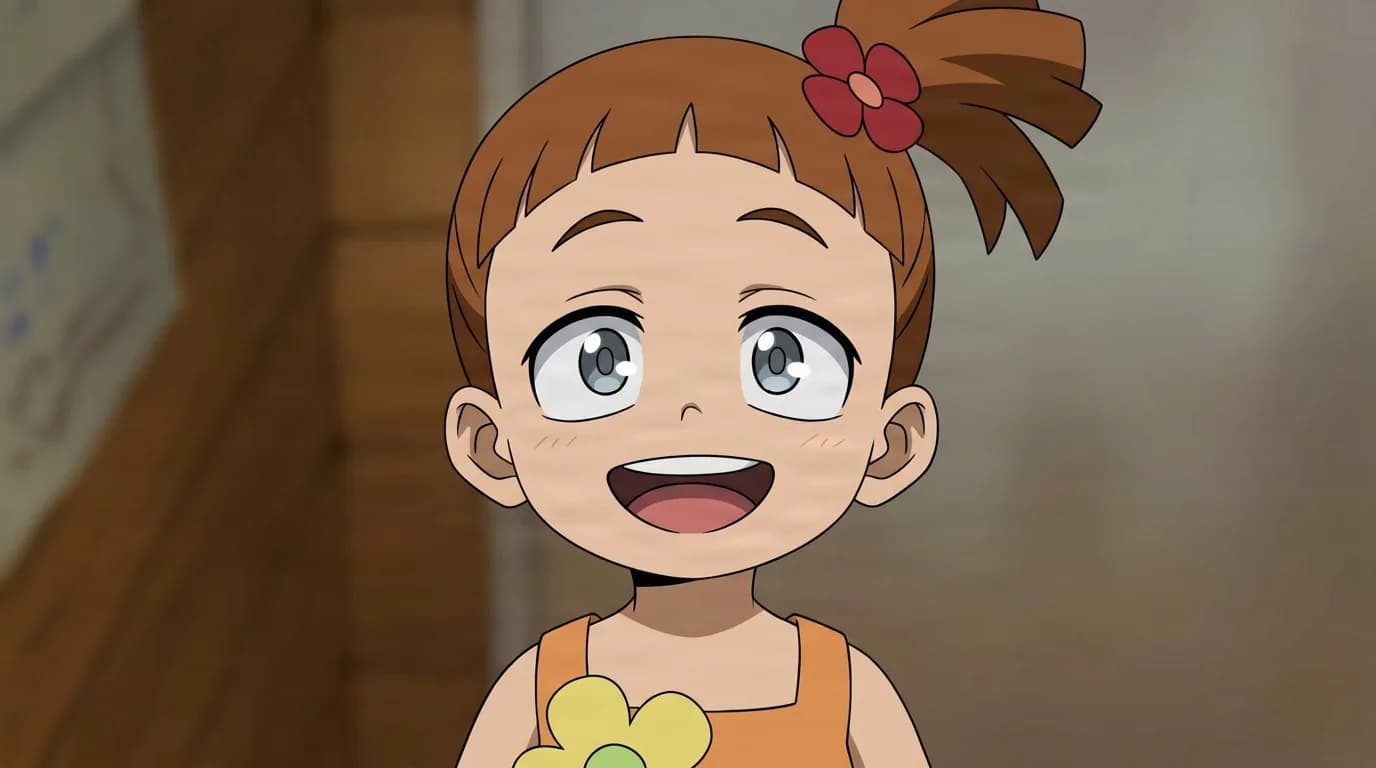
Lala Soul
CharacterThe youngest of the Soul children grew up in a caravan in Otheon's shantytown because her father picked a doomsday sect over his own family. Lala came through it cheerful anyway, and the orange flower Rody Soul keeps in his coat pocket is hers.
Appearance
Lala is a small girl with gray eyes and brown hair drawn up into a high side ponytail, held by a flower tie, the strands drawn in flat noodle-like shapes. Her sundress carries two flowers down the front, one small and high, one larger and low, worn over dark leggings cut off above the knee, plus slip-on sneakers.

Personality
Roro's devotion to their eldest brother is mirrored exactly in Lala. The family's disgrace, which cost them their house and dumped them in the shanty town, did not sour her at all; she is a kind, happy child who adores Rody. The clearest picture of her is the two younger siblings handing Rody his tie as he heads out to work and promising him they will study and cook for themselves while he is gone.
Related Reading
See all
Naruto vs Luffy: Does the Fight Change if Luffy Tickles Hinata?
Naruto vs Luffy with the twist nobody asked for: Luffy tickled Hinata on date night, and she kind of liked it. We break down the whole fight and commit to a winner....
Namek Has No Women, and Piccolo Pulls Anyway
There are no women on Namek. That isn't an oversight, it's the biology. Why we handed Piccolo the one thing his own species rules out, and why it had to be trap soul....
History
Born in the European nation of Otheon, Lala is the only daughter of the celebrated engineer Eddie Soul and the youngest of three behind Roro and Rody. Her mother did not survive long past the birth, and with their father consumed by his job, Rody was raising both siblings from a very young age. Even so the early years were good ones, spent playing with her brothers and with other children.
Then Eddie abandoned all three of them, for reasons nobody could make sense of, and joined Humarise, the sect that calls Quirks a disease and had a hand in a string of incidents. The school expelled the Soul children, neighbors and acquaintances talked, other parents kept their kids away, and one day the family came home to smashed windows and insults painted across the walls. The stigma made honest work impossible for Rody. With nothing left, they moved into a dilapidated caravan in the capital's slums, where Rody broke the necklace his father had given him and promised his crying siblings he would never leave, whatever came. Life there started hard, and he absorbed beatings from the rougher residents, sometimes to keep Roro and Lala out of them.
Years later, Rody told the two to study, feed themselves if he was late, and ignore any stranger who spoke to them, then left for work. Neither knew the news was branding him an accomplice to the supposed terrorist Izuku Midoriya. Days after that, Flect Turn hijacked every communications network to announce Trigger Bombs planted across twenty-five countries, set to detonate inside two hours, and Otheon's capital dissolved into panic while the World Heroes Association deployed everyone it had. Roro and Lala waited in the mobile home, frightened, hoping their brother would come back for them. Rody disarmed the bombs worldwide, saving the city and the two of them with it, and they threw their arms around him at the hospital afterward. With the world safe and their brother credited as the man who stopped it, both were able to return to school and make friends again. Several months on, the Souls watched the Final War play out on their phones, and Lala cheered Izuku on as the heroes cleared his path to finish the fight.
Frequently Asked Questions
Who is Lala Soul in My Hero Academia?
Lala Soul is the youngest child of the Soul family, introduced in the movie My Hero Academia: World Heroes' Mission. She is Rody Soul's little sister and grew up with him and their brother Roro in the European nation of Otheon.
Why did the Soul family end up in the shantytown?
The Soul family fell into poverty after their father Eddie abandoned Lala and her brothers to join Humarise, a sect that calls Quirks a disease. The stigma got the children expelled from school and made honest work impossible for Rody, forcing the family into a run down caravan in the capital's slums.
What is the significance of the orange flower Rody Soul carries?
The orange flower that Rody Soul keeps in his coat pocket belongs to Lala, a small token connecting him to his little sister while he works to support both her and their brother Roro.
Who are Lala Soul's siblings?
Lala Soul's siblings are her older brothers Roro Soul and Rody Soul, with Rody being the eldest of the three. Rody largely raised Lala and Roro himself after their mother died shortly after Lala's birth and their father grew consumed by his job.
What happened to Lala Soul's father?
Lala Soul's father, the engineer Eddie Soul, abandoned her and her brothers for reasons the family could never make sense of and joined Humarise, a sect tied to a string of incidents. His departure left Rody to raise Lala and Roro alone.
Sources & Information
Looking for more on Lala Soul? The My Hero Academia Wiki on Fandom has a dedicated page with community notes.
View on FandomThis content is original writing by Daddy Jim Headquarters based on the My Hero Academia anime series, manga, and official materials. My Hero Academia was created by Kohei Horikoshi, published by Shueisha, and animated by Bones. All rights to My Hero Academia and its characters belong to their respective owners. Episode and chapter references are cited where applicable.
Rights holders
All rights belong to their respective owners.
Character and scene imagery on this site is original artwork by Daddy Jim Headquarters, not screenshots or licensed imagery. Official cover art is used on three types of pages for editorial commentary:
- Movie pages: theatrical posters and key visuals, credited to Bones and Shueisha.
- Game pages: official box art, credited to the game's respective publishers.
- Manga chapter pages: volume covers, credited to Shueisha and Kohei Horikoshi.
Official resources:
Help Us Keep This Wiki Accurate
Daddy Jim Headquarters maintains this encyclopedia. If you spot an error, a translation issue, or something that doesn't look right, let us know.