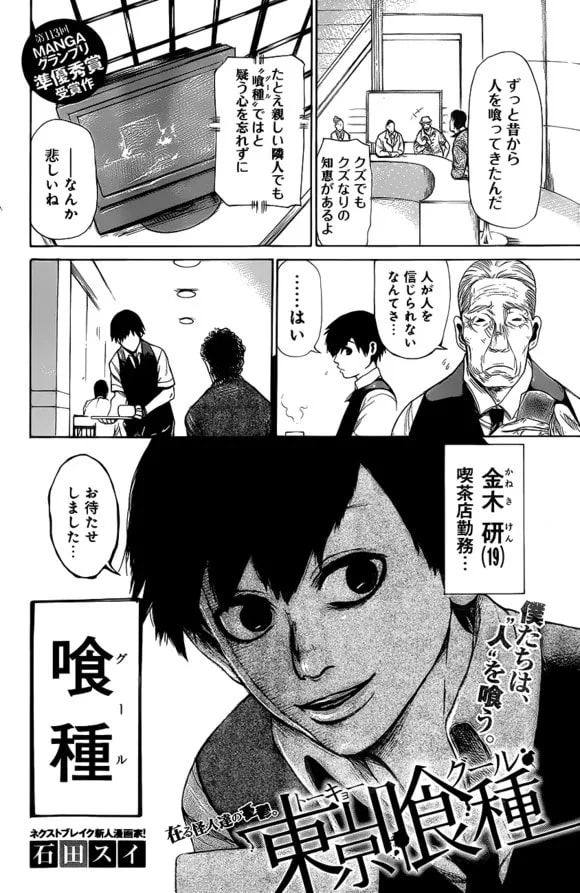
The prototype chapter that launched the series, printed in Miracle Jump during 2011. It sketches an early version of Ken Kaneki as a ghoul waiter who cannot keep human food down, then pits him against the investigator Yukinori Shinohara before a twist reframes who the true killer really is.
Summary
The story opens on a talk show where a guest activist discusses a string of recent killings blamed on a flesh eater. Attention shifts to Ken Kaneki, a ghoul earning a living as a waiter beside his coworker Touka. When their manager offers both of them sandwiches at lunch, Touka begs off by citing a diet, leaving Kaneki with no such cover. He forces the food down, then rushes to a restroom to bring it back up, since his body cannot process it. The ghoul investigator Yukinori Shinohara clocks the odd behavior.
Back home, Kaneki keeps a stash of victims to feed on and consumes a severed arm before heading to a cafe. There he runs into Shinohara again, is pressured into eating another sandwich, and vomits it onto the table. Humiliated and enraged, he resolves to kill the investigator.
Key Events
Touka spots Kaneki tailing Shinohara and follows out of curiosity. In a deserted stretch of a station, Kaneki tries a surprise strike but is completely outmatched and overpowered. Touka steps in to shield him, and Kaneki seizes her as a hostage to buy his escape. Shinohara, convinced that one human life is a fair trade for a dead ghoul, presses the attack anyway. Touka then rakes his face, exposing herself as a ghoul too, and it comes out that she is the one behind the recent murders rather than Kaneki. She keeps the investigator occupied while Kaneki lands the killing blow.
Notes
The chapter closes with the two waiters wondering whether their employer Yoshimura suspects what they are. The final panels answer the question by showing Yoshimura himself feeding on the corpse of the activist from the broadcast, revealing him as another ghoul. This pilot ran in Miracle Jump on March 15, 2011, spanned 36 pages, and directly preceded the serialized Chapter 1. Its cast are early, standalone takes on characters who would be reworked for the main manga.
Related Reading
See all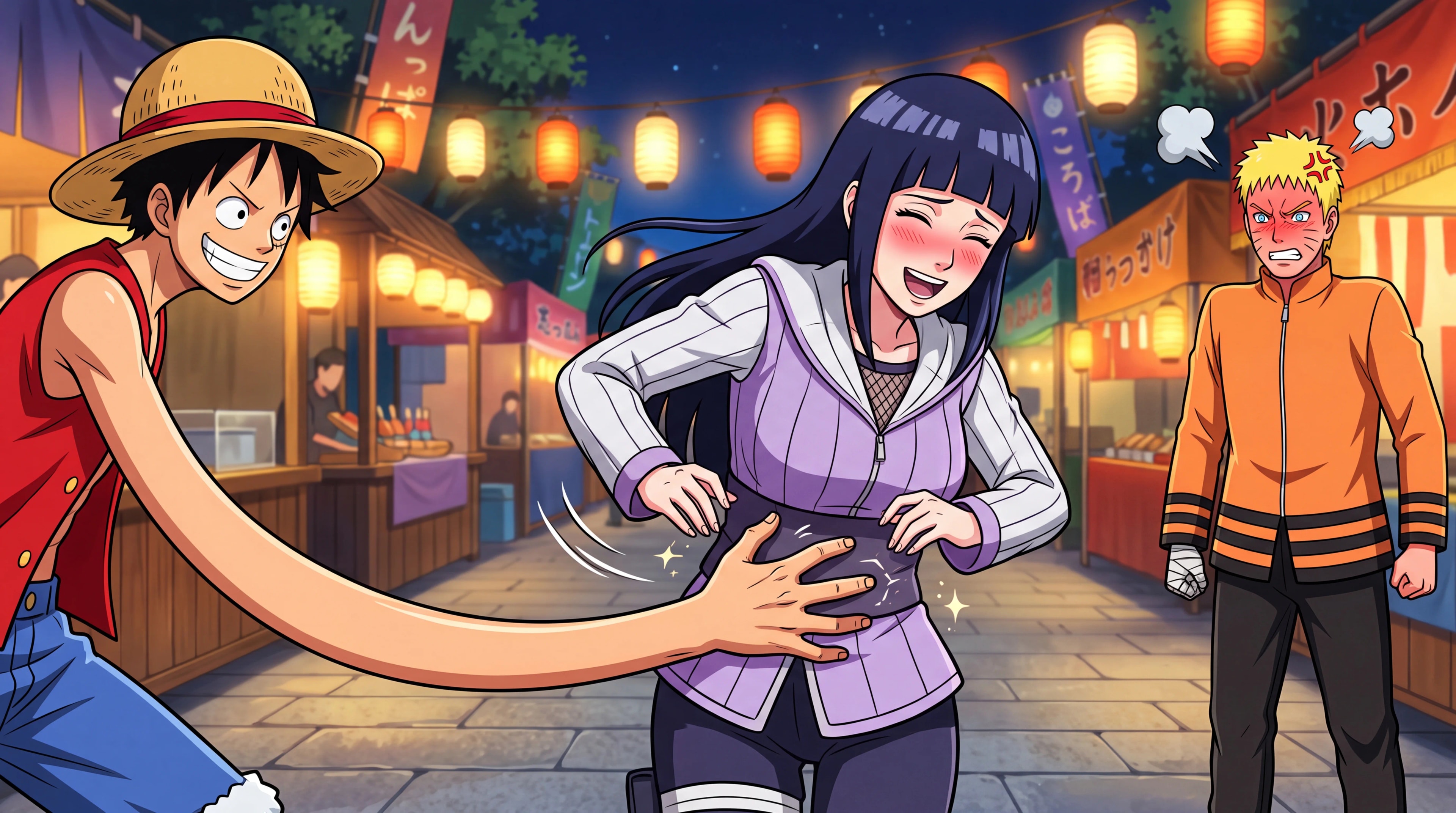
Naruto vs Luffy: Does the Fight Change if Luffy Tickles Hinata?
Naruto vs Luffy with the twist nobody asked for: Luffy tickled Hinata on date night, and she kind of liked it. We break down the whole fight and commit to a winner....
Piccolo Gets the Namek Hoes: Namek Has No Women, and He Pulls Anyway
There are no women on Namek. That isn't an oversight, it's the biology. Why we handed Piccolo the one thing his own species rules out, and why it had to be trap soul....
Frequently Asked Questions
What does one-shot mean in anime?
In manga and anime, a oneshot is a standalone chapter published outside of an ongoing series. Tokyo Ghoul's own Oneshot is an example: a 36-page prototype that ran in Miracle Jump in 2011 and introduced early versions of characters before the serialized manga began.
Who turns out to be the real killer in the Tokyo Ghoul Oneshot?
In the Oneshot, the waitress Touka is revealed to be the true culprit behind the recent string of murders, not her coworker Ken Kaneki. She exposes her own kagune, holds off investigator Yukinori Shinohara, and lets Kaneki land the killing blow.
Why does Kaneki vomit up his food in the Oneshot?
In the Oneshot, Ken Kaneki is secretly a ghoul working as a waiter, so his body cannot process human food. When his manager offers him a sandwich, he forces it down and then rushes to a restroom to bring it back up, catching the attention of investigator Yukinori Shinohara.
What twist about the manager Yoshimura closes out the Oneshot?
The Oneshot ends by revealing that Kaneki and Touka's employer, Yoshimura, is also a ghoul. The final panels show him feeding on the corpse of the activist from the chapter's opening broadcast.
When was the Tokyo Ghoul Oneshot published and how does it connect to the main manga?
The Tokyo Ghoul Oneshot ran in Miracle Jump number 2 on March 15, 2011, spanning 36 pages. It served as the prototype pilot chapter that directly preceded the serialized Chapter 1, with early standalone versions of characters later reworked for the main story.
Sources & Information
Looking for more on Oneshot? The Dragon Ball Wiki on Fandom has a dedicated page with community notes.
View on FandomThis content is original writing by Daddy Jim Headquarters based on the Dragon Ball anime series, manga, and official materials. Episode and chapter references are cited where applicable.
Character and scene imagery on this site is original artwork by Daddy Jim Headquarters, not screenshots or licensed imagery. Official cover art is used on three types of pages for editorial commentary:
- Movie pages: theatrical posters and key visuals, credited to Toei Animation and Shueisha.
- Game pages: official box art, credited to Bandai Namco, Atari, and other publishers.
- Manga chapter pages: Jump Comics volume covers, credited to Shueisha and Akira Toriyama.
Official resources:
Help Us Keep This Wiki Accurate
Daddy Jim Headquarters maintains this encyclopedia. If you spot an error, a translation issue, or something that doesn't look right, let us know.