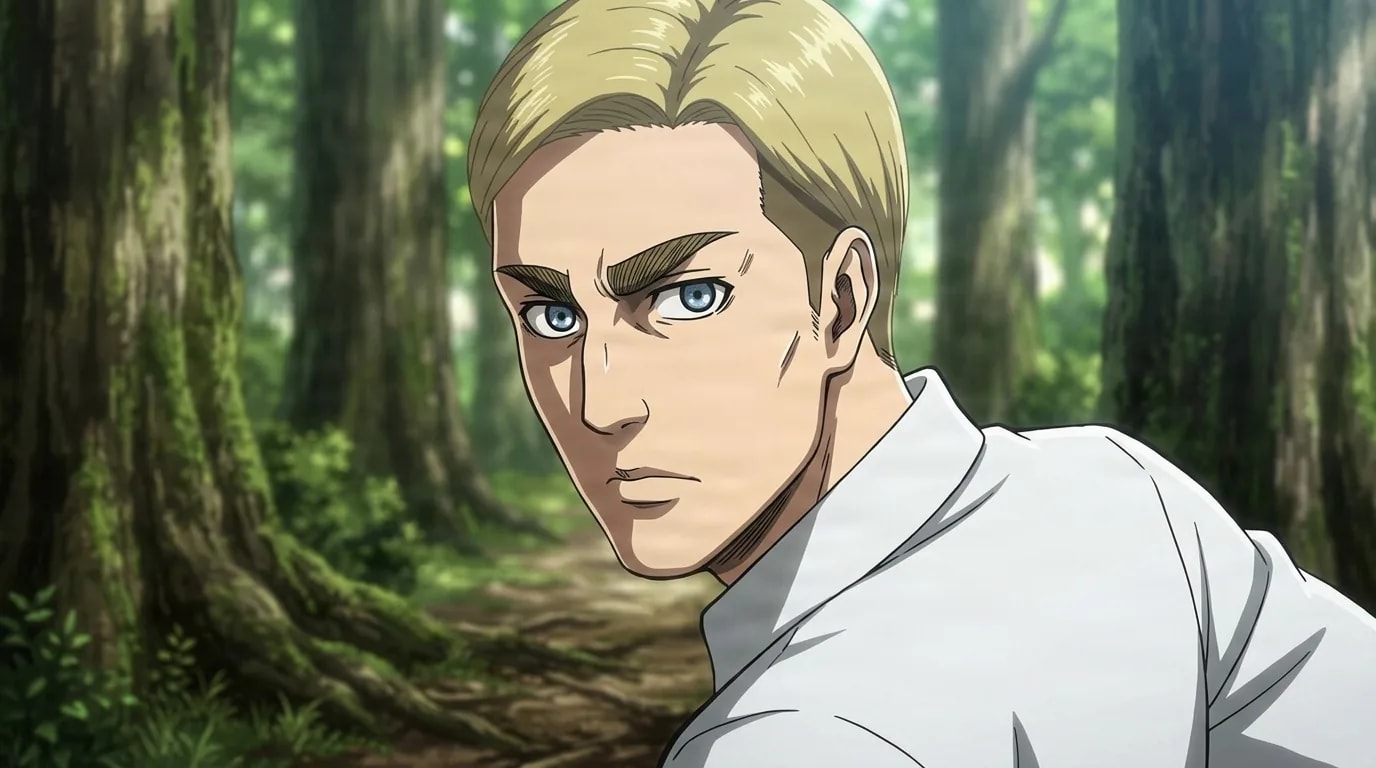
Erwin Smith
CharacterErwin Smith was the Survey Corps's 13th commander, architect of the Long-Distance Enemy Scouting Formation and of the coup that unseated a false king. Haunted by his father's death and a childhood question about the world, he spent thousands of lives chasing an answer he chose, at the very end, never to see.
Appearance
Erwin loomed over most of his scouts, broad and powerfully built, his blond hair kept neatly parted on the left. Icy blue eyes dominated a face that rarely broke its composed expression, and his famously thick eyebrows earned him the childhood nickname of Eyebrow. He dressed in the standard uniform with the Corps's green cape in the field, plus the emerald bolo tie shared by the other branch commanders. A Titan's jaws took his right arm just below the shoulder during the second battle against the Armored Titan, and from then on he saluted with his left.
Personality
Calculation defined Erwin. He planned years ahead, sensed the spy inside his own ranks before anyone else, and devised tests to sort which soldiers could hold the truth. His speeches could turn tribunals and fill recruitment rolls, and he met praise, mockery, and catastrophe with the same grim equanimity. Armin grouped him with the rare men capable of ordering soldiers to their deaths for humanity's benefit, and the Corps followed him into those deaths willingly.
Beneath the composure sat a confession he made only to Levi: his dream outweighed mankind's victory. The theory that got his father murdered had hardened into obsession, and every sacrifice he ordered doubled as one more step toward checking that answer. He felt the dead watching him, waiting to see what their lives had bought, and the guilt left him quietly suicidal; Zackly and Pixis each saw through the noble front to the self-interest underneath. Yet when the choice finally came, basement or soldiers, he let the dream go, led the recruits' charge in person, and died relieved.


History
Erwin's path began with a schoolboy's question: how could every memory of the world before the Walls simply vanish? His father's private answer, that the crown had rewritten humanity's memories, leaked through the boy's innocent chatter and cost the man his life at the hands of the Interior Police. Erwin enlisted, gave up the woman he loved rather than abandon the truth, and rose through the Survey Corps, where the casualty-sparing scouting formation he proposed was rejected by Commander Keith Shadis, who nevertheless chose Erwin as his successor after Wall Maria fell.
As commander, Erwin engineered the Female Titan's capture by hiding the operation from his own ranks, exposed Annie Leonhart in Stohess, and lost his right arm leading the charge that pulled Eren back from Reiner and Bertolt. Convinced the government was rotten at the core, he plotted a coup with Pixis and Zackly, survived his own march to the gallows when the nobles condemned half of humanity aloud, and put Historia Reiss on the throne, admitting to Zackly afterward that a childhood dream, not humanity, had driven him all along.
Retaking Shiganshina became his last gamble. Pinned against the Wall while the Beast Titan shelled his recruits, Erwin confessed to Levi that the basement mattered more to him than anything, then accepted Levi's decision on his behalf: he would die with the recruits so Levi could kill the Beast Titan. Declaring that it falls to the living to give the dead their meaning, he led the smokescreen cavalry charge into the barrage and was torn from his horse by a flying stone. Carried back mortally wounded, he lay seconds from receiving the sole Titan serum when Levi, honoring his release from the dream, gave it to Armin instead. Erwin died in peace, and he returns at the story's close among the fallen soldiers who salute Levi after Eren's defeat.
Related Reading
See all
Naruto vs Luffy: Does the Fight Change if Luffy Tickles Hinata?
Naruto vs Luffy with the twist nobody asked for: Luffy tickled Hinata on date night, and she kind of liked it. We break down the whole fight and commit to a winner....
Piccolo Gets the Namek Hoes: Namek Has No Women, and He Pulls Anyway
There are no women on Namek. That isn't an oversight, it's the biology. Why we handed Piccolo the one thing his own species rules out, and why it had to be trap soul....

Frequently Asked Questions
Who was Erwin Smith in love with?
The wiki content does not name Erwin Smith's love interest. It only states that he gave up a woman he loved rather than abandon his search for the truth about the Titans.
Was Erwin Smith good or bad?
Erwin Smith is morally complex rather than simply good or bad. As Survey Corps commander he willingly sent soldiers, including himself, to their deaths for humanity's sake, and he privately admitted his own dream mattered to him more than victory, yet in his final moments he let that dream go and chose to die with his recruits.
Is Erwin Smith a higher rank than Levi?
Yes. Erwin Smith served as the Survey Corps' 13th Commander, the organization's top position, while Levi Ackerman served under him as his right hand.
What happened to Erwin Smith?
Erwin Smith died leading a cavalry charge against the Beast Titan's artillery barrage during the mission to retake Shiganshina District. Mortally wounded and moments from receiving the last Titan serum, he let Levi give it to Armin Arlert instead, dying at peace with his choice.
What is Erwin Smith's famous line?
Erwin Smith is remembered for declaring that it falls to the living to give the dead their meaning, a line he spoke just before leading the doomed cavalry charge at Shiganshina District.
Sources & Information
Looking for more on Erwin Smith? The Dragon Ball Wiki on Fandom has a dedicated page with community notes.
View on FandomThis content is original writing by Daddy Jim Headquarters based on the Dragon Ball anime series, manga, and official materials. Episode and chapter references are cited where applicable.
Character and scene imagery on this site is original artwork by Daddy Jim Headquarters, not screenshots or licensed imagery. Official cover art is used on three types of pages for editorial commentary:
- Movie pages: theatrical posters and key visuals, credited to Toei Animation and Shueisha.
- Game pages: official box art, credited to Bandai Namco, Atari, and other publishers.
- Manga chapter pages: Jump Comics volume covers, credited to Shueisha and Akira Toriyama.
Official resources:
Help Us Keep This Wiki Accurate
Daddy Jim Headquarters maintains this encyclopedia. If you spot an error, a translation issue, or something that doesn't look right, let us know.