Near
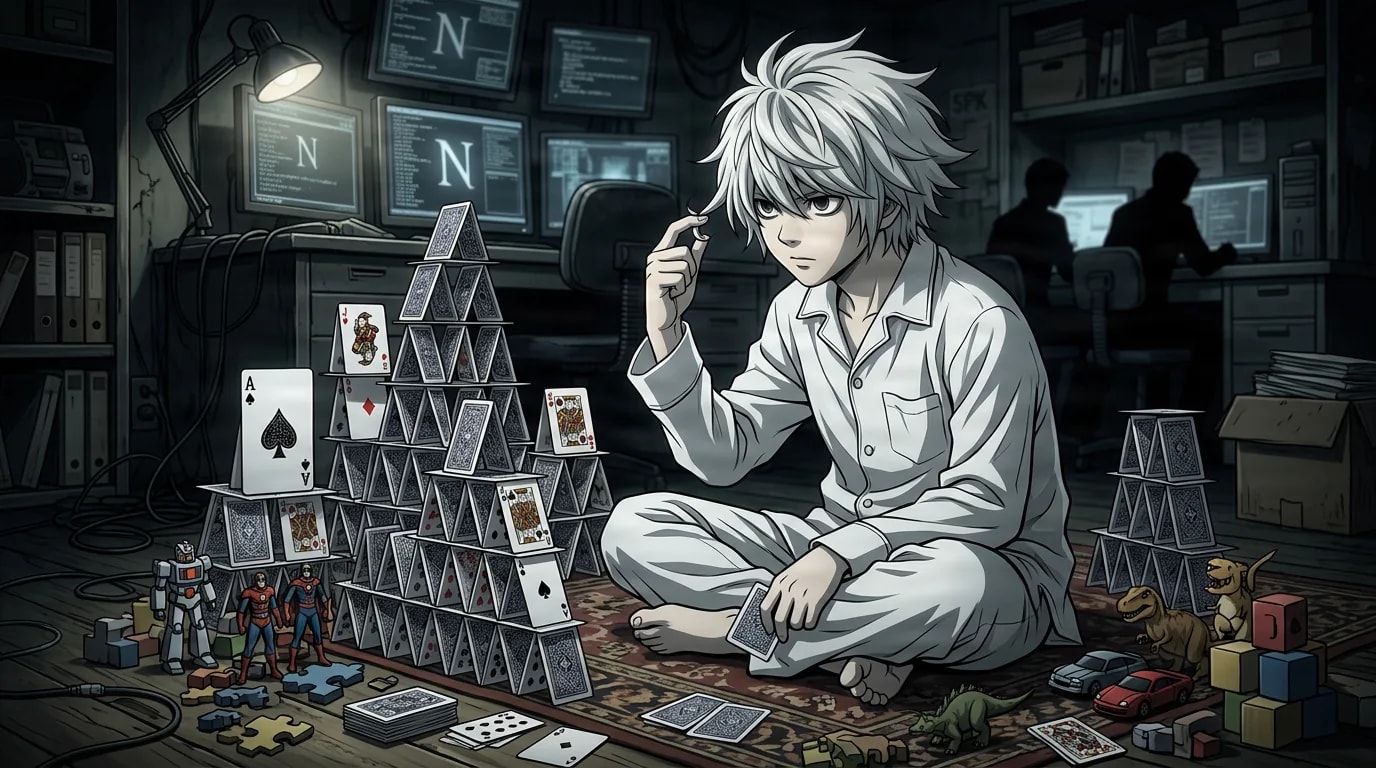
CharacterThe quieter of the two boys groomed at Wammy's House to inherit L's mantle, Near rebuilds the Kira case from nothing after the great detective falls. Cool, toy-obsessed, and ruthlessly pragmatic, he eventually heads an American task force and corners Light Yagami where L could not.
Appearance
A head of pale platinum hair, forever being twisted around his fingers, tops a slight, boyish frame. Near's skin is fair and his eyes gray, and his wardrobe never changes: a loose white pajama top and matching bottoms, the trousers tinted light blue in the animated version. He folds himself into a crouch that echoes L's signature pose and tends to keep his face blank. By the one-shot set three years past the Kira affair, dark shadows have settled under his eyes, his hair runs longer, and a late growth spurt has finally caught up with him.

Personality
Behind a childish surface sits one of the sharpest minds in the series, sharp enough that strangers like President David Hoope underestimate him on sight. Near treats every case as a puzzle to be assembled, and his focus is famous: he once finished a jigsaw colored almost entirely blank. He juggles banks of monitors at once and works either hand with equal ease, throwing darts left-handed while stacking dice with the right. Socially, though, he is hopeless and admittedly fragile, leaning on his team so heavily that he asks Rester to fly with him to Japan rather than board a plane alone. Death Note 13: How to Read frames his composure as possibly steadier than L's, paired with a willingness to bend rules close to breaking, since outcomes matter to him more than methods. A small smirk gives him away whenever a deduction lands. Tsugumi Ohba noted that the character was meant to read as less likable over time, his cheekiness striking some readers as smug, even a cheat. Surrounded always by dice, darts, robots, and later towering card structures, Near nonetheless holds the most grounded, existentialist view of justice among the story's geniuses.
History
Near first appears as an orphan at Wammy's House, assembling a stark white jigsaw marked only by a black 'L' while turning down a girl named Linda's invitation to play. When Roger Ruvie gathers him and Mello to break the news of L's death, Mello erupts and Near stays eerily calm, scattering his finished puzzle and remarking that anyone who cannot solve it is simply a loser. With L's files wiped, he rebuilds the Kira investigation from zero over the next four years. He and FBI Director Steve Mason then brief the American President, exposing the standing 'L' as a fabrication of the Japanese police and laying out how Kyosuke Higuchi killed using a notebook. Recognized as L's rightful heir, Near takes charge of the newly formed Special Provision for Kira.
His hunt tangles with Mello's mafia, whose kidnappings of Takimura and Sayu Yagami force an uneasy alliance with the Japanese task force and the man now calling himself L. Near needles his rival, trades intelligence, and survives Mello wiping out most of his agents. Piece by piece, through Aizawa's disclosures and the Takada surveillance run by Halle Lidner and Rester, he pins Light Yagami as Kira and identifies Teru Mikami as the proxy who does the killing. His endgame hinges on swapping Mikami's notebook for a forgery, and at the Yellow Box Warehouse the trap springs: Mikami writes every name but Light's, unmasking him. Near declares that he and Mello together have finally outdone L, dismisses Light's god complex as plain murder, and watches Matsuda gun him down before Ryuk ends him. Near assumes the title of the third L, later dismissing the copycat C-Kira on live television and, in the later auction affair, conceding defeat to a killer shielded by the United States President.
Related Reading
See all
Super Saiyan Pubes: The Song About Where Super Saiyan Hair Actually Goes
The transformation everyone knows, the follow-up question nobody would touch. Why we made a smooth R&B track about the golden glow Dragon Ball never talks about....

The Bleach Female Characters Nobody Can Agree On, Settled
Five Bleach female characters, ranked and settled. Yoruichi sits at number five, the spot nobody expects, and our number one is an Arrancar with a soft heart....

Frequently Asked Questions
Was Near supposed to be L's son?
No. In Death Note, Near is not L's son but an orphan raised at Wammy's House, the institution that groomed gifted children to inherit L's role. He was recognized as L's rightful heir after the detective's death, not as a blood relative.
Is Near a boy or girl in Death Note?
Near is male. His real name is Nate River, and he is one of the two boys groomed at Wammy's House to succeed L.
Is Near related to L in Death Note?
Near is not related to L by blood. He was one of the gifted orphans at Wammy's House chosen to inherit L's mantle, and after L died he was recognized as the detective's rightful successor, taking the title of the third L.
Why did they replace L with Near?
Near took over because L died during the Kira investigation, and Near was one of the successors raised at Wammy's House specifically to inherit L's role. With L's files wiped, he rebuilt the Kira case from nothing and was recognized as L's rightful heir.
What is Near's real name in Death Note?
Near's real name is Nate River. He also goes by the alias N and later takes the title of the third L after assuming leadership of the Special Provision for Kira.
Sources & Information
Looking for more on Near? The Death Note Wiki on Fandom has a dedicated page with community notes.
View on FandomThis content is original writing by Daddy Jim Headquarters based on the Death Note anime series, manga, and official materials. Episode and chapter references are cited where applicable.
Character and scene imagery on this site is original artwork by Daddy Jim Headquarters, not screenshots or licensed imagery. Official cover art is used on three types of pages for editorial commentary:
- Movie pages: theatrical posters and key visuals, credited to Nippon Television and Warner Bros. Japan.
- Game pages: official box art, credited to Konami and other publishers.
- Manga chapter pages: Jump Comics volume covers, credited to Shueisha, Tsugumi Ohba, and Takeshi Obata.
Official resources:
Help Us Keep This Wiki Accurate
Daddy Jim Headquarters maintains this encyclopedia. If you spot an error, a translation issue, or something that doesn't look right, let us know.