Special Provision for Kira
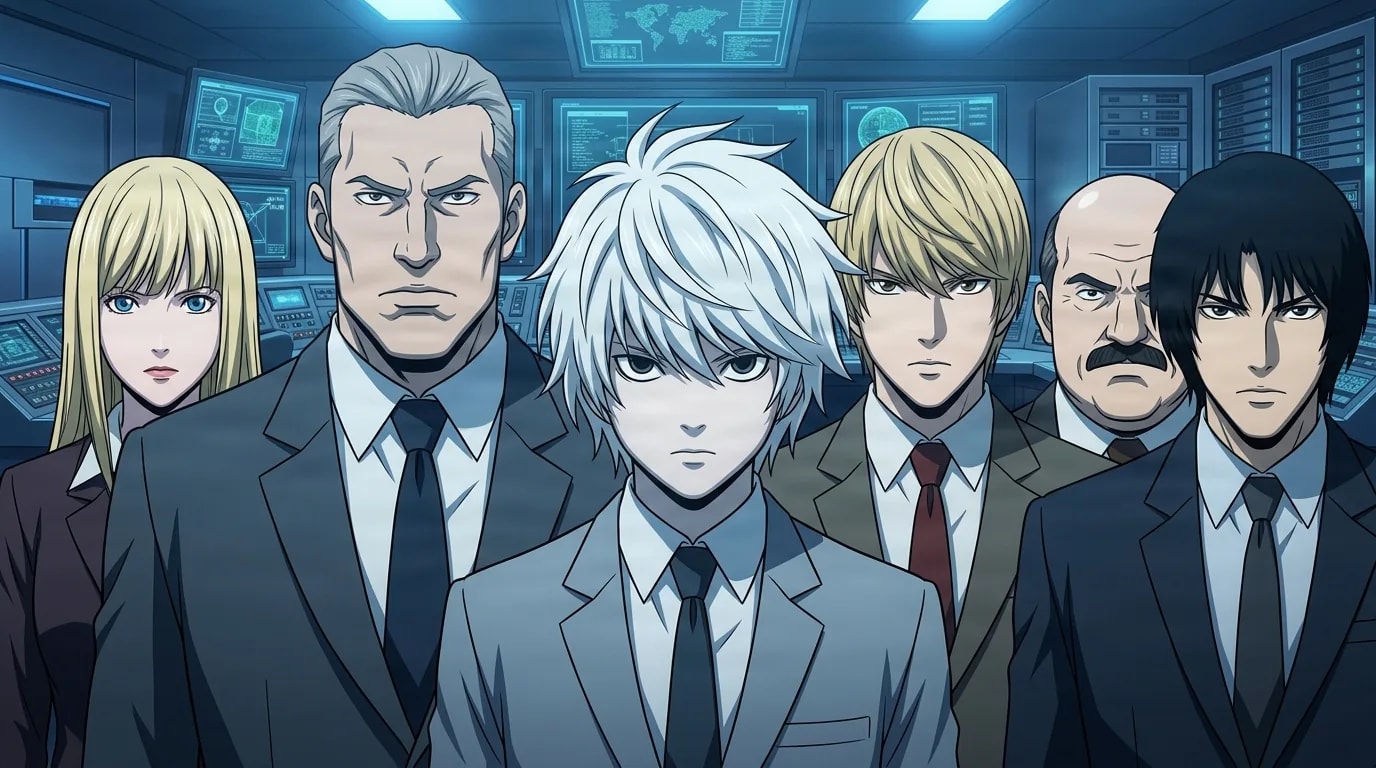
CharacterThe Special Provision for Kira, shortened to SPK, is the handpicked American answer to the Kira problem after L's death. Drawn from intelligence and federal ranks and commanded by his successor Near, the cell stays deliberately tiny, guarding its secrets and operating at arm's length from Japan's own investigators.
Overview
The unit gathers a small circle of supposedly elite operatives pulled from the FBI and CIA, all answering to Near. Keeping the headcount low is a deliberate guard against leaks, and the group charts its own course rather than folding into the Japanese Task Force.
Its birth comes more than four years after L dies, in the spring of 2009, or 2012 in the anime telling. Near sits down with the sitting American President, a figure the manga names David Hoope while the anime calls him George Sairas, to lay out the truth surrounding Kyosuke Higuchi and the notebook: that such a weapon is real, that Japanese police are sitting on it, and that the genuine L is gone. Armed with presidential backing, he founds the SPK.
Role
The conflict ignites when police director Kanichi Takimura is seized and held for ransom, the price being the Death Note that the Task Force has hidden away. Soichiro Yagami, approached by FBI man John McEnroe with a request to surrender the notebook to American hands, leaps to the wrong conclusion that the Bureau staged the abduction, and the two sides agree to cooperate in freeing the director. Near, meanwhile, correctly fingers Mello, the second of Wammy's House's two heirs, as the true kidnapper.
Working through the Mafia and an informant he had slipped inside the SPK, Mello engineers the abduction of Sayu Yagami and walks away with the Task Force's notebook. The Mafia then writes most of the SPK into oblivion, sparing only Near, Halle Lidner, Anthony Rester, and Stephen Gevanni. The Relight 2 retelling drops the Mafia thread entirely, having Kiyomi Takada and Teru Mikami eliminate the members instead.
A war of wits follows as the survivors hunt Mello's hideouts and he stays a step ahead using leaks from the president's office. Near foresees that the cornered rival will reach out to Lidner, plants bugs on her, and is outmaneuvered when she ditches the devices in the shower to brief Mello in private. Once she reveals that Kira and the second L are one, Mello shoulders his way into the SPK's own base to seize his photograph, trading vital intelligence to Near in the bargain.
Relocating to Japan to close the distance, Near deduces that the man leading the Task Force, Light Yagami, is the second L. Sensing a further killer he dubs X-Kira, he zeroes in on Teru Mikami and sets Gevanni to shadow him, while Lidner embeds herself on the security detail of Kira's mouthpiece, Kiyomi Takada. The endgame turns on a forged notebook: Gevanni swaps Mikami's real one for a copy, and at the showdown inside the Yellow Box Warehouse, Near uses that counterfeit to strip away Light's mask and expose him as Kira.
Notable Members
Near, whose true name is Nate River, is the architect of the whole enterprise and L's foremost heir. His second is Anthony Rester, born Anthony Carter, once captain of a special-operations squad. Rounding out the inner core are Stephen Gevanni, born Stephen Loud, a gifted forger and lock-picker brought aboard for those exact talents and handed the job of tailing Mikami, and Halle Lidner, whose real name is Halle Bullook.
Lidner is the group's most slippery thread. A veteran of the Secret Service and the CIA, she insists she serves neither Near nor Mello and wants only to see Kira caught, yet she repeatedly funnels the SPK's findings to Mello. Assigned to worm her way into Takada's bodyguard unit, she plays the dutiful handler while quietly digging for the link between Takada and Kira. Her private motive, which Death Note 13: How to Read later spells out, is vengeance for a loved one slain by the Yotsuba Kira. The wider roster also counts fallen names such as Steve Mason, John McEnroe, Ill Ratt, and Ellickson Gardner, with several more surfacing only in the Relight specials.
Related Reading
See all
Super Saiyan Pubes: The Song About Where Super Saiyan Hair Actually Goes
The transformation everyone knows, the follow-up question nobody would touch. Why we made a smooth R&B track about the golden glow Dragon Ball never talks about....

The Bleach Female Characters Nobody Can Agree On, Settled
Five Bleach female characters, ranked and settled. Yoruichi sits at number five, the spot nobody expects, and our number one is an Arrancar with a soft heart....

Frequently Asked Questions
What is the SPK in Death Note?
The Special Provision for Kira, or SPK, is the handpicked American answer to the Kira problem after L's death. Drawn from FBI and CIA ranks and commanded by L's successor Near, the cell stays deliberately tiny to guard its secrets and operates at arm's length from Japan's own investigators.
Who leads the SPK?
The SPK answers to Near, whose true name is Nate River, the architect of the whole enterprise and L's foremost heir. His second in command is Anthony Rester, born Anthony Carter, once captain of a special-operations squad.
When and why was the SPK formed?
The SPK was founded more than four years after L's death, in the spring of 2009, or 2012 in the anime. Near met with the American President to reveal that the Death Note was real, that Japanese police were concealing it, and that the true L was gone, then established the SPK with presidential backing.
What happened to most of the SPK members?
After Mello seized the Task Force's notebook, the Mafia wrote most of the SPK into oblivion, sparing only Near, Halle Lidner, Anthony Rester, and Stephen Gevanni. The Relight 2 retelling instead has Kiyomi Takada and Teru Mikami eliminate the members.
How did the SPK expose Light as Kira?
The SPK's endgame turned on a forged notebook: Stephen Gevanni swapped Teru Mikami's real Death Note for a copy. At the showdown inside the Yellow Box Warehouse, Near used that counterfeit to strip away Light Yagami's mask and expose him as Kira.
Sources & Information
Looking for more on Special Provision for Kira? The Death Note Wiki on Fandom has a dedicated page with community notes.
View on FandomThis content is original writing by Daddy Jim Headquarters based on the Death Note anime series, manga, and official materials. Episode and chapter references are cited where applicable.
Character and scene imagery on this site is original artwork by Daddy Jim Headquarters, not screenshots or licensed imagery. Official cover art is used on three types of pages for editorial commentary:
- Movie pages: theatrical posters and key visuals, credited to Nippon Television and Warner Bros. Japan.
- Game pages: official box art, credited to Konami and other publishers.
- Manga chapter pages: Jump Comics volume covers, credited to Shueisha, Tsugumi Ohba, and Takeshi Obata.
Official resources:
Help Us Keep This Wiki Accurate
Daddy Jim Headquarters maintains this encyclopedia. If you spot an error, a translation issue, or something that doesn't look right, let us know.