Beast Breathing
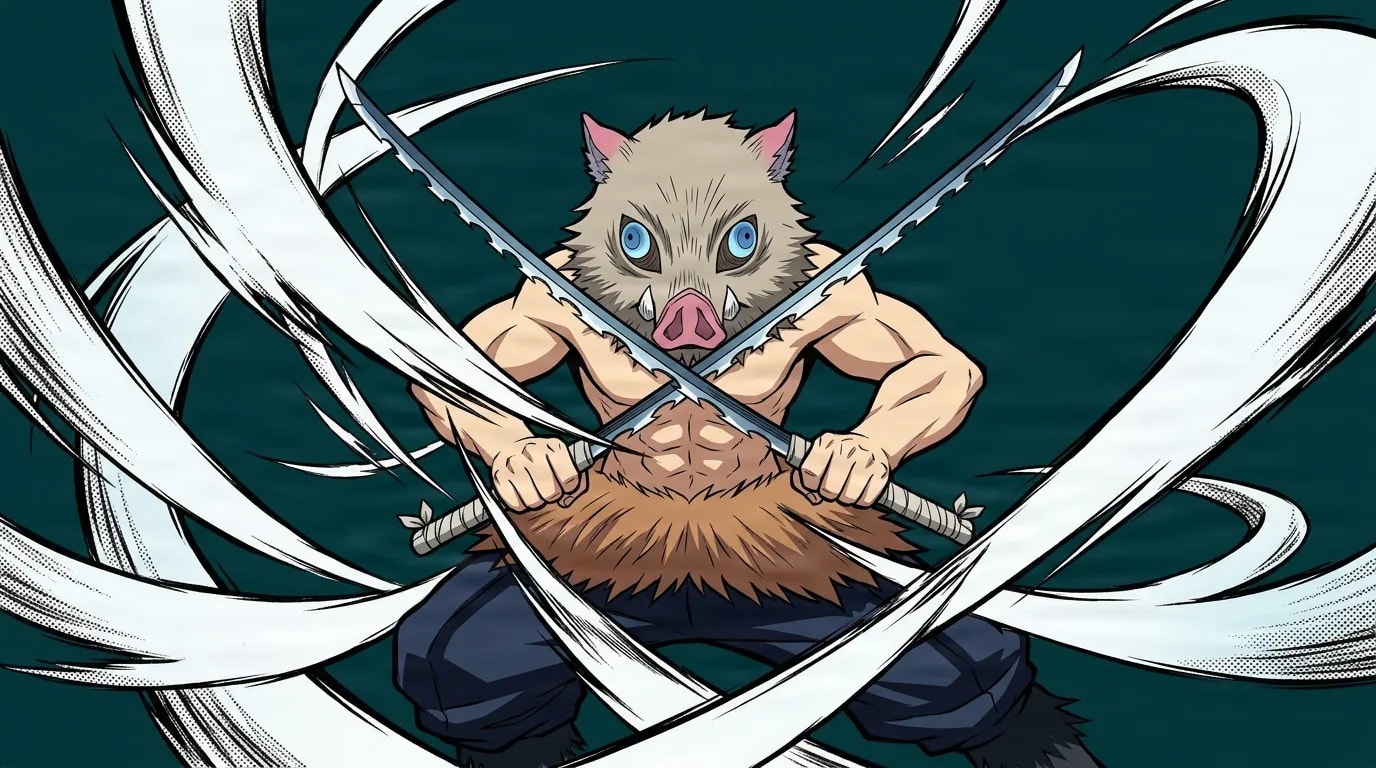
CharacterBeast Breathing is a self-taught swordsmanship style that channels the ferocity and instinct of wild animals. Born in the mountains from a fight for survival, it favors raw, unpredictable strikes delivered through dual blades and a razor-sharp sense of touch.
Overview
Beast Breathing draws on the wild, untamed behavior of animals, copying their savage attacks, sudden movements, and keen senses through the user's own body. Its known techniques tend to be plain and aggressive rather than elegant, leaning on raw instinct, though one of them taps into a heightened sense of touch to read an opponent's position the way an animal reads its surroundings. When the style is unleashed, practitioners picture themselves tearing at a foe with fangs and claws.
The art counts as a distant offshoot of Wind Breathing. Inosuke Hashibira developed it himself after growing up among the mountains and surviving by combat alone, which means it suits a fighter who wields two Nichirin katana at once and possesses an unusually acute sense of touch.
Forms
The style is built around roughly a dozen named techniques, with an improvised move added during the clash against the Upper Rank demon Doma. Unlike most Breathing Styles, its attacking moves are labeled "Fangs" rather than "Forms," while supporting techniques keep the "Form" label.
Early Fangs are blunt and direct: the First Fang drives both blades into the throat, the Third releases twin horizontal cuts aimed at decapitation (Chapter 23, Episode 12), and later Fangs deliver crossing slashes, scattered mid-air cutting, and saw-like double strikes. The Seventh Form, Spatial Awareness (Chapter 29), abandons offense entirely, letting the user feel faint shifts in the air to locate hidden enemies across an entire mountainside. Higher numbered Fangs add dislocated-joint reach extensions, spinning deflection of projectiles, and even a thrown twin-blade strike.

Notable Users
Inosuke Hashibira is the sole known practitioner and the creator of the style. He modeled it on the wild boars that raised him as well as the bears and wolves he admired. Because the art depends on dual-wielding and an exceptional sense of touch, no other swordsman is shown using it.
Related Reading
See all
Demon Slayer Infinity Castle Is the Biggest Anime Movie Ever but It Still Lost in Japan
Demon Slayer: Infinity Castle earned $778 million globally and nearly 40 billion yen in Japan, but it still couldn't top Mugen Train's domestic record. Here's why that barely matters....

Super Saiyan Pubes: The Song About Where Super Saiyan Hair Actually Goes
The transformation everyone knows, the follow-up question nobody would touch. Why we made a smooth R&B track about the golden glow Dragon Ball never talks about....

Frequently Asked Questions
What is Beast Breathing in Demon Slayer?
Beast Breathing is a self-taught swordsmanship style in Demon Slayer that channels the ferocity and instinct of wild animals through raw, unpredictable strikes. It is delivered through dual blades and a razor-sharp sense of touch, copying savage attacks, sudden movements, and keen senses.
Is Inosuke the only Beast Breathing user?
Yes, Inosuke Hashibira is the sole known practitioner of Beast Breathing as well as its creator. Because the art depends on dual-wielding and an exceptional sense of touch, no other swordsman is shown using it.
What is the 7th form of Beast Breathing?
The Seventh Form of Beast Breathing is Spatial Awareness, introduced in Chapter 29. It abandons offense entirely, letting the user feel faint shifts in the air to locate hidden enemies across an entire mountainside.
What is Beast Breathing derived from?
Beast Breathing counts as a distant offshoot of Wind Breathing. Inosuke Hashibira developed it himself after growing up among the mountains, modeling it on the wild boars that raised him as well as the bears and wolves he admired.
How many forms does Beast Breathing have?
Beast Breathing is built around roughly a dozen named techniques, with an improvised move added during the clash against the Upper Rank demon Doma. Its attacking moves are labeled "Fangs" rather than "Forms," while supporting techniques keep the "Form" label.
Sources & Information
Looking for more on Beast Breathing? The Demon Slayer Wiki on Fandom has a dedicated page with community notes.
View on FandomThis content is original writing by Daddy Jim Headquarters based on the Demon Slayer anime series, manga, and official materials. Episode and chapter references are cited where applicable.
Character and scene imagery on this site is original artwork by Daddy Jim Headquarters, not screenshots or licensed imagery. Official cover art is used on three types of pages for editorial commentary:
- Movie pages: theatrical posters and key visuals, credited to ufotable and Aniplex.
- Game pages: official box art, credited to Sega, Aniplex, and other publishers.
- Manga chapter pages: Jump Comics volume covers, credited to Shueisha and Koyoharu Gotouge.
Official resources:
Help Us Keep This Wiki Accurate
Daddy Jim Headquarters maintains this encyclopedia. If you spot an error, a translation issue, or something that doesn't look right, let us know.