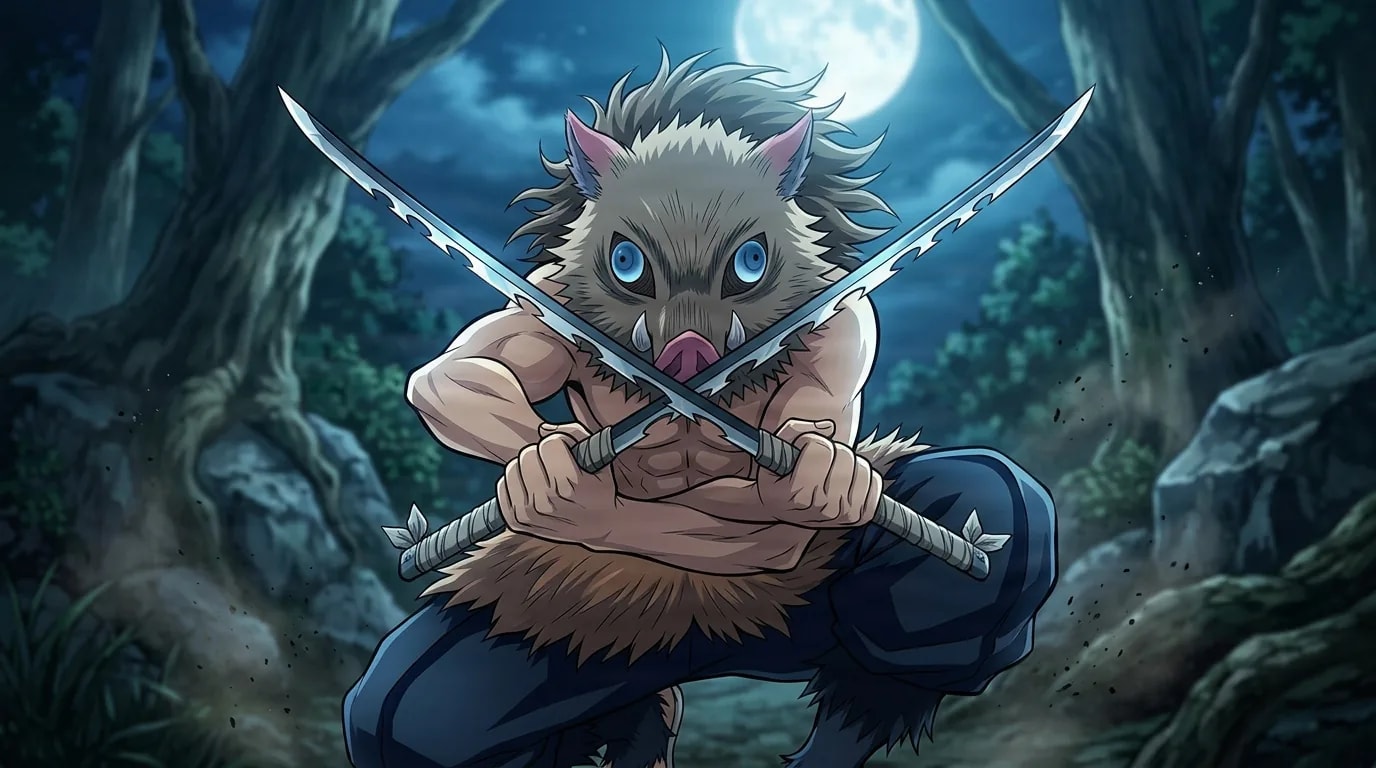
Inosuke Hashibira
CharacterInosuke Hashibira is a feral, boar-masked fighter raised in the mountains who travels alongside Tanjiro, Nezuko, and Zenitsu. Self-taught in focused breathing, he created his own Beast Breathing by mimicking wild animals and fights with two notched Nichirin blades, growing from a brash loner into a devoted friend.
Appearance and Temperament
Of roughly average height and pale-skinned, he possesses a strikingly muscular build, though his face is delicate enough that Zenitsu at first mistook him for a girl. His black hair turns blue toward the tips, and he is best known for the hollowed boar head he keeps over his face, modified so he can still see through it. His custom uniform is fur-trimmed and leaves his heels and toes uncovered.
Loud, conceited, and itching for a fight, he constantly declares himself the strongest and picks quarrels with almost everyone he meets, often rushing headlong into danger by overestimating himself. Raised by boars, he struggles with human manners, cannot read, and mangles people's names. Over time, shaped by Tanjiro's kindness, he learns to value friendship, gratitude, and teamwork.
Combat Prowess
Without any formal training, he learned focused breathing on his own, survived the wilderness, and passed Final Selection. His combat is wild and unpredictable, attacking from brutally low angles in a way Tanjiro likens to a four-legged animal. Wielding a katana in each hand, he shows off both raw power and skill, and he is blessed with an uncanny sense of touch, remarkable flexibility, and sharp instincts.
He can dislocate his joints and even shift his organs, famously sliding his heart out of the way to dodge a killing blow. He resisted Gyutaro's deadly poison to a degree, traded strikes with Upper Rank demons, and learned Repetitive Action after seeing it only once. His sheer willpower keeps him fighting through crippling wounds.
Beast Breathing
The style he devised himself, Beast Breathing, draws on the movements and savagery of mountain creatures rather than conventional swordsmanship. It pairs naturally with his chipped, jagged blades and his hunched, pouncing stance, and unlike other styles it depends heavily on his exceptional sense of touch to locate foes he cannot see.
Across the story he aids in defeating Enmu, the sibling Upper Ranks Daki and Gyutaro, and the far deadlier Doma, whose past as the man who left him motherless feeds Inosuke's fury. When the final battle comes, he hurls himself directly at Muzan, mourning the fallen slayers and demanding the demon king answer for all he has done.
Related Reading
See all
Demon Slayer Infinity Castle Is the Biggest Anime Movie Ever but It Still Lost in Japan
Demon Slayer: Infinity Castle earned $778 million globally and nearly 40 billion yen in Japan, but it still couldn't top Mugen Train's domestic record. Here's why that barely matters....
Super Saiyan Pubes: The Song About Where Super Saiyan Hair Actually Goes
The transformation everyone knows, the follow-up question nobody would touch. Why we made a smooth R&B track about the golden glow Dragon Ball never talks about....
Frequently Asked Questions
Who is Inosuke Hashibira in Demon Slayer?
Inosuke Hashibira is a feral, boar-masked fighter raised in the mountains who travels alongside Tanjiro, Nezuko, and Zenitsu. Self-taught in focused breathing, he created his own Beast Breathing and fights with two notched Nichirin blades.
Is Inosuke Hashibira a demon in Demon Slayer?
No, Inosuke Hashibira is a human, not a demon. He is a Demon Slayer raised by boars in the mountains who fights with his self-made Beast Breathing.
Who voices Inosuke Hashibira in Demon Slayer?
Inosuke Hashibira is voiced by Bryce Papenbrook in the English dub and by Yoshitsugu Matsuoka in the original Japanese.
How old is Inosuke Hashibira in Demon Slayer?
Inosuke Hashibira is 15 years old. He stands 164 cm tall and goes by the alias King of the Mountain.
What weapons does Inosuke Hashibira use in Demon Slayer?
Inosuke Hashibira wields two chipped, notched Nichirin katana, one in each hand. He pairs them with his self-created Beast Breathing and a hunched, pouncing fighting stance.
Sources & Information
Looking for more on Inosuke Hashibira? The Demon Slayer Wiki on Fandom has a dedicated page with community notes.
View on FandomThis content is original writing by Daddy Jim Headquarters based on the Demon Slayer anime series, manga, and official materials. Episode and chapter references are cited where applicable.
Character and scene imagery on this site is original artwork by Daddy Jim Headquarters, not screenshots or licensed imagery. Official cover art is used on three types of pages for editorial commentary:
- Movie pages: theatrical posters and key visuals, credited to ufotable and Aniplex.
- Game pages: official box art, credited to Sega, Aniplex, and other publishers.
- Manga chapter pages: Jump Comics volume covers, credited to Shueisha and Koyoharu Gotouge.
Official resources:
Help Us Keep This Wiki Accurate
Daddy Jim Headquarters maintains this encyclopedia. If you spot an error, a translation issue, or something that doesn't look right, let us know.