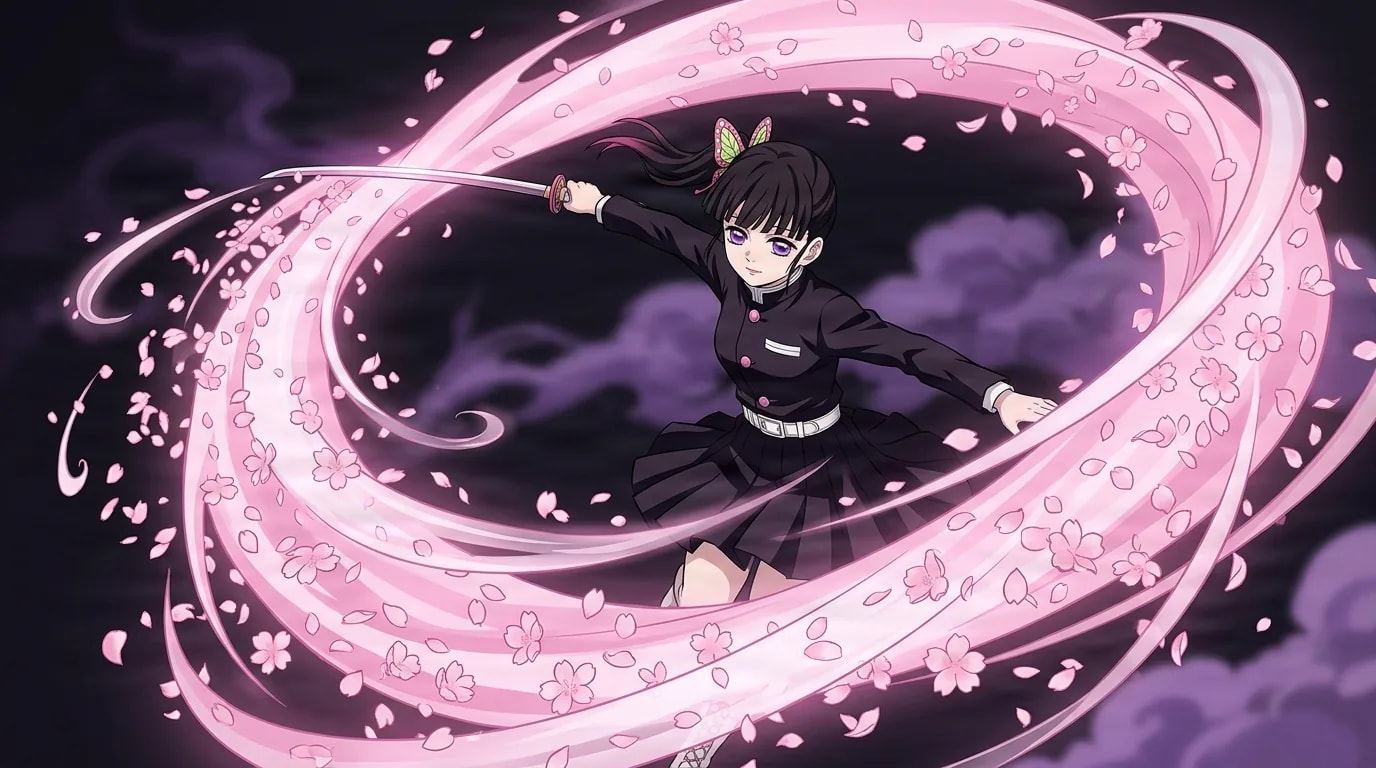
Flower Breathing
CharacterFlower Breathing is a graceful swordsmanship style branched from Water Breathing. It mirrors blossoms and fruit flowers through agile, flowing strikes, and it sharpens the user's vision to extraordinary degrees, though pushing that gift too far risks their eyesight.
Overview
Flower Breathing imitates both perennial flowers and fruit blossoms, translating them into the user's movements and attacks. Its forms favor elegance and agility, weaving cuts that twist and curve rather than overpowering an opponent by force. The style also heightens the wielder's eyesight, an advantage that can come at the cost of the eyes themselves. As they fight, practitioners picture themselves scattering petals and conjuring flowers in the wake of their blade.
Exactly when the art was founded is unclear, but it predates the Taisho Era and likely the Meiji period before it. The single recorded detail about whoever founded it is that they set a cherry tree in the garden of what would later become the Butterfly Mansion.
Forms
At least seven techniques exist, five of which are demonstrated, including the Final Form. The Second Form, Honorable Shadow Plum (Chapter 158), spins out several rotating cuts that turn aside incoming attacks. The Fourth Form, Crimson Hanagoromo (Chapter 143), is a single slash that bends and curls with grace, while the Fifth strings together nine flowing strikes and the Sixth pivots on the user's own weight to attack while evading.
The Final Form, Equinoctial Vermilion Eye (Chapter 162), is a focusing technique used as a last resort. It drives the user's kinetic vision to its absolute peak, turning the whites of their eyes red and making the world appear to crawl in slow motion. The strain is dangerous enough to rupture blood vessels and cause partial or permanent blindness, yet it remains usable even with only one working eye (Chapter 202).

Notable Users
Flower Breathing is practiced by Kanae Kocho and her adopted sister Kanao Tsuyuri. According to Kanao, the cherry tree in the Butterfly Mansion garden, named Victory, was planted there by the very first user of the style (Chapter 204). Alongside Mist Breathing, it is one of only two branching styles outside the five fundamentals that no Taisho Era Hashira personally invented.
Related Reading
See all
Demon Slayer Infinity Castle Is the Biggest Anime Movie Ever but It Still Lost in Japan
Demon Slayer: Infinity Castle earned $778 million globally and nearly 40 billion yen in Japan, but it still couldn't top Mugen Train's domestic record. Here's why that barely matters....

Super Saiyan Pubes: The Song About Where Super Saiyan Hair Actually Goes
The transformation everyone knows, the follow-up question nobody would touch. Why we made a smooth R&B track about the golden glow Dragon Ball never talks about....

Frequently Asked Questions
Who uses Flower Breathing in Demon Slayer?
Flower Breathing is practiced by Kanae Kocho and her adopted sister Kanao Tsuyuri in Demon Slayer. It was first created by an unnamed founder who planted a cherry tree, later named Victory, in the garden of the Butterfly Mansion.
How many forms of Flower Breathing are there?
Flower Breathing has at least seven techniques, five of which have been demonstrated, including the Final Form. The shown forms include the Second, Fourth, Fifth, Sixth, and the Final Form, Equinoctial Vermilion Eye.
What is the 4th form of Flower Breathing?
The Fourth Form of Flower Breathing is Crimson Hanagoromo, introduced in Chapter 143. It is a single slash that bends and curls with grace rather than relying on raw force.
What is the final form of Flower Breathing?
The Final Form of Flower Breathing is Equinoctial Vermilion Eye, a focusing technique used as a last resort that first appears in Chapter 162. It drives the user's kinetic vision to its peak, turning the whites of the eyes red and making the world appear in slow motion, but it can rupture blood vessels and cause partial or permanent blindness.
What is Kanao's Flower Breathing?
Flower Breathing is the graceful swordsmanship style used by Kanao Tsuyuri, branched from Water Breathing and imitating perennial flowers and fruit blossoms through agile, flowing strikes. It heightens the user's eyesight, an advantage that can come at the cost of the eyes themselves.
Sources & Information
Looking for more on Flower Breathing? The Demon Slayer Wiki on Fandom has a dedicated page with community notes.
View on FandomThis content is original writing by Daddy Jim Headquarters based on the Demon Slayer anime series, manga, and official materials. Episode and chapter references are cited where applicable.
Character and scene imagery on this site is original artwork by Daddy Jim Headquarters, not screenshots or licensed imagery. Official cover art is used on three types of pages for editorial commentary:
- Movie pages: theatrical posters and key visuals, credited to ufotable and Aniplex.
- Game pages: official box art, credited to Sega, Aniplex, and other publishers.
- Manga chapter pages: Jump Comics volume covers, credited to Shueisha and Koyoharu Gotouge.
Official resources:
Help Us Keep This Wiki Accurate
Daddy Jim Headquarters maintains this encyclopedia. If you spot an error, a translation issue, or something that doesn't look right, let us know.