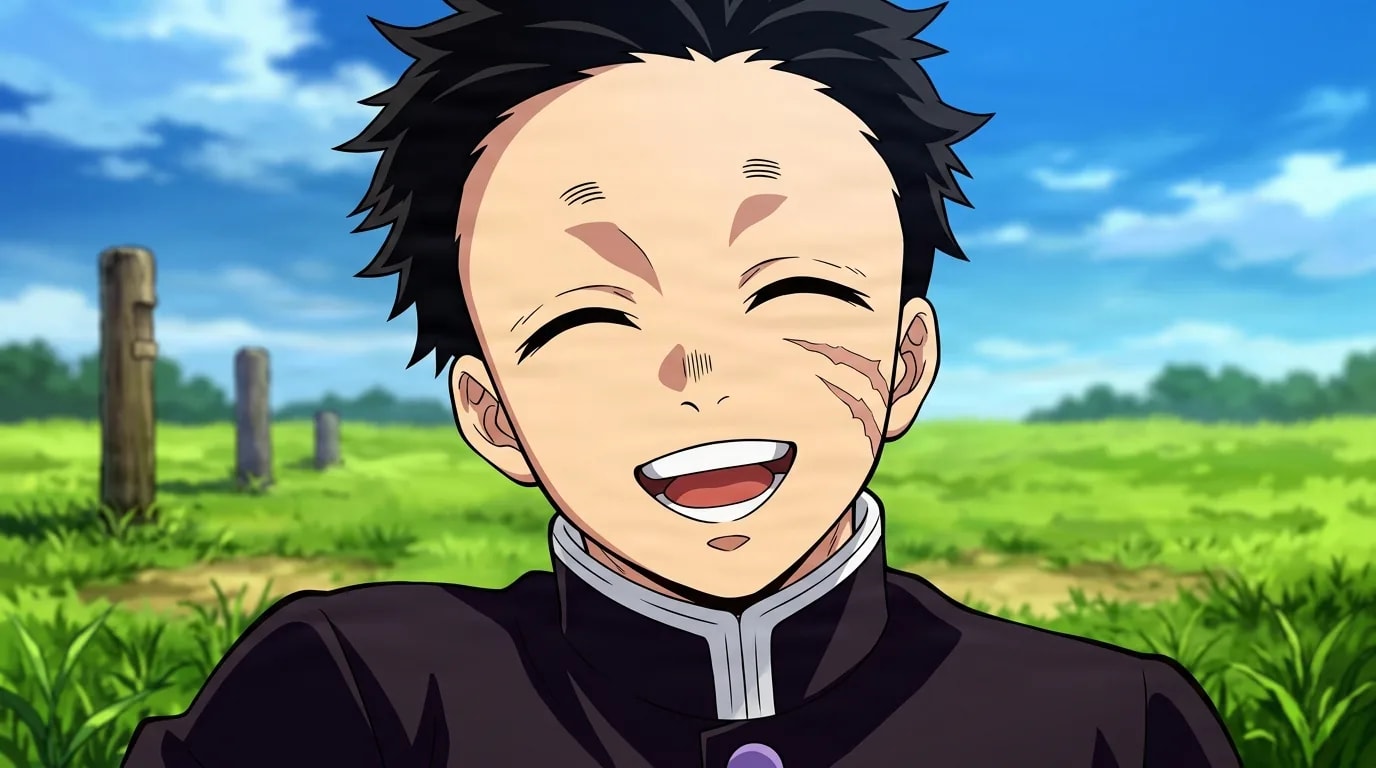
Masachika Kumeno
CharacterMasachika Kumeno is a Wind Breathing swordsman who became a close friend and mentor figure to the young Sanemi Shinazugawa. He died fighting the Lower Rank One demon Ubume before the main story, an event that shaped Sanemi's path to becoming the Wind Hashira.
Appearance
Masachika is a young man of average build with short, spiky black hair. He has small, rounded eyebrows and two noticeable scars on his left cheek, and his mouth is usually set in a cheerful smile.
He wears the standard Corps uniform: a dark gakuran jacket, a white belt, and loose hakama trousers tucked into white cloth wraps around the ankles.
Personality
Masachika is warm and kind, the opposite of Sanemi's harsh, short-tempered nature. He took Sanemi under his wing and connected him with someone who could train him. Jolly and high-spirited, he frequently teased the younger man, inviting him out to eat and urging Sanemi to think of him as an older brother. He was sociable and charming enough to win over a grumpy old man and to amuse Shinobu Kocho with a funny story about Gyomei.
Beneath the playfulness he had a serious side. He was disgusted to learn that Ubume had tortured her own daughter as a human, and grew furious when the demon made excuses and falsely pitied Sanemi over his abusive home. In his final moments his kindness cost him focus when one of Ubume's captives moved to defend her, leaving an opening that proved fatal.
History
Before joining the Corps, Masachika lost a younger brother to demons. On one mission he encountered a young Sanemi, who was chasing the same demon despite not being a slayer and wounding himself to use his rare Marechi blood. Recognizing his potential, Masachika arranged for Sanemi to train under his cultivator and learn Wind Breathing, formally bringing him into the Corps.
The two later confronted Ubume, the former Lower Rank One of the Twelve Kizuki. Though they defeated her, Masachika was killed in the fight. For the victory Sanemi was named Wind Hashira, yet he remained bitter over the loss. Kagaya Ubuyashiki, who memorized the name and story of every fallen slayer, later passed Masachika's will on to Sanemi.
Related Reading
See all
Demon Slayer Infinity Castle Is the Biggest Anime Movie Ever but It Still Lost in Japan
Demon Slayer: Infinity Castle earned $778 million globally and nearly 40 billion yen in Japan, but it still couldn't top Mugen Train's domestic record. Here's why that barely matters....
Super Saiyan Pubes: The Song About Where Super Saiyan Hair Actually Goes
The transformation everyone knows, the follow-up question nobody would touch. Why we made a smooth R&B track about the golden glow Dragon Ball never talks about....
Frequently Asked Questions
Who is Masachika Kumeno in Demon Slayer?
Masachika Kumeno is a Wind Breathing swordsman who became a close friend and mentor figure to the young Sanemi Shinazugawa. He died fighting the Lower Rank One demon Ubume before the main story, an event that shaped Sanemi's path to becoming the Wind Hashira.
What happened to Masachika Kumeno in Demon Slayer?
Masachika Kumeno was killed during the battle against Ubume, the former Lower Rank One of the Twelve Kizuki. Though he and Sanemi defeated the demon, his kindness cost him focus when one of Ubume's captives moved to defend her, leaving a fatal opening.
Who was Sanemi's best friend in Demon Slayer?
Sanemi Shinazugawa's close friend and mentor was Masachika Kumeno, a warm, high-spirited Wind Breathing swordsman. He took Sanemi under his wing, arranged his training, and urged Sanemi to think of him as an older brother.
What is Masachika Kumeno's Breathing Style in Demon Slayer?
Masachika Kumeno uses Wind Breathing. He arranged for the young Sanemi to train under his cultivator and learn the same Wind Breathing style, formally bringing him into the Demon Slayer Corps.
How did Masachika Kumeno die in Demon Slayer?
Masachika Kumeno died fighting the demon Ubume alongside Sanemi. His kindness cost him focus in his final moments when one of Ubume's captives moved to defend her, leaving an opening that proved fatal, though the two had already defeated the demon.
Sources & Information
Looking for more on Masachika Kumeno? The Demon Slayer Wiki on Fandom has a dedicated page with community notes.
View on FandomThis content is original writing by Daddy Jim Headquarters based on the Demon Slayer anime series, manga, and official materials. Episode and chapter references are cited where applicable.
Character and scene imagery on this site is original artwork by Daddy Jim Headquarters, not screenshots or licensed imagery. Official cover art is used on three types of pages for editorial commentary:
- Movie pages: theatrical posters and key visuals, credited to ufotable and Aniplex.
- Game pages: official box art, credited to Sega, Aniplex, and other publishers.
- Manga chapter pages: Jump Comics volume covers, credited to Shueisha and Koyoharu Gotouge.
Official resources:
Help Us Keep This Wiki Accurate
Daddy Jim Headquarters maintains this encyclopedia. If you spot an error, a translation issue, or something that doesn't look right, let us know.