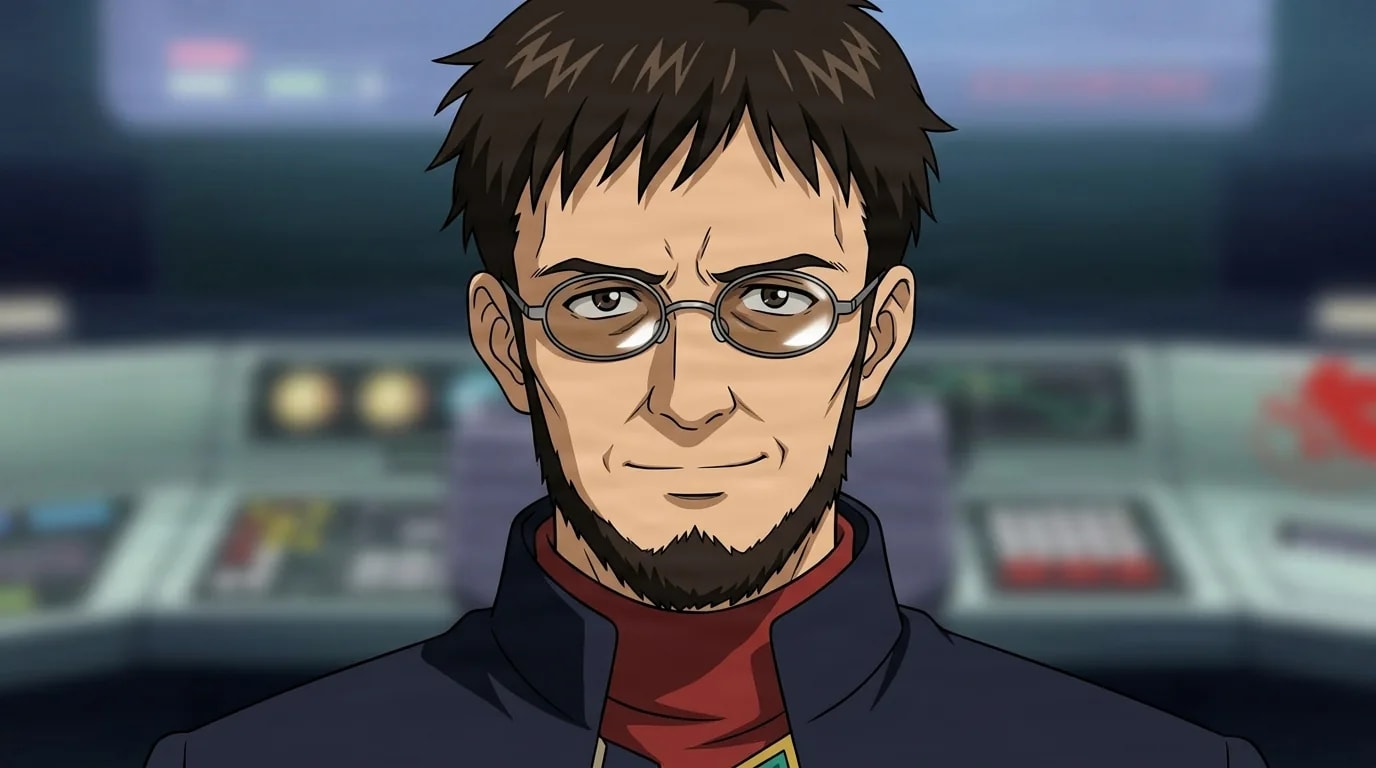
Gendo Ikari
CharacterGendo Ikari commands NERV and stands as the chief antagonist of the Evangelion saga. Father to Shinji and widower of Yui, he steers the Evangelion program and the Human Instrumentality Project toward a single private goal: engineering a reunion with the wife he lost.
Appearance
White gloves are the most revealing part of Gendo's wardrobe. They cover hands that were badly burned when he wrenched open the superheated hatch of Unit-00's ejected entry plug to pull Rei to safety, and he almost never removes them. His eyewear changed over the years as well: squared lenses early on gave way to rounder ones carrying a red or brown tint that catches the glow of NERV's giant displays.
Middle-aged and bearded, he wears his hair in a shape close to his son's. On duty he stays in his black commander's uniform, the jacket edged in gold and marked with green triangular identification pieces at the sleeves and collar, a red sweater visible beneath it. Other clothing rarely appears on him.
Personality
Series creator Hideaki Anno described Gendo as a man who weighs everything against the good of his organization and will reach his goal by fair means or foul. On screen that translates into a chess player's coldness: he maneuvers NERV, SEELE, and the people around him like pieces, discarding anyone whose usefulness has run out, and toward Shinji he is a father in name only, distant to the point of cruelty.
His self-control is near total. Seated, he habitually folds his hands in front of his mouth, and crisis after crisis fails to move his expression. Smiles from him are rare enough to be events; Rei draws a few, and the battle against Sachiel earns exactly one.
The End of Evangelion finally strips the armor away. Every ruthless act has served one purpose, using Third Impact to restore Yui, and in his last moments he grasps that the effort defeated itself: Yui's real wish was a brighter future for Shinji, the very son Gendo spent to get her back. Dying, he confesses that he kept away from the boy because he feared hurting him just as much as Shinji feared him, a symmetry that makes him read as his son's dark adult mirror, with Ryoji Kaji often cited as the positive counterpart. His final words ask Shinji's forgiveness.



History
He begins life as Gendo Rokubungi, a surname meaning sextant, with almost nothing recorded of his youth beyond hints of a difficult upbringing. As a student he meets Yui Ikari and befriends Professor Kozo Fuyutsuki. Gossip holds that Yui's SEELE connections are what drew him, though the story gradually shows the bond ran far deeper. Marrying her at the start of the twenty-first century, he takes the Ikari name, and their son Shinji arrives in 2001. Gendo rises to head Gehirn, but Yui is lost during Unit-01's failed activation test, and the loss remakes him: he sends the toddler Shinji away to live with a teacher, freezes over emotionally, and enters loveless affairs, first with Naoko Akagi, then with Ritsuko, Naoko's daughter, relationships he exploits for leverage and silence.
As NERV's commander he plays the obedient servant of SEELE while quietly building his own road to Third Impact. Adam's embryo ends up grafted into his hand, and his plan is to merge with Rei before Lilith so the event unfolds entirely under his control. In The End of Evangelion the scheme collapses: Rei declares she is no puppet of his, takes Adam from him, and joins with Lilith to begin Instrumentality on her own terms. Confronted by visions of the Reis, Kaworu, and Yui herself, Gendo admits his terror of the invisible bonds people form, and a spectral Unit-01 bites him in two as he speaks his apology to Shinji.
The manga sharpens his cruelty. There he triggers Unit-01's Dummy System against Bardiel with fatal results for Toji Suzuhara, swallows Adam rather than carrying it in his hand, and tells Shinji outright that he never loved him and envied Yui's attention to the boy. After Rei destroys Adam and rejects him, a dying Ritsuko shoots him through the neck; in his final vision Yui prompts him to recall holding the newborn Shinji, the first time love for his son ever touched him, and he dies redeemed by that memory. Lighter spin-offs recast him wholesale: Shinji Ikari Raising Project plays him for comedy as a husband routinely swatted by a living Yui, while Gakuen Datenroku reveals its Gendo as a doppelganger from another universe who replaced a dead original and is finally crushed by falling debris, implied to be Yui's doing.
Related Reading
See all
Naruto vs Luffy: Does the Fight Change if Luffy Tickles Hinata?
Naruto vs Luffy with the twist nobody asked for: Luffy tickled Hinata on date night, and she kind of liked it. We break down the whole fight and commit to a winner....
Piccolo Gets the Namek Hoes: Namek Has No Women, and He Pulls Anyway
There are no women on Namek. That isn't an oversight, it's the biology. Why we handed Piccolo the one thing his own species rules out, and why it had to be trap soul....

Frequently Asked Questions
Did Gendo Ikari actually love Shinji?
Yes, in the end. During his final moments in The End of Evangelion, Gendo admits he loved Shinji as much as he feared hurting him, and the manga later shows a redemptive memory of him first holding his newborn son.
Is Gendo Ikari good or bad?
Gendo Ikari is Evangelion's chief antagonist, a ruthless manipulator who uses NERV, SEELE, and even his own son as pieces toward reuniting with his dead wife Yui, though his final moments reveal genuine remorse.
What happens to Gendo Ikari at the end of Evangelion?
In The End of Evangelion, Gendo's plan collapses when Rei rejects him and merges with Lilith on her own terms. Confronted by visions of Yui and the people he hurt, he apologizes to Shinji as a spectral Unit-01 bites him in two.
What does Gendo Ikari represent in Evangelion?
Gendo Ikari functions as Shinji's dark adult mirror, a man so afraid of hurting his son that he pushed him away entirely, with Ryoji Kaji often cited as his positive counterpart.
Who is the true villain of Evangelion?
Gendo Ikari stands as Evangelion's chief antagonist, steering NERV and the Human Instrumentality Project toward his private goal of reuniting with his late wife Yui, regardless of the human cost.
Sources & Information
Looking for more on Gendo Ikari? The Dragon Ball Wiki on Fandom has a dedicated page with community notes.
View on FandomThis content is original writing by Daddy Jim Headquarters based on the Dragon Ball anime series, manga, and official materials. Episode and chapter references are cited where applicable.
Character and scene imagery on this site is original artwork by Daddy Jim Headquarters, not screenshots or licensed imagery. Official cover art is used on three types of pages for editorial commentary:
- Movie pages: theatrical posters and key visuals, credited to Toei Animation and Shueisha.
- Game pages: official box art, credited to Bandai Namco, Atari, and other publishers.
- Manga chapter pages: Jump Comics volume covers, credited to Shueisha and Akira Toriyama.
Official resources:
Help Us Keep This Wiki Accurate
Daddy Jim Headquarters maintains this encyclopedia. If you spot an error, a translation issue, or something that doesn't look right, let us know.