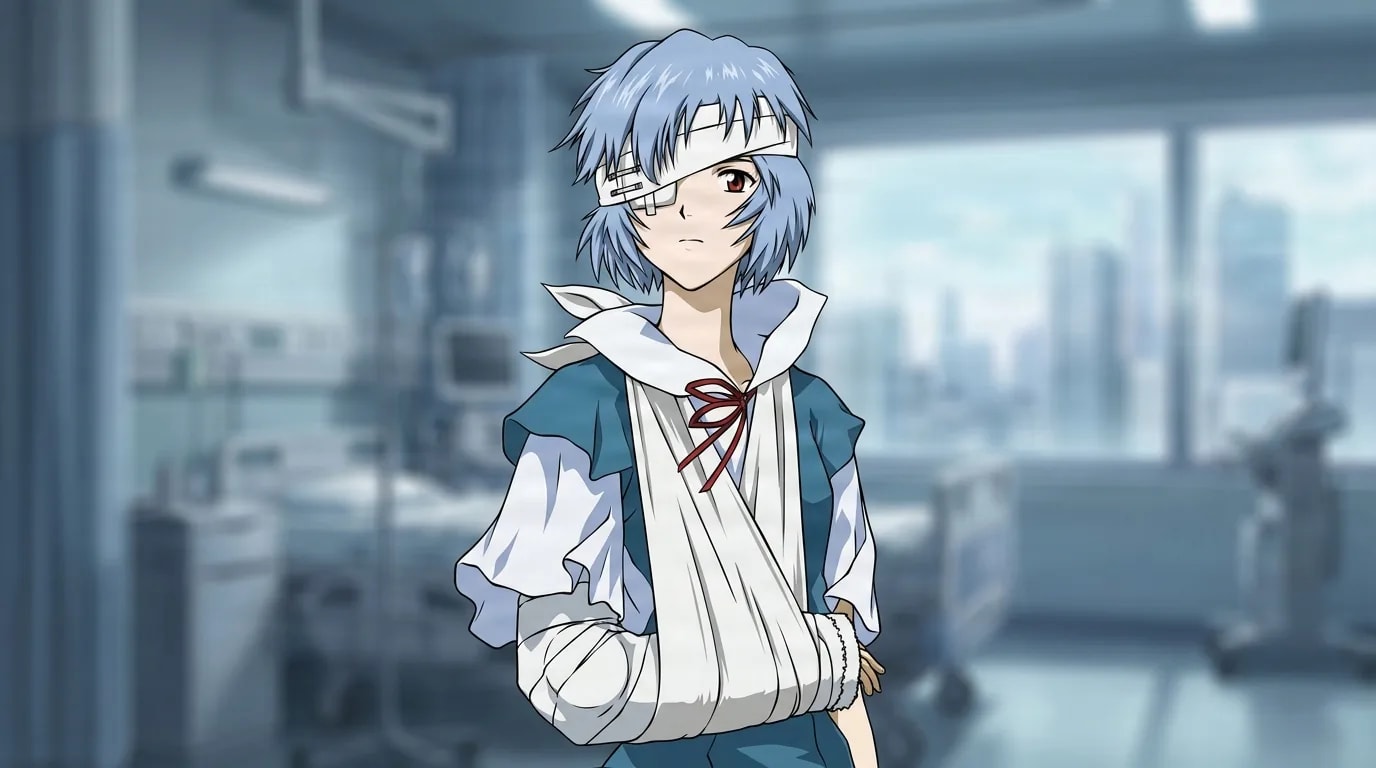
Rei Ayanami
CharacterRei Ayanami is the First Child of Neon Genesis Evangelion, the enigmatic girl who pilots Evangelion Unit-00. Behind her silence lies one of the story's darkest secrets: she is a clone grown from Shinji's mother and the vessel for Lilith's soul, and the fate of Third Impact ultimately rests in her hands.
Appearance
Crimson eyes beneath a pale blue bob give Rei one of the most instantly recognizable faces in anime. Her bangs part at the center of her forehead, her build is slight, and her skin carries an almost bloodless pallor. When Shinji first encounters her she is freshly injured, one arm in a cast and one eye hidden under bandages, an image that became iconic in its own right.
At school she dresses in the standard uniform but swaps in white loafers over black ankle socks, small quirks that distinguish her from her classmates. Character designer Yoshiyuki Sadamoto drew her red eyes and blue hair deliberately as the chromatic inverse of Asuka.
Personality
Rei begins the series so withdrawn that classmates cannot read her at all. She speaks rarely, displays almost no visible emotion, and lives alone in a bleak, barely furnished Tokyo-3 apartment whose emptiness mirrors her inner life. The one person she initially shows any devotion to is Gendo Ikari, though even that bond stays cold and distant. Her bookshelf hints at a private curiosity, holding tagged medical texts on psychology and genetics, including one she reads in German.
Underneath the blankness sits a corrosive fatalism. Convinced she is disposable, she states plainly that a replacement exists if she dies. Hideaki Anno instructed that she be understood as a bitterly unhappy girl with almost no sense of her own presence, and her voice actresses played her not as emotionless but as someone who never learned what emotion is. Contact with Shinji slowly changes her. She smiles genuinely for the first time after the Ramiel battle, later weeps without understanding why, and by the finale has begun choosing her own attachments over the purpose she was built for.

History
The series keeps Rei's origins deliberately murky. Ritsuko reveals only that she came into being in a hidden chamber far below NERV headquarters, while supplementary material explains she was grown from what could be salvaged of Yui Ikari after Yui vanished into Unit-01 in 2004. Gendo presents the small child to his staff in 2010 as the daughter of an acquaintance, and Naoko Akagi remarks on how much the girl resembles Yui. Kaworu Nagisa later tells her they are alike, both human shells carrying inhuman souls: his holding Adam's, hers holding Lilith's. A tank beneath the Dummy System chamber holds rows of soulless spare bodies, and each time Rei dies her soul moves into a fresh one, its memories arriving blurred.
Three incarnations carry the name. The first, still a child, is strangled by Naoko Akagi in 2010. The second is the Rei of most of the television series, who ends her own life detonating Unit-00 with the Angel Armisael caught in the blast. The third awakens afterward and persists through The End of Evangelion, where she abandons Gendo's script for Third Impact and instead gives control of the event to Shinji. Ghostly images of her appear over the dying during the film, and a final spectral Rei watches Shinji and Asuka on the shore in its closing shot. The series finale also imagines an alternate world where she is an ordinary, expressive schoolgirl, a version later explored in the spin-off Angelic Days.
Sadamoto's manga warms her considerably, strongly implying she falls in love with Shinji and framing her as a maternal presence in his life. Other spin-offs push further: Gakuen Datenroku arms her with the Lance of Longinus as a secret Angel-hunter, while Shinji Ikari Raising Project recasts her as a bright, teasing relative of Shinji's. Her cultural footprint is enormous; critics credit her with launching an industry-wide wave of quiet, pale-haired heroines, and merchandise of the bandaged Rei outsold everything else in the franchise's early boom.
Related Reading
See all
Naruto vs Luffy: Does the Fight Change if Luffy Tickles Hinata?
Naruto vs Luffy with the twist nobody asked for: Luffy tickled Hinata on date night, and she kind of liked it. We break down the whole fight and commit to a winner....
Piccolo Gets the Namek Hoes: Namek Has No Women, and He Pulls Anyway
There are no women on Namek. That isn't an oversight, it's the biology. Why we handed Piccolo the one thing his own species rules out, and why it had to be trap soul....
Frequently Asked Questions
Who is Rei Ayanami in love with?
Rei Ayanami's feelings stay ambiguous in the Neon Genesis Evangelion TV series, but Yoshiyuki Sadamoto's manga adaptation strongly implies she falls in love with Shinji Ikari and frames her as a maternal presence in his life.
Is Rei technically Shinji's mother?
No, Rei is not literally Shinji Ikari's mother. She is a clone grown from what could be salvaged of Yui Ikari, Shinji's mother, after Yui vanished into Evangelion Unit-01, which makes Rei genetically linked to Yui rather than his biological parent.
Is Rei still alive at the End of Evangelion?
Not exactly. The third Rei chooses to give control of Third Impact to Shinji rather than follow Gendo's script, but The End of Evangelion closes on only a spectral, ghost-like image of her, suggesting she dissolves into the Instrumentality event rather than surviving intact.
What is the point of Rei in Evangelion?
Rei Ayanami serves as the vessel for Lilith's soul and pilots Evangelion Unit-00 as the First Child. Her choices ultimately decide how Third Impact unfolds, making her central to unraveling NERV's true purpose.
How many times has Rei Ayanami died?
Rei Ayanami dies at least twice across the series. The first incarnation is strangled by Naoko Akagi in 2010, and the second detonates Unit-00 while destroying the Angel Armisael; a third incarnation then awakens and carries the story through The End of Evangelion.
Sources & Information
Looking for more on Rei Ayanami? The Dragon Ball Wiki on Fandom has a dedicated page with community notes.
View on FandomThis content is original writing by Daddy Jim Headquarters based on the Dragon Ball anime series, manga, and official materials. Episode and chapter references are cited where applicable.
Character and scene imagery on this site is original artwork by Daddy Jim Headquarters, not screenshots or licensed imagery. Official cover art is used on three types of pages for editorial commentary:
- Movie pages: theatrical posters and key visuals, credited to Toei Animation and Shueisha.
- Game pages: official box art, credited to Bandai Namco, Atari, and other publishers.
- Manga chapter pages: Jump Comics volume covers, credited to Shueisha and Akira Toriyama.
Official resources:
Help Us Keep This Wiki Accurate
Daddy Jim Headquarters maintains this encyclopedia. If you spot an error, a translation issue, or something that doesn't look right, let us know.
