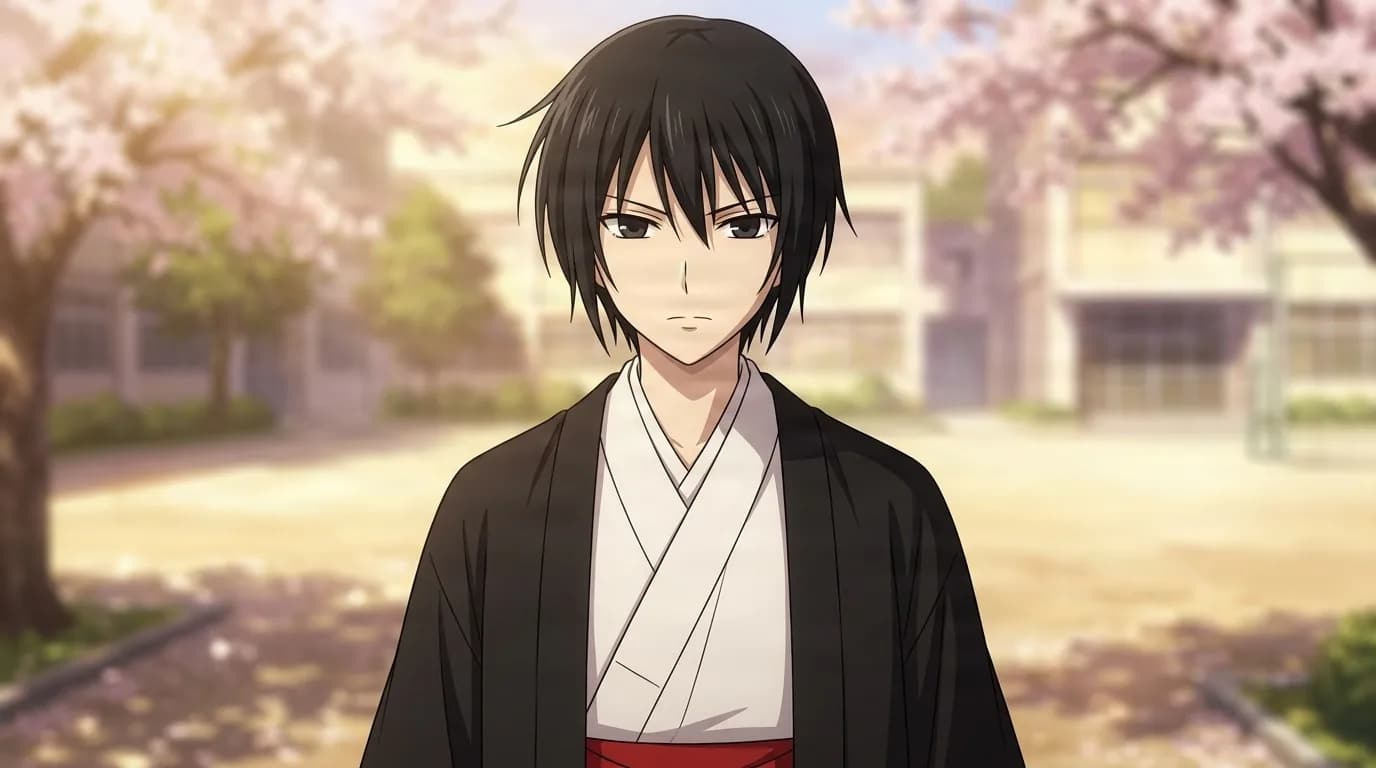
Akito Sohma
CharacterAkito Sohma is the head of the Sohma clan and the central antagonist of Fruits Basket, the human vessel of the Zodiac's God. Raised as a boy by a jealous mother and told by her father that she was destined for endless love, she grows into a cruel, terrified ruler before Tohru's kindness finally frees her.
Appearance
Akito is a tall, fair young woman whose look leans deliberately masculine. For most of the story her black hair barely reaches her nape, with long unkempt bangs shadowing thick lashes and piercing purple eyes, rendered grey in the 2001 adaptation. To disguise a female frame, she piles on layers of men's clothing, sometimes fitted and sometimes oversized. Inside the Sohma estate she favors white robes bound with a black or red obi under a loose black haori cut for men, while away from home she turns to dark turtlenecks or button-up shirts with black trousers and shoes.
Once the curse lifts, she lets her hair grow to her shoulders and moves into traditional feminine dress, a signal that she can finally live openly as a woman. A later cameo in Another shows her in dresses with her hair cropped short again.

Personality
As a child Akito was tender, doting, and spoiled, given to the odd tantrum but sweet at heart. Her father's coddling convinced her she existed to be adored and obeyed, while her mother's relentless cruelty left her starved for love, wandering the household to ask whether anyone truly cared for her. The combined weight of Akira's death, Kureno's curse breaking, and Ren's poison finally shattered that gentleness, and her warmth curdled into instability and malice.
Behind a frail, composed surface, Akito lashes out at the Zodiac to vent her grief and terror, arrogant and manipulative one moment and shrieking the next. She insists the men of the Zodiac owe their devotion to her alone, and she despises other women, seeing her mother in each of them; that jealousy drove her to hurl Rin from a window, beat Kisa bloody, and cost Hatori much of the sight in one eye. She excuses it all by claiming a god answers to no one.
Underneath the tyranny sits a deeply insecure person convinced she has no worth beyond the title of God, clinging to the bonds because Ren swore she would otherwise be alone and unloved. Tohru becomes the first to reach past that fear and accept her, and Akito slowly reclaims the kindness of her childhood, owns her cruelty, and resolves to change. In Another she is a remorseful, gentle mother to Shiki who quietly spends her life atoning.
Related Reading
See all
Naruto vs Luffy: Does the Fight Change if Luffy Tickles Hinata?
Naruto vs Luffy with the twist nobody asked for: Luffy tickled Hinata on date night, and she kind of liked it. We break down the whole fight and commit to a winner....
Namek Has No Women, and Piccolo Pulls Anyway
There are no women on Namek. That isn't an oversight, it's the biology. Why we handed Piccolo the one thing his own species rules out, and why it had to be trap soul....

History
Akito was born the sole child of family head Akira and a maid named Ren, already inhabited at conception by the spirit of the Zodiac's God, whose coming reached Hatori, Shigure, Ayame, and Kureno in shared dreams. Terrified of being replaced in Akira's heart, Ren insisted the girl be presented as a boy and threatened to end the pregnancy to force the point. Akito grew up adoring the warm father who told her she was a special being sure to be loved so long as her bonds held, and loathing the cold mother who fed her insecurity.
Akira's early death left the young Akito alone at his bedside and exposed to Ren's screaming that no one needed her now. A maid handed her an empty box said to hold her father's spirit, a keepsake she guarded for life, and she took his place as head of the family. She kept the Rat, Yuki, first as a treasured playmate and then as a victim, locking him away and convincing him he was worthless. When Kureno's curse suddenly broke, she panicked and begged him never to leave, and over the years her mind gave way entirely.
As the story unfolds, the bonds she depended on begin to snap one after another. Wounded and frantic, she stabs Kureno, flees the estate, and corners Tohru with a knife, only for Tohru to offer friendship instead of blame moments before the unstable cliffside gives way and Tohru falls. Rather than gloat, Akito screams for help, and Tohru's survival and forgiveness turn her toward change. With the curse broken, she reconciles with Shigure, begins living as a woman, and in Another marries him and raises their son Shiki, once shielding the boy from Ren's knife and taking the wound herself.
Frequently Asked Questions
Who does Akito marry in Fruits Basket?
After the curse breaks, Akito Sohma reconciles with Shigure Sohma and the two eventually marry. In the sequel Fruits Basket Another, they are raising their son, Shiki, together.
Why was Akito raised as a boy?
Akito was raised as a boy because her mother, Ren, feared losing her husband Akira's love to their newborn daughter. Ren insisted the child be presented as a son and even threatened to end the pregnancy if Akira did not agree.
What role does Akito play in the Sohma family?
Akito Sohma is the head of the Sohma family and the human vessel of the Zodiac's God, making her the figure the cursed members of the zodiac feel bound to obey and love.
How does Tohru Honda change Akito?
Tohru becomes the first person to see past Akito's cruelty and accept her, which helps Akito slowly reclaim the kindness she had as a child. Akito eventually owns up to her cruelty and resolves to change.
Who are Akito Sohma's parents?
Akito Sohma is the daughter of Akira Sohma, the former head of the family, and Ren, a maid who married him. Ren insisted Akito be raised as a boy, while Akira doted on her and told her she was destined to be loved.
Sources & Information
Looking for more on Akito Sohma? The Fruits Basket Wiki on Fandom has a dedicated page with community notes.
View on FandomThis content is original writing by Daddy Jim Headquarters based on the Fruits Basket anime series, manga, and official materials. Fruits Basket was created by Natsuki Takaya, published by Hakusensha, and animated by TMS Entertainment. All rights to Fruits Basket and its characters belong to their respective owners. Episode and chapter references are cited where applicable.
Rights holders
- Created byNatsuki Takaya
- Published byHakusensha
- Animated byTMS Entertainment
All rights belong to their respective owners.
Character and scene imagery on this site is original artwork by Daddy Jim Headquarters, not screenshots or licensed imagery. Official cover art is used on three types of pages for editorial commentary:
- Movie pages: theatrical posters and key visuals, credited to TMS Entertainment and Hakusensha.
- Game pages: official box art, credited to the game's respective publishers.
- Manga chapter pages: volume covers, credited to Hakusensha and Natsuki Takaya.
Official resources:
Help Us Keep This Wiki Accurate
Daddy Jim Headquarters maintains this encyclopedia. If you spot an error, a translation issue, or something that doesn't look right, let us know.