Chizome Akaguro
CharacterChizome Akaguro hunted the heroes he judged false, killing seventeen of them and crippling twenty-four more under the name Stain. His creed, that only conviction earns the title, outlived his capture and pulled a wave of criminals toward the League of Villains he had refused to join.
Appearance
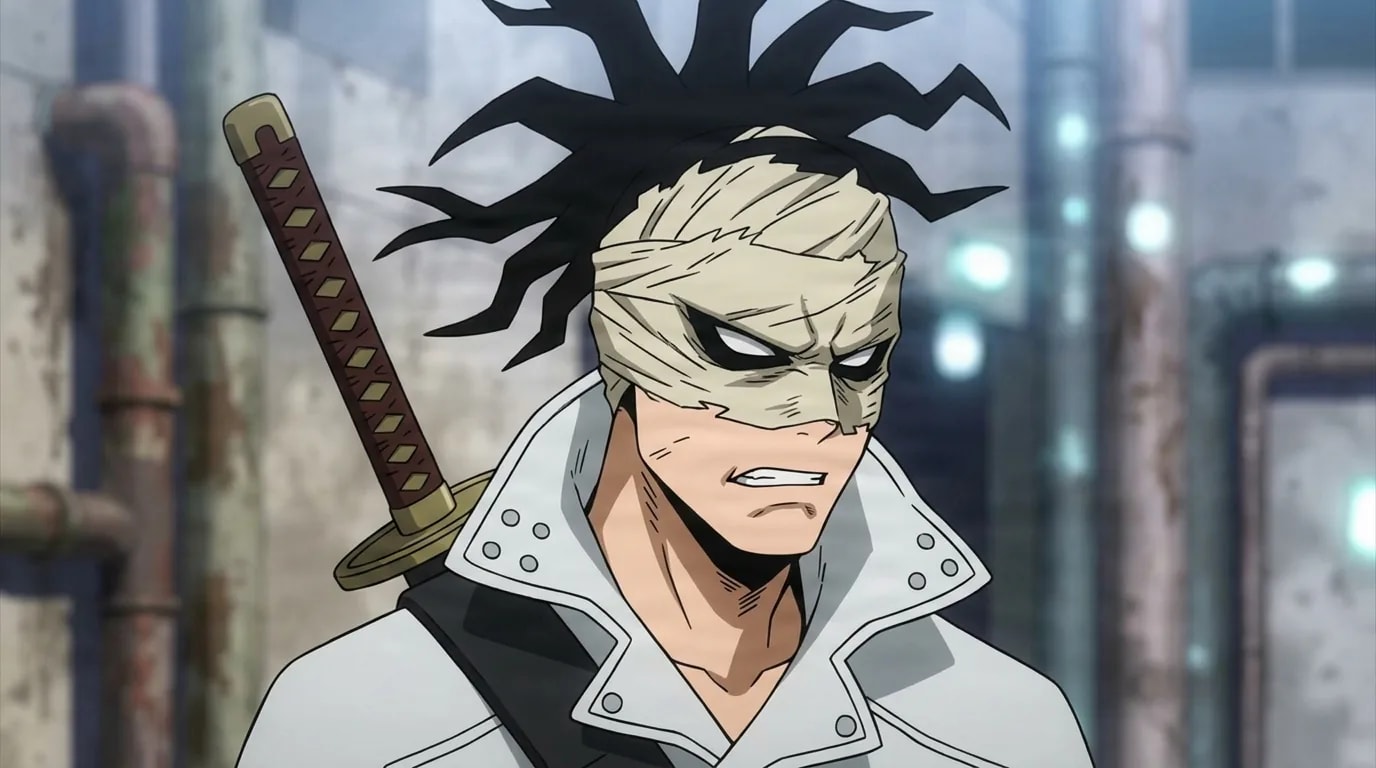
Stain moved with a pronounced stoop, and up close the face under his mask was the worst of him: flat, faintly triangular, missing the nose he had cut away himself, with a tongue far too long for it and studded with small papillae. His eyes were red in the anime and white on the page, small, the irises smaller still. Black hair hung long and unkempt, held off his features only by the headband and the cloth across his mouth.
He fought in dark armored gear, metal plating bolted over it as weapon mounts, the torso cut sleeveless so he could wrap his arms in yellow bandage from shoulder to wrist. Black wristbands, a watch on the left, steel knee guards, and spiked plated boots completed it. The blood-red scarf and matching headband were his signature.
The man who walked out of Tartarus dressed differently: a loose white jacket with overlong sleeves, bandaged forearms, red gloves, navy trousers, red kneepads, and boots trimmed in white. A katana rode on a belt across his chest and a short machete on another at his hip, and his hair was gathered into a tail behind the mask.
Years earlier, as Stendhal, that hair was longer and neatly bound, and he wore black and red gear resembling body armor with six folding knives split evenly across his sides above two pairs of pockets. A mask covered his face completely. Out of costume he was ordinary to the point of invisibility: collared shirt, beige trousers, a cap, and a bag holding his weapons alongside a sheathed katana with a carrying handle.
Personality
What drove him was a conviction he never doubted: that the title of hero belongs only to people who act without thought of money or applause, and that everyone else wearing it is rot to be cut out. All Might alone escaped his contempt. He knew perfectly well that murder was wrong and did it anyway, casting himself as the man who has to be stained so the rest of society can be clean, a martyr in his own accounting. He offered his life to the retired All Might and said plainly that no other hand would be permitted to take it.
The vigilante Stendhal came first, working from the rule that power without conviction makes a sinner, and calling the executions that followed heroism rather than hypocrisy. He would work beside criminals like Kuin Hachisuka when it served the purge, and he felt something like kinship with other vigilantes, pulling Koichi Haimawari away from Akira Iwako and recognizing his own road in Knuckleduster, though none of that would have stopped him from killing either man. Under the mask he considered himself a separate being, judgment given a body, while the man beneath it was a common civilian who merely believed in what heroes were supposed to mean. Knuckleduster broke that arrangement by telling him that anyone hiding behind a false face is a phony on a power trip. He took it to heart, cut away his broken nose, let the two selves collapse into one, and became Stain.
He was not indiscriminate. Killing without cause disgusted him, which is what put him at odds with Tomura Shigaraki, and he had no interest in Tenya Ida until the boy provoked him. He lectured Tenya about hunting revenge for his brother Tensei rather than saving Native, spared Izuku Midoriya for showing the strength, honor, and instinct he thought a hero required, and let Tomura live after sensing a genuine, if warped, conviction in him. Creeds were everything to him; without one, he held, a person is weak and will simply be weeded out. His sheer force of will radiated as bloodlust strong enough to freeze veteran heroes in place, and even from a cell his recorded speech pulled criminals and vigilantes toward the League of Villains in numbers.
He would also stand with heroes when something worse was loose. During the Tartarus break he refused All For One's side, gathered intelligence on the escapees, and promised a dying guard the data would reach the right hands. His admiration had never been about power, he said, but about the smile and the effort All Might put into helping people. At the end he threw himself into All Might's last fight against All For One, and, broken and dying, called the man his everything before holding out his arms and telling him to live and win.
Abilities
Overall Abilities: Nobody had killed more heroes since All Might arrived. Seventeen Pro Heroes died by his hand and twenty-four more never fully recovered, among them Tensei Ida, whose defeat left him paraplegic and closed the Hero Killer's tally. Stain fought with misdirection, relentless pressure, and a read on what his opponent would do next, using terrain and surprise to make up for a Quirk that demanded he draw blood first. When Tomura Shigaraki tried to recruit him and got a refusal, Stain put both him and Kurogiri down without much trouble.
In Hosu City he had Native cornered when Tenya Ida arrived seeking revenge and was swiftly beaten for it. Izuku Midoriya's timing saved the boy's life; Stain blindsided the newcomer anyway and paralyzed him, then chose not to finish him. Shoto Todoroki proved the harder problem, alternating fire and ice, and the delay let Bloodcurdle lapse on Izuku. With Tenya free of both the paralysis and his own thirst for vengeance, three of U.A.'s best fought the Hero Killer at once, and it took all three to bring him down. Beaten, ribs through his lungs, he still tore loose in time to kill the Winged Nomu that had snatched Izuku out of the air.
Speed, Strength, and Endurance: His speed was what his enemies remembered. He slipped Tenya's opening kick and partly blocked a Recipro Burst from the fastest student at U.A., and Shoto could not land a single hit or even entertain retreat. Only Recipro Extend paired with a five-percent Detroit Smash caught him, and Shoto suspected desperation played a part. He sheared cleanly through Shoto's ice, shrugged off that same Detroit Smash to the head, stayed upright after losing consciousness, and swam the whole distance from Tartarus to dry land. After All For One hurled him through several city blocks he held on long enough to say one last thing to All Might. Despite the ruin of his nose his sense of smell was extraordinary, sharp enough to memorize All Might's scent in Kamino and, much later, to identify stray blood on a battlefield as All For One's rather than All Might's.
Bloodcurdle: Tasting a target's blood locked their body in place. Duration depended on blood type, shortest for O, then A, then AB, with B lasting longest, and eight minutes was the ceiling for anyone. He read the chaos in Hosu correctly as Tomura's work, noted that Shoto leaned so hard on Half-Cold Half-Hot's destructive force that he became easy to predict, and carried a hidden blade for the moment an opponent stripped him of his weapons. In the Final War the Quirk froze a rewound All For One long enough for Stain to go for his head, until the Symbol of Evil swapped his own blood type to break the paralysis, overpowered him, and took Bloodcurdle along with his life.
Equipment: Before his arrest he carried a worn katana, five daggers, throwing knives, folding knives, and boots spiked at the toe. Afterward he traveled lighter, with the katana, a small machete, and throwing knives. He also flew a Detnerat glider stolen off some hooligans while wandering Japan, riding it above the battlefields of the Final War to reach All Might.
Related Reading
See all
Naruto vs Luffy: Does the Fight Change if Luffy Tickles Hinata?
Naruto vs Luffy with the twist nobody asked for: Luffy tickled Hinata on date night, and she kind of liked it. We break down the whole fight and commit to a winner....
Piccolo Gets the Namek Hoes: Namek Has No Women, and He Pulls Anyway
There are no women on Namek. That isn't an oversight, it's the biology. Why we handed Piccolo the one thing his own species rules out, and why it had to be trap soul....
Frequently Asked Questions
What is Chizome Akaguro's Quirk?
Chizome Akaguro's Quirk was Bloodcurdle, which let him paralyze a target's body simply by tasting their blood, with the paralysis lasting up to eight minutes depending on the victim's blood type. He lost the Quirk when All For One killed him and took it during the Final War.
How did Stain lose his nose?
Stain cut away his own nose after the vigilante Knuckleduster told him that hiding behind a mask made him a phony chasing a power trip. He took the words to heart and let his masked persona and his civilian self collapse into a single identity.
Was Stain killed by All For One?
Yes, Stain was killed by All For One during the Final War. After Stain paralyzed a rewound All For One with Bloodcurdle, All For One swapped his own blood type to break free, overpowered him, and took his life along with his Quirk.
Is Chizome Akaguro Stain?
Yes, Chizome Akaguro is the Hero Killer known as Stain. He hunted heroes he judged unworthy of the title, killing seventeen and crippling twenty-four more before his eventual capture.
What is Chizome Akaguro's real name?
Chizome Akaguro is the real name of the villain known as Stain, the Hero Killer, who also went by the alias Stendhal earlier in his career as a vigilante.
Sources & Information
Looking for more on Chizome Akaguro? The Dragon Ball Wiki on Fandom has a dedicated page with community notes.
View on FandomThis content is original writing by Daddy Jim Headquarters based on the Dragon Ball anime series, manga, and official materials. Episode and chapter references are cited where applicable.
Character and scene imagery on this site is original artwork by Daddy Jim Headquarters, not screenshots or licensed imagery. Official cover art is used on three types of pages for editorial commentary:
- Movie pages: theatrical posters and key visuals, credited to Toei Animation and Shueisha.
- Game pages: official box art, credited to Bandai Namco, Atari, and other publishers.
- Manga chapter pages: Jump Comics volume covers, credited to Shueisha and Akira Toriyama.
Official resources:
Help Us Keep This Wiki Accurate
Daddy Jim Headquarters maintains this encyclopedia. If you spot an error, a translation issue, or something that doesn't look right, let us know.