Den Den Mushi
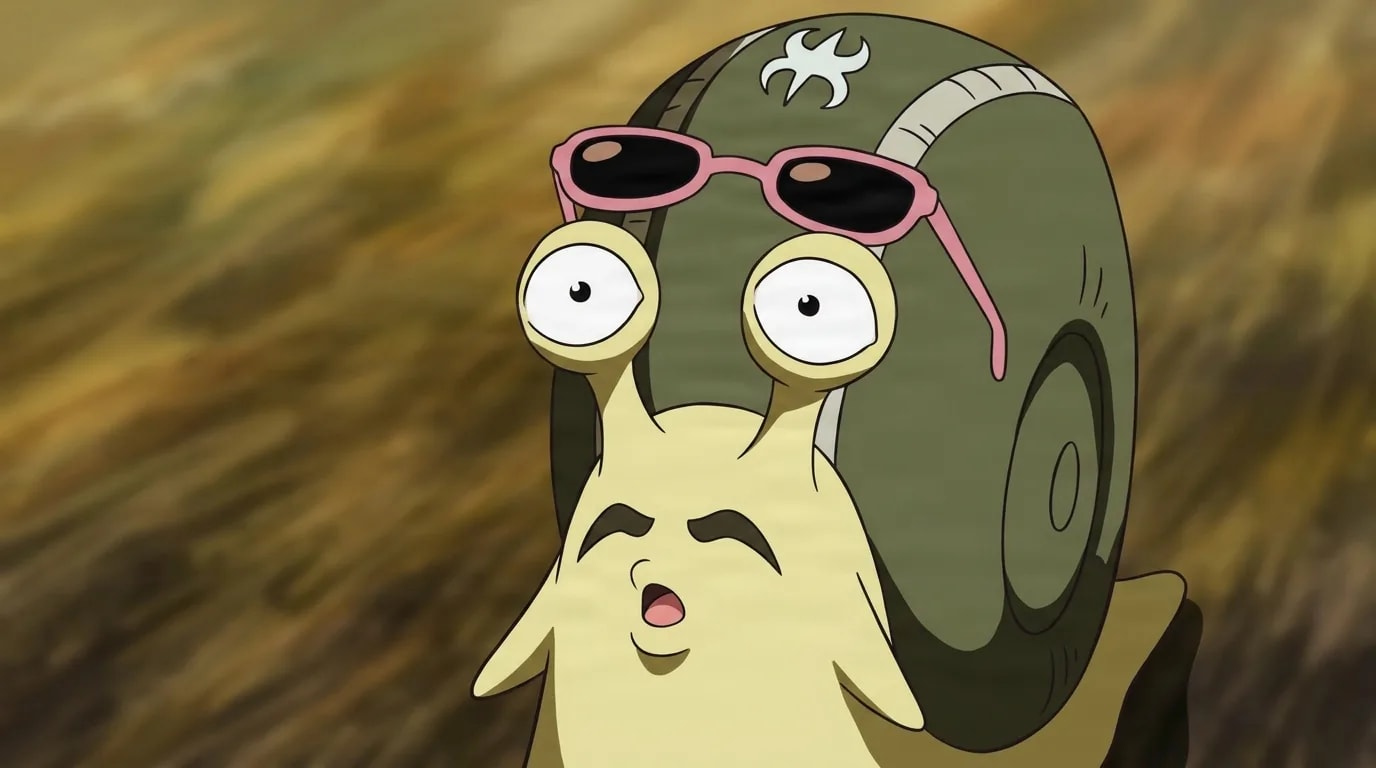
CharacterDen Den Mushi, known in English as Transponder Snails, are a telepathic snail species used worldwide to communicate. Once dials and receivers are attached, they behave like telephones, and numerous specialized breeds handle audio, video, surveillance, and recording.
Appearance
About as large as an ordinary house cat, the common variety carries its dialing gear and receiver inside the shell, though in rarer cases a separate device is plugged into the back of the head. Shell colors and markings differ enormously and owners often personalize them, the Marines for instance branding their crest onto theirs. Their size means the snails are normally left resting on a desk, with people devising makeshift ways to carry them when the need arises.
The name comes from an old Tokyo folk word for snails, which Oda combined with fresh kanji standing for electric, communication, and insect. Officially they fall under type B animals, labeled small and friendly. Their look draws on real land snails, unlike the tower-shell sea snails that inspired Wano's Tanishi, and Elbaph's giants rely on a much bigger cousin, the Dengo Mushi, whose segmented shell recalls a woodlouse and stands roughly as tall as a human.



Personality
By nature these snails are sluggish, dozing whenever idle and occasionally nodding off only seconds after a call wraps up. They have no objection to being kept, since the trade gives them steady meals, and their attachments come off harmlessly at any time so they can be released back into the wild. An incoming signal draws a purururu noise styled after an old-fashioned ring, while lifting or setting down the receiver produces a gacha click.
These creatures do far more than carry sound. During a call a snail conveys the speaker's feelings, telltale facial features, and even wounds, and according to its mood it may disguise itself or copy the look of someone nearby. They also have dedicated signals, such as an S.O.S. that sets them sobbing aloud. Just how clever they are stays uncertain, yet they obey commands, can learn to tune their ring volume or hush on cue, and in dire moments reveal emotions like terror and thankfulness, as one of Buggy's mistreated snails did at Marineford.

Abilities
Every snail's defining trait is long-distance telepathic contact, seemingly through electric signals, joined to an uncanny knack for reproducing speech down to a person's exact voice. Punching in a number opens a link to the matching snail, just as a phone would, and a healthy specimen can span entire oceans, while fancier setups can even relay documents and photos in the manner of a fax. Their signals are not foolproof: Black Den Den Mushi tap into them, figures such as Aramaki can seize and override them, Doflamingo's Bird Cage cuts off distant transmission, and being alive they can sicken or be downed by Supreme King Haki.
A wide array of biological variants exists. On the audio side sit the wearable Baby, the eavesdropping Black, the encrypting White, the jamming Horned, the cold-hardy Snow, plus earpiece and megaphone forms. The visual breeds revolve around the Cameko, a young snail that captures and stores footage, and the larger Proko that projects those feeds, together with Surveillance and Projector types and Vegapunk's globe-reaching Transmission model. Rarest are the Golden and Silver pair: one press of the button on the solid-gold snail unleashes the World Government's feared Buster Call and sets off the alarm on its silver mate, a power reserved for those of Admiral rank or higher.
Related Reading
See all
The Most Popular Women of One Piece: A Fan's Journey Through Anime's Greatest Female Characters...
When I first decided to commit to watching One Piece seriously, I knew I was embarking on one of anime's longest and most beloved series. With over 100...

Super Saiyan Pubes: The Song About Where Super Saiyan Hair Actually Goes
The transformation everyone knows, the follow-up question nobody would touch. Why we made a smooth R&B track about the golden glow Dragon Ball never talks about....


Frequently Asked Questions
What is a Den Den Mushi in One Piece?
Den Den Mushi, known in English as Transponder Snails, are a telepathic snail species used across the One Piece world to communicate. Once dials and receivers are attached to their shells, they function like telephones, with specialized breeds handling audio, video, surveillance, and recording.
Are Den Den Mushi rare or common?
Most Den Den Mushi, like the common shell-dwelling variety used as everyday telephones, are common and found worldwide. A handful of specialized breeds are much rarer, most notably the Golden and Silver Den Den Mushi, which trigger the World Government's feared Buster Call and are reserved for Admiral rank or higher.
Do Den Den Mushi need to eat?
Yes, Den Den Mushi need to eat, and keeping one as a communication device provides it with steady meals rather than mistreatment. Their attachments can also be removed harmlessly at any time, letting them be released back into the wild.
What does Den Den Mushi mean in Japanese?
The name Den Den Mushi comes from an old Tokyo folk word for snails, which creator Eiichiro Oda combined with kanji meaning electric, communication, and insect. Its literal meaning is rendered as Electric Transmission Bug, reflecting its role as a living telephone.
What are the different types of Den Den Mushi?
Den Den Mushi come in many specialized breeds. Audio types include the wearable Baby, eavesdropping Black, encrypting White, jamming Horned, and cold hardy Snow varieties, while visual types include the recording Cameko and projecting Proko, alongside the rare Golden and Silver Den Den Mushi used to trigger a Buster Call.
Sources & Information
Looking for more on Den Den Mushi? The One Piece Wiki on Fandom has a dedicated page with community notes.
View on FandomThis content is original writing by Daddy Jim Headquarters based on the One Piece anime series, manga, and official materials. Episode and chapter references are cited where applicable.
Character and scene imagery on this site is original artwork by Daddy Jim Headquarters, not screenshots or licensed imagery. Official cover art is used on three types of pages for editorial commentary:
- Movie pages: theatrical posters and key visuals, credited to Toei Animation and Toei Company.
- Game pages: official box art for the One Piece console and mobile games, credited to Bandai Namco.
- Manga chapter pages: Jump Comics volume covers, credited to Shueisha and Eiichiro Oda.
Official resources:
Help Us Keep This Wiki Accurate
Daddy Jim Headquarters maintains this encyclopedia. If you spot an error, a translation issue, or something that doesn't look right, let us know.