Uta
CharacterUta is a globe-spanning singing sensation who grew up among Shanks' Red Hair Pirates before being left on the island of Elegia to train. After rising to fame, she turns her adoring audience into the engine of a utopian scheme, serving as the central villain of One Piece Film: Red.
Appearance
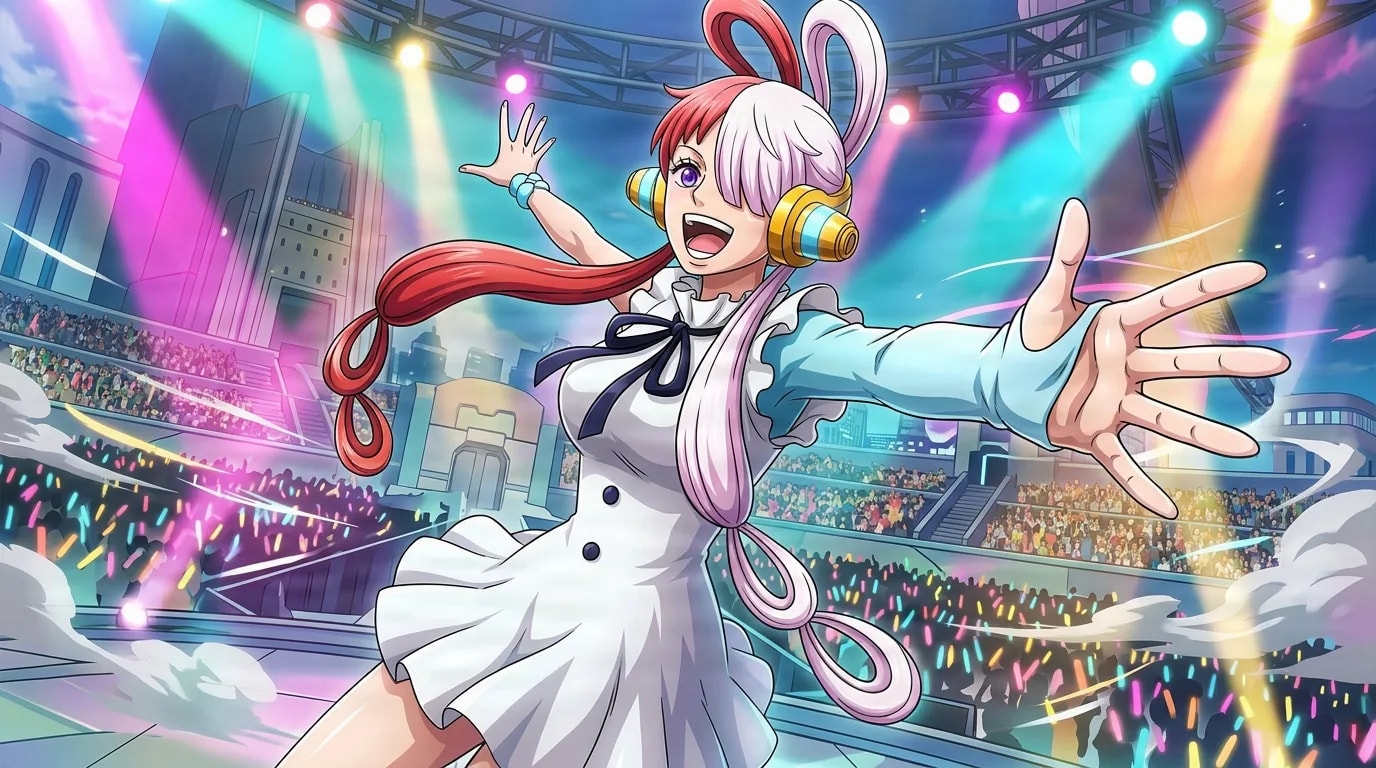
A performer of medium build, Uta has bright purple eyes and hair split down the middle of her scalp into two clean colors, white running along her left side and red along her right. She gathers the strands into a pair of long ponytails capped with round braids, with matching circular braids near the top of her head, and the white portion drapes over and hides her left eye. At times feathered wings sprout behind her, the one on the right pink and the one on the left white.
Her usual costume is a short white dress reaching her upper thighs, trimmed with a frilled neckline and closed down the front by a black bow and a row of buttons. A light blue sleeve covers her entire left arm and carries a childhood drawing by Luffy of Shanks' own straw hat. Golden cone-shaped headphones banded in pale blue sit over her ears, and on occasion she has worn a multicolored jacket scattered with various designs.
Personality
Bright, self-assured, and idealistic, Uta has adored music since she was an infant and delights in sharing her voice with everyone nearby. She prizes human connection above almost all else and will go to any length to lift up the people she loves. Once she began performing and gathering followers, she lived for their encouragement, and that devotion grew into her plot to abolish the Great Pirate Era so the suffering pirates caused her fans would vanish. Even after she discovered her father and his crew had not cruelly abandoned her, she pressed ahead for the sake of her audience.
Her vision of peace was shaped by an adolescence spent in isolation on Elegia, leaving her ignorant of much of the world and willing to go to extremes her own fans found unsettling. Her New Genesis plan called for slowly killing herself so that nearly everyone alive could dwell forever in a dreamworld. Confidence frequently tipped into arrogance, and she feared neither the Marines nor the Celestial Dragons, striking at Saint Charlos without hesitation. As Sanji noted, her steady intake of wake-shrooms eroded her emotional control, and during her final clashes she swung between fits of laughter and rage. After Tot Musica was beaten, remorse overtook her, and she chose to free everyone trapped in Uta World rather than save her own life.
History
Nineteen years before the present, pirates raided Uta's hometown and killed her parents, then seized the toddler. When that crew crossed paths with the Red Hair Pirates and lost, Shanks found the two-year-old hidden in a treasure chest and, recalling how he himself had been discovered as a baby, raised her as his daughter. She became the crew's musician and, before turning nine, ate the Uta Uta no Mi. The pirates set up at Foosha Village, where she met and befriended a young Luffy through a string of childhood competitions.
Later the crew brought her to Elegia, where she unknowingly released the demon Tot Musica, which leveled the island. To shield her from the blame, Shanks publicly took responsibility, left her with the survivor Gordon, and departed with the treasure, leaving Uta convinced she had been betrayed. Over the following decade she became a worldwide singer, and using salvaged Den Den Mushi she broadcast her music and devised New Genesis. At her first live concert she pulled listeners into Uta World and reunited with Luffy, but his refusal to abandon piracy turned her hostile. After summoning Tot Musica and being consumed by it, she was freed when an alliance led by Luffy and Shanks destroyed the demon. She then sang everyone back to reality, reconciled with Shanks, and departed aboard the Red Force, her ultimate fate left unknown.
Related Reading
See all
The Most Popular Women of One Piece: A Fan's Journey Through Anime's Greatest Female Characters...
When I first decided to commit to watching One Piece seriously, I knew I was embarking on one of anime's longest and most beloved series. With over 100...
Super Saiyan Pubes: The Song About Where Super Saiyan Hair Actually Goes
The transformation everyone knows, the follow-up question nobody would touch. Why we made a smooth R&B track about the golden glow Dragon Ball never talks about....

Frequently Asked Questions
Is Uta still alive in One Piece?
Uta's ultimate fate is left unknown; after Tot Musica was destroyed she sang everyone in Uta World back to reality, reconciled with Shanks, and departed aboard the Red Force.
Is Luffy in love with Uta?
The story does not portray Luffy and Uta as romantically involved; they are childhood friends who met and competed together at Foosha Village before reuniting years later at her first concert.
Is Uta Shanks' real daughter?
Uta is not Shanks' biological daughter; pirates killed her real parents when she was a toddler, and Shanks found her hidden in a treasure chest and raised her as his own.
Why did Uta turn evil in One Piece?
Uta grew up isolated on Elegia and came to believe pirates caused all of her fans' suffering, so she devised the New Genesis plan to trap nearly everyone in a permanent dreamworld and end the Great Pirate Era, even at the cost of her own life.
What Devil Fruit does Uta have?
Uta ate the Uta Uta no Mi, a Paramecia Devil Fruit meaning song, before she turned nine years old.
Sources & Information
Looking for more on Uta? The One Piece Wiki on Fandom has a dedicated page with community notes.
View on FandomThis content is original writing by Daddy Jim Headquarters based on the One Piece anime series, manga, and official materials. Episode and chapter references are cited where applicable.
Character and scene imagery on this site is original artwork by Daddy Jim Headquarters, not screenshots or licensed imagery. Official cover art is used on three types of pages for editorial commentary:
- Movie pages: theatrical posters and key visuals, credited to Toei Animation and Toei Company.
- Game pages: official box art for the One Piece console and mobile games, credited to Bandai Namco.
- Manga chapter pages: Jump Comics volume covers, credited to Shueisha and Eiichiro Oda.
Official resources:
Help Us Keep This Wiki Accurate
Daddy Jim Headquarters maintains this encyclopedia. If you spot an error, a translation issue, or something that doesn't look right, let us know.