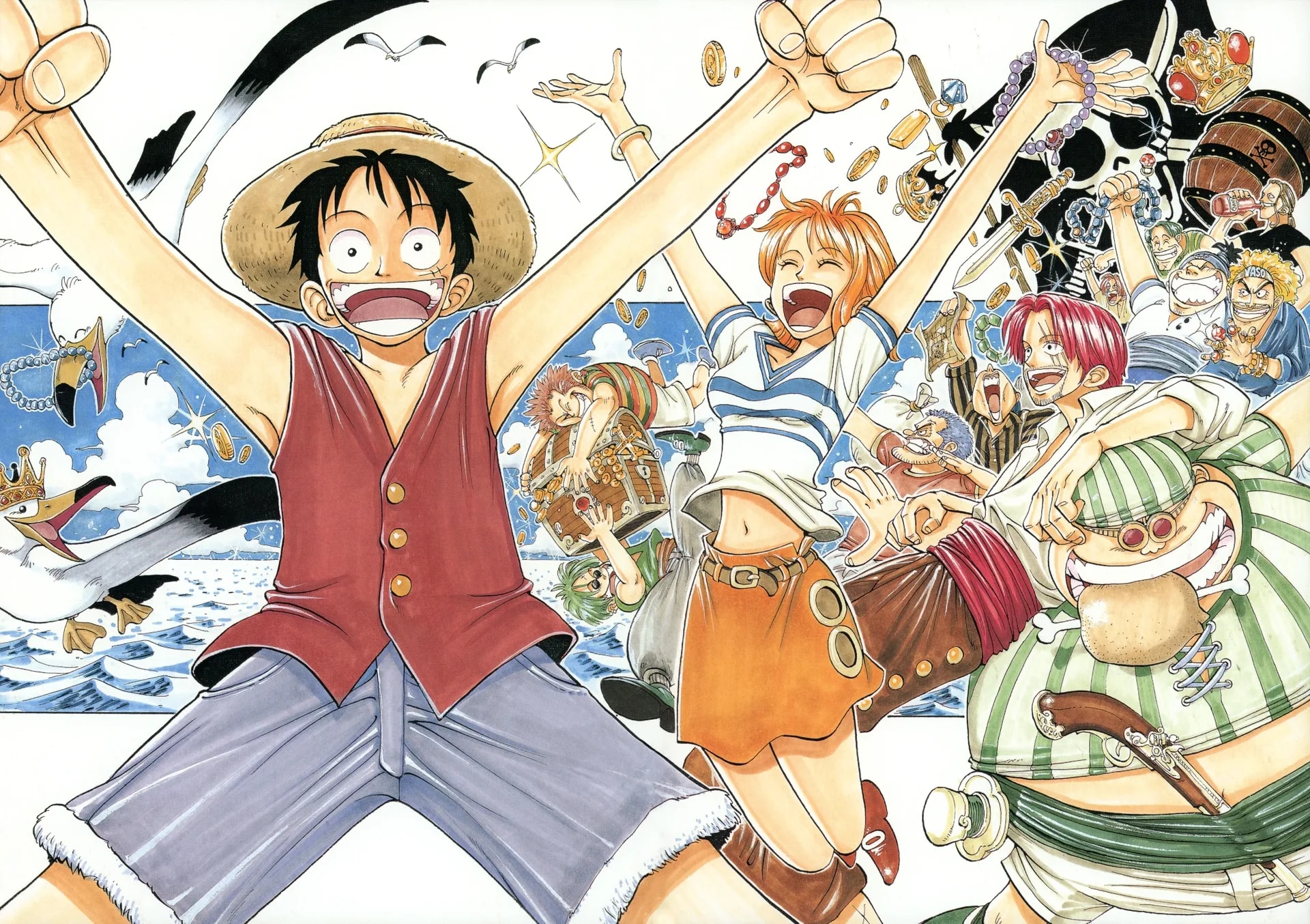
The debut installment introduces a young, rubber-bodied Monkey D. Luffy and his idol, the pirate Shanks. It follows the boyhood ordeal that forges his dream and, a decade on, the morning he finally rows out to seek the crown of Pirate King.
Summary
Having gathered every scrap of fame, riches, and power a pirate could hold, Gold Roger met his end before a public crowd, and his parting words lit the world on fire: his fortune, he declared, waits out there for whoever dares search the whole sea for it. That announcement set the Great Pirate Era in motion. Years later the Red Hair Pirates settle for a stretch in the sleepy port of Foosha Village, where a local boy keeps pestering captain Shanks for a place aboard. Shrugged off again, Luffy drives a knife beneath one eye to prove his grit. While snacking in the bar he then bolts down a spiral-marked fruit lifted from an enemy vessel, which turns out to be the Gomu Gomu no Mi, a Devil Fruit that renders his frame elastic but strips away his ability to swim for life.
Key Events
When the mountain bandit Higuma humiliates Shanks in the tavern and the captain declines to retaliate, a disgusted Luffy storms off. Higuma later returns, captures the boy after he attacks, and hauls him out to sea in a small boat. A towering Sea King, the Lord of the Coast, swallows the bandit whole and then turns on Luffy, but Shanks reaches him just in time, snatching him clear and routing the beast with a single glare, a rescue that costs the captain his left arm. Moved by the sacrifice, Luffy accepts that he is not yet fit for the sea. As the crew prepares to leave the village for good, he vows to assemble his own band, outdo Shanks, and claim the title of Pirate King. Impressed, Shanks settles his prized straw hat on the boy's head and asks for its return once Luffy has become a great pirate.
Notes
Ten years on, a teenaged Luffy pushes off from that same harbor, swats the Lord of the Coast aside with a punch he calls Gomu Gomu no Pistol, and proclaims his ambition to the open horizon, picturing a crew of roughly ten and a flag of his own. It stands as the series' opening chapter, the start of the East Blue Saga and of the Romance Dawn Arc alike. In keeping with Weekly Shonen Jump's custom for a premiere, it far outruns a normal weekly entry and stays the longest chapter to date, carrying unusually heavy color work. It is now and then called Romance Dawn, Version 3, a nod to the two earlier one-shot prototypes, and Nami appears on its cover yet not within the story, a remnant of Oda's abandoned plan to cast her as Luffy's first recruit.
Related Reading
See all
The Most Popular Women of One Piece: A Fan's Journey Through Anime's Greatest Female Characters...
When I first decided to commit to watching One Piece seriously, I knew I was embarking on one of anime's longest and most beloved series. With over 100...
Super Saiyan Pubes: The Song About Where Super Saiyan Hair Actually Goes
The transformation everyone knows, the follow-up question nobody would touch. Why we made a smooth R&B track about the golden glow Dragon Ball never talks about....
Frequently Asked Questions
Why is One Piece Chapter 1 called Romance Dawn?
Chapter 1 carries the title Romance Dawn as a continuation of the name Oda used for his two earlier one-shot prototypes, and it is sometimes referred to as Romance Dawn, Version 3, marking the true start of Luffy's pirate adventure.
Is Romance Dawn the first part of One Piece?
Yes, Romance Dawn is Chapter 1, the opening chapter of the One Piece manga and the start of both the Romance Dawn Arc and the East Blue Saga.
Is One Piece Romance Dawn canon?
Yes, this Romance Dawn is the official canon opening chapter of One Piece, distinct from Oda's two earlier non-canon one-shot prototypes that shared the same title.
What Devil Fruit does Luffy eat in Chapter 1?
Luffy eats the Gomu Gomu no Mi, a Devil Fruit taken from an enemy ship that turns his body to rubber while permanently taking away his ability to swim.
How does Luffy get his straw hat in Chapter 1?
After saving Luffy from the Lord of the Coast at the cost of his own arm, Shanks places his treasured straw hat on Luffy's head and tells him to return it once he has become a great pirate.
Sources & Information
Looking for more on Chapter 1: Romance Dawn? The One Piece Wiki on Fandom has a dedicated page with community notes.
View on FandomThis content is original writing by Daddy Jim Headquarters based on the One Piece anime series, manga, and official materials. Episode and chapter references are cited where applicable.
Character and scene imagery on this site is original artwork by Daddy Jim Headquarters, not screenshots or licensed imagery. Official cover art is used on three types of pages for editorial commentary:
- Movie pages: theatrical posters and key visuals, credited to Toei Animation and Toei Company.
- Game pages: official box art for the One Piece console and mobile games, credited to Bandai Namco.
- Manga chapter pages: Jump Comics volume covers, credited to Shueisha and Eiichiro Oda.
Official resources:
Help Us Keep This Wiki Accurate
Daddy Jim Headquarters maintains this encyclopedia. If you spot an error, a translation issue, or something that doesn't look right, let us know.