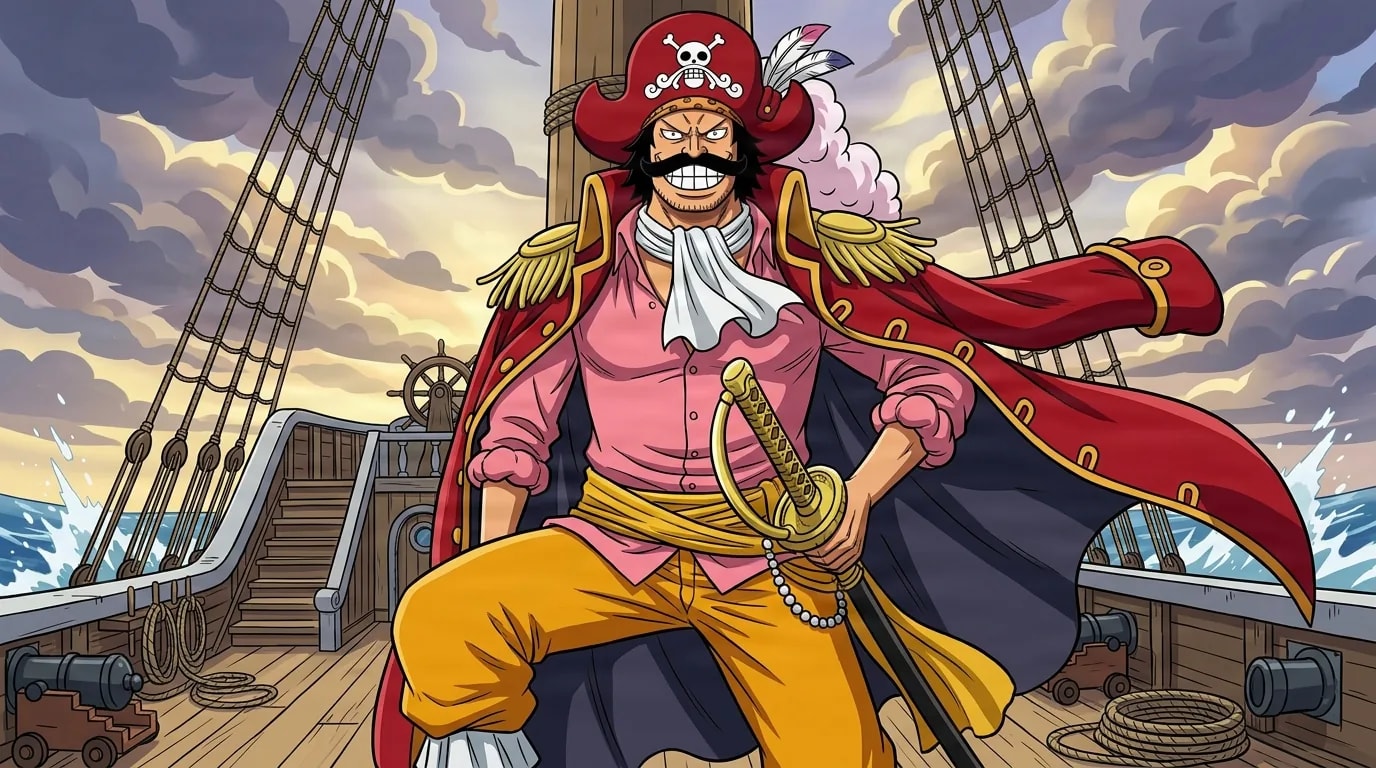
Gol D. Roger
CharacterCaptain of the Roger Pirates and the only man crowned Pirate King, Gol D. Roger, widely called Gold Roger, became the first since Joy Boy to sail the entire Grand Line and reach its last island. His final words about the One Piece set off the Great Pirate Era.
Appearance
During the last stretch of his life, Roger stood as a towering, heavily muscled man with a thick neck and a dense head of black hair. The features that defined him most were a long, upward-curling mustache, an almost ever-present fierce grin, and a piercing gaze. Over a blue shirt he draped a long captain's coat in red with gold trim, cinched at the waist by a yellow sash, with a white cravat at his throat, dark blue trousers, and black sea boots. When he surrendered himself, he topped the outfit with a pirate hat bearing his Jolly Roger set over a yellow-dotted bandana.
His look shifted across the decades. As a young man asking Rayleigh aboard, he wore the same straw hat now worn by Monkey D. Luffy. Thirty-eight years before the present he sometimes let that hat dangle behind his coat, lacked his trademark mustache, and bore a striking likeness to his future son, Ace. A necklace appeared in depictions from thirty years prior, and during the Edd War he swapped his coat for a dark blue vest paired with a yellow sash.


Personality
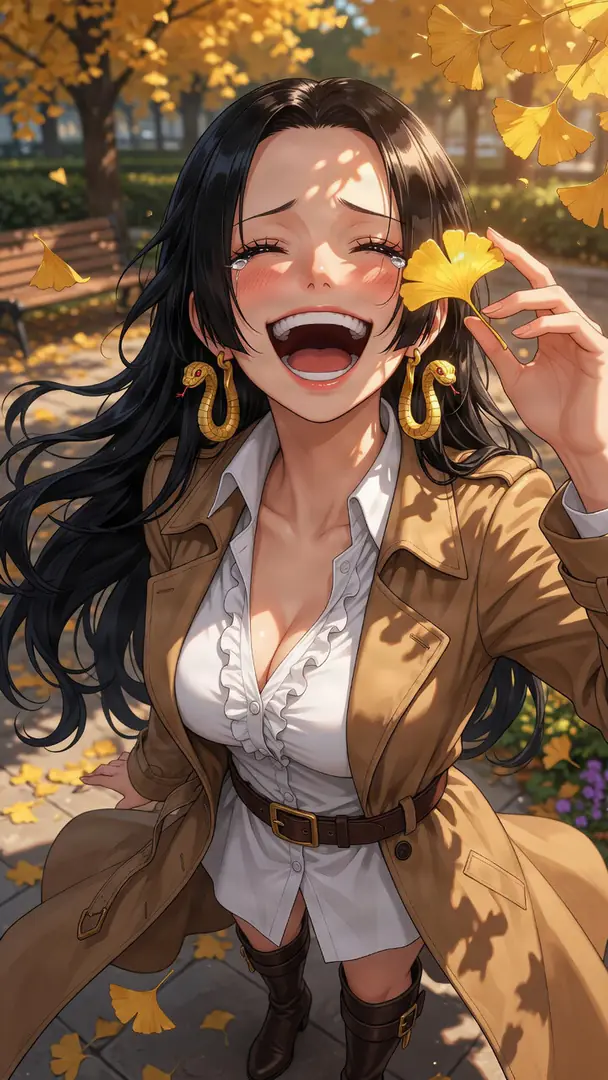
Roger carried himself without fear, and onlookers at his death insisted he was smiling right up to the blade. Those who knew him repeatedly compared his temperament to Luffy's: open, impulsive, and quick to invite a stranger like Rayleigh aboard with no idea of his strength. He delighted in grand, flashy things and openly relished his title even as illness closed in. He was equally short-tempered, retaliating against the smallest insult aimed at his crew, and could turn merciless when truly angered, as when he personally wiped out Squard's entire crew.
For all his pride, he was strikingly humble, bowing to Whitebeard and Oden to request Oden's service and offering up his treasure in exchange. He socialized eagerly with rivals, forbade his men from robbing ordinary civilians, and held a tenderness toward children, cradling the infant Hiyori and gently reassuring young Pedro and Shyarly. In his youth he showed a glaring weakness for beautiful women, going so far as to chase Shakuyaku across the seas only to be powerless before her charm. His distinctive laugh ran "Wahahaha."
History
Born seventy-seven years ago in Loguetown within the East Blue, Roger came up through hardship and grew terrified above all of losing those he loved. As a young man he was so impressed by Rayleigh's stolen ship that he asked him to help turn the world upside down, and the two became lifelong friends and the founders of the Roger Pirates. He commissioned the shipwright Tom to build the Oro Jackson from Treasure Tree Adam wood, feuded endlessly with the Marine Garp, and repeatedly hounded the Kuja Pirates in fruitless attempts to win over Shakuyaku.
When Shakuyaku was captured and offered up as the prize in the Native Hunting Competition held on God Valley, Roger rallied his crew to free her. The resulting incident saw him briefly join forces with Garp, and after Imu turned Rocks D. Xebec into a demon, the two rivals fought together to bring him down. Soon after, a one-year-old Shanks was discovered stowed away in the crew's plunder. Roger later slipped into Big Mom's territory to copy her Road Poneglyph, then grew curious about the samurai who had joined Whitebeard.
Twenty-eight years ago an incurable disease pushed Roger to launch one last voyage, recruiting the doctor Crocus at Reverse Mountain to keep him alive. He defeated Shiki's armada at the Edd War, overpowered Oden and dueled Whitebeard to a draw, then convinced Oden to sail with him for a year to decode the Road Poneglyphs. Hearing the Voice of All Things, he gathered the clues and reached the Grand Line's final island, where the laughter that greeted Joy Boy's legacy led him to name it Laugh Tale.
With the world hailing him as Pirate King, Roger disbanded his crew, fathered a child with Portgas D. Rouge in Baterilla, and asked Garp to shield the unborn baby from being branded a criminal. He surrendered to the Marines, who returned him to Loguetown for a public execution meant to deter piracy. Smiling without regret, he declared that the One Piece awaited anyone who could find it, and his death instead ignited the Great Pirate Era. He never used a Devil Fruit, relying on mastery of all three Haki types and the sword Ace, one of the twelve Supreme Grade Blades.
Related Reading
See all
The Most Popular Women of One Piece: A Fan's Journey Through Anime's Greatest Female Characters...
When I first decided to commit to watching One Piece seriously, I knew I was embarking on one of anime's longest and most beloved series. With over 100...
Super Saiyan Pubes: The Song About Where Super Saiyan Hair Actually Goes
The transformation everyone knows, the follow-up question nobody would touch. Why we made a smooth R&B track about the golden glow Dragon Ball never talks about....
Frequently Asked Questions
Is Luffy actually Gol D. Roger?
No, Monkey D. Luffy is not Gol D. Roger. Roger was executed in Loguetown before Luffy set out to become Pirate King, and Roger's own son is Portgas D. Ace, not Luffy.
Is Gol D. Roger good or bad?
Gol D. Roger was a pirate and the trigger of the Great Pirate Era, yet he showed real humility and kindness, bowing to Whitebeard and Oden, forbidding his crew from robbing civilians, and treating children gently. He could also turn ruthless when angered, as when he personally wiped out Squard's entire crew.
Who did Gol D. Roger fall in love with?
Gol D. Roger fell in love with Portgas D. Rouge, and the two had a son together, Portgas D. Ace, born in Baterilla.
What was Gol D. Roger's disease?
Gol D. Roger's exact disease was never named. It was described only as an incurable illness that pushed him to launch one final voyage, with a newly recruited doctor, Crocus, keeping him alive along the way.
How did Gol D. Roger die, and what did his death spark?
Gol D. Roger surrendered to the Marines and was publicly executed in Loguetown as a deterrent to piracy. Smiling without regret, he declared that the One Piece awaited anyone who could find it, and his death instead ignited the Great Pirate Era.
Sources & Information
Looking for more on Gol D. Roger? The One Piece Wiki on Fandom has a dedicated page with community notes.
View on FandomThis content is original writing by Daddy Jim Headquarters based on the One Piece anime series, manga, and official materials. Episode and chapter references are cited where applicable.
Character and scene imagery on this site is original artwork by Daddy Jim Headquarters, not screenshots or licensed imagery. Official cover art is used on three types of pages for editorial commentary:
- Movie pages: theatrical posters and key visuals, credited to Toei Animation and Toei Company.
- Game pages: official box art for the One Piece console and mobile games, credited to Bandai Namco.
- Manga chapter pages: Jump Comics volume covers, credited to Shueisha and Eiichiro Oda.
Official resources:
Help Us Keep This Wiki Accurate
Daddy Jim Headquarters maintains this encyclopedia. If you spot an error, a translation issue, or something that doesn't look right, let us know.