Dream Soccer King
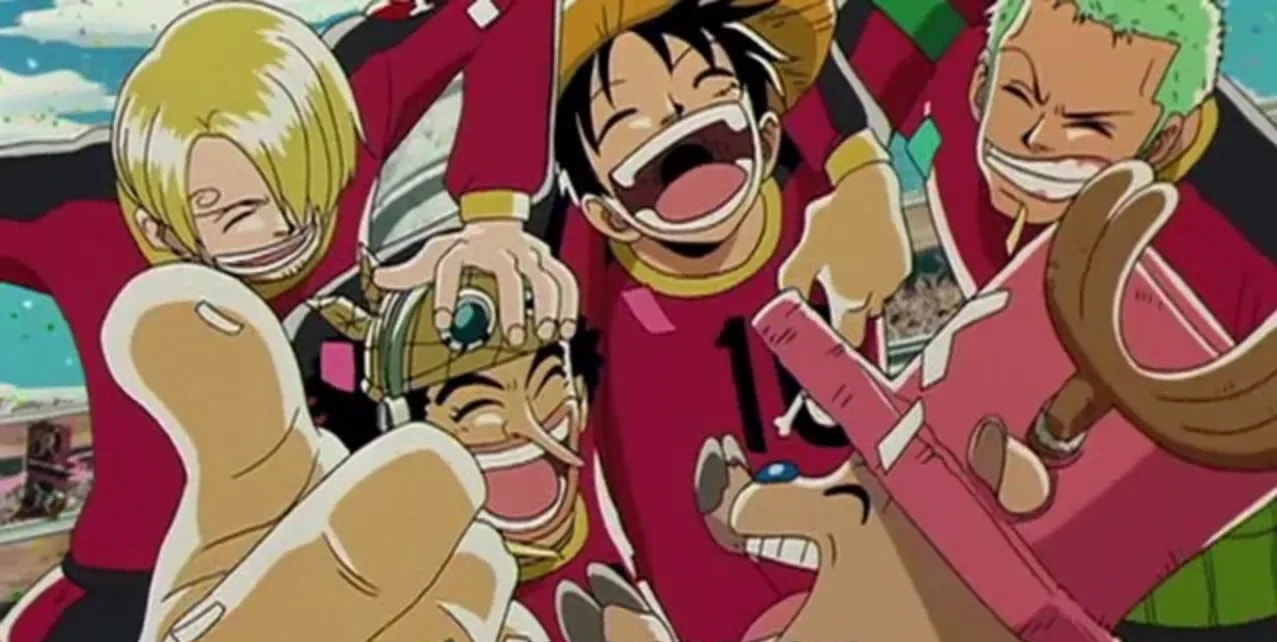
MovieThis brief animated short rode alongside the crew's third theatrical feature and stages a Grand Line Cup soccer final between Luffy's team and Buggy's roster of villains. Created to salute Japan's role in co-hosting the 2002 World Cup, it even hands creator Eiichiro Oda a guest role.
Overview
Lasting roughly five and a half minutes, the featurette shipped as a companion to the third Chopper-centered movie in the Toei anime lineup, the strange-animals island adventure. Its production tied into Japan's co-hosting of the 2002 World Cup. The standout draw is a guest turn by series author Eiichiro Oda, who lends his voice to an original figure called Odacchi.
Plot
A stadium brims with soccer-obsessed pirates, Marines, and ordinary spectators for the Grand Line Cup playoffs, and the final pits Luffy's Pirates against Buggy's Villain All-Stars. When the score refuses to break, officials announce a penalty shootout, with Koby minding the net and Helmeppo officiating, each team sending forward five kickers. Luffy, Zoro, and Usopp all find the goal, but Chopper wastes his turn when his Heavy Point muscles rupture the ball. Buggy fumbles a misguided curve attempt, yet Jango, Hatchan, and Mr. 2 all convert to level things at three each.
For their final kicker the villains produce a mystery reserve, Odacchi, who is revealed to be the event's announcer. He brags about his years of experience, then sends up a limp shot that Koby swats away with ease before his own teammates round on him. That leaves the outcome to Sanji, whose strike blasts the ball far above the crossbar and into the heavens. Buggy crows that it is forfeit, only for the ball, driven with enough power to loop the whole planet, to sail back into the stadium and cross the line. As the crowd goes wild, Luffy jolts awake on the Going Merry, the entire game having played out in a nap, and immediately boots what he takes for a soccer ball but is actually Usopp's rear.
Reception
In terms of continuity, the short fits a narrow slice of the Arabasta Arc, landing after the crew has met Mr. 2 but before their arrival at Arabasta proper, given that Vivi is still aboard the Merry and cheers from the sidelines here. A Doskoi Panda logo marks every ball in the piece, and among the flags the crowd waves are Jolly Rogers tied to the Alvida, Arlong, and Hiriluk crews. Nami's cheerleading getup would return years later as a bonus costume in the 2005 title Grand Battle! Rush! and its American successor.
Related Reading
See all
The Most Popular Women of One Piece: A Fan's Journey Through Anime's Greatest Female Characters...
When I first decided to commit to watching One Piece seriously, I knew I was embarking on one of anime's longest and most beloved series. With over 100...
Super Saiyan Pubes: The Song About Where Super Saiyan Hair Actually Goes
The transformation everyone knows, the follow-up question nobody would touch. Why we made a smooth R&B track about the golden glow Dragon Ball never talks about....
Frequently Asked Questions
What is Dream Soccer King?
Dream Soccer King is a roughly five-and-a-half-minute animated short that screened alongside the third One Piece film, staging a Grand Line Cup soccer final between Luffy's Pirates and Buggy's Villain All-Stars.
Why was Dream Soccer King made?
Dream Soccer King was created to celebrate Japan's co-hosting of the 2002 FIFA World Cup, and it even features creator Eiichiro Oda voicing an original character named Odacchi.
How does the soccer match end in Dream Soccer King?
In Dream Soccer King, Sanji's final kick sends the ball flying so hard it loops around the planet and lands back in the goal for the win, though the whole game turns out to have been a dream Luffy had while napping on the Going Merry.
Who does Odacchi play for in Dream Soccer King?
Odacchi, voiced by Eiichiro Oda himself, is revealed as the event's announcer and comes in as a surprise reserve kicker for Buggy's Villain All-Stars, though his weak shot is easily blocked by Koby.
What movie was Dream Soccer King paired with?
Dream Soccer King was paired with Chopper's Kingdom on the Island of Strange Animals, the third One Piece film, for its theatrical release in March 2002.
Sources & Information
Looking for more on Dream Soccer King? The One Piece Wiki on Fandom has a dedicated page with community notes.
View on FandomThis content is original writing by Daddy Jim Headquarters based on the One Piece anime series, manga, and official materials. Episode and chapter references are cited where applicable.
Character and scene imagery on this site is original artwork by Daddy Jim Headquarters, not screenshots or licensed imagery. Official cover art is used on three types of pages for editorial commentary:
- Movie pages: theatrical posters and key visuals, credited to Toei Animation and Toei Company.
- Game pages: official box art for the One Piece console and mobile games, credited to Bandai Namco.
- Manga chapter pages: Jump Comics volume covers, credited to Shueisha and Eiichiro Oda.
Official resources:
Help Us Keep This Wiki Accurate
Daddy Jim Headquarters maintains this encyclopedia. If you spot an error, a translation issue, or something that doesn't look right, let us know.