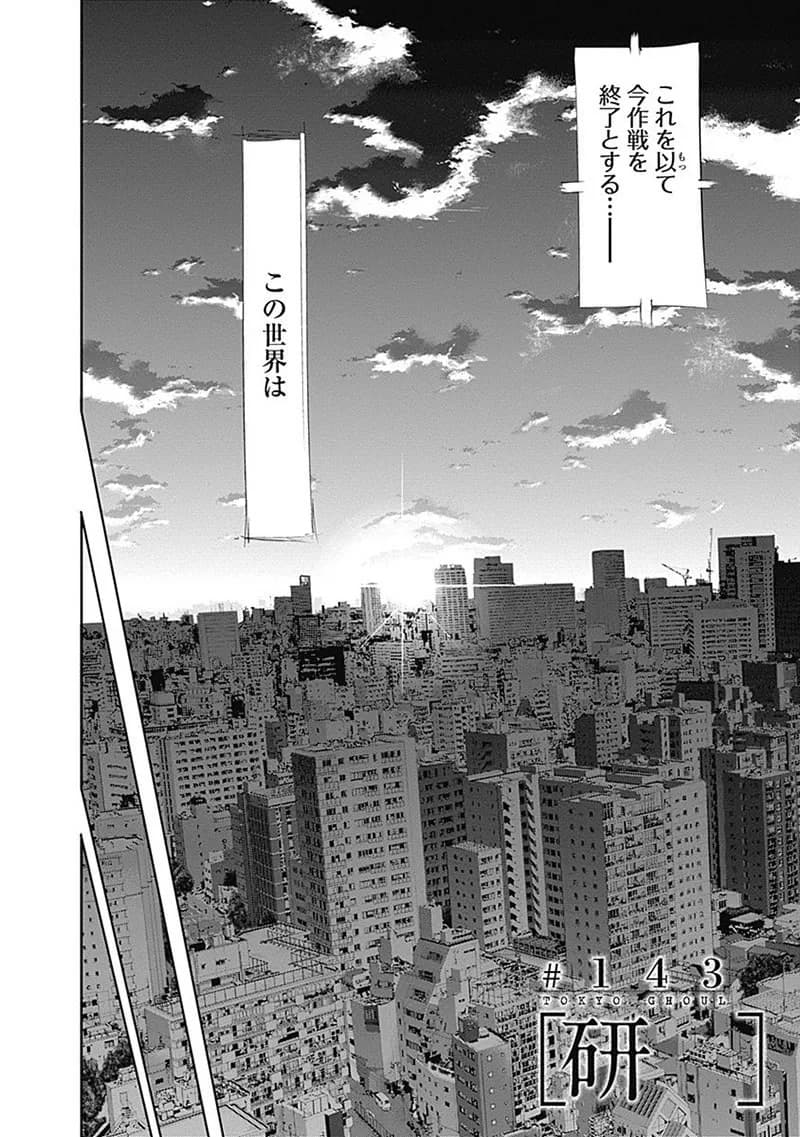
The final chapter of Tokyo Ghoul surveys the wreckage left by the CCG's raid: grieving allies, ruined investigators, Kanou's new lab, the Clowns, and a demolished Anteiku, all threaded through Kaneki's fading thoughts as Touka clings to the hope that he will come back.
Summary
In the aftermath of the battle and Kaneki's fall, Shuu Tsukiyama sinks into a catatonic grief and refuses to eat, until Nishiki Nishio warns him he will die at this rate, confessing that even he has rarely struggled so much. The CCG logs the operation's extermination rate at ninety-nine percent and closes the books on it. Massive blood loss and brain damage leave Yukinori Shinohara in a permanent coma, and his old comrade Fujishige Iba visits to honor his devotion. Word spreads that Amon died in the fighting; Misato Gori openly mourns while Akira Mado holds firm and calls losses the price of war, only to break down and weep when Misato scolds her, admitting she cared for both Amon and Takizawa.
Kaneki's group scatters, with Banjou, Hinami, and others heading deeper into the city for new hiding places. Investigators note that the bodies of the dead and the fates of the Centipede and the One-Eyed Owl remain unknown. Dr. Kanou surfaces in a fresh laboratory stocked with owl subjects in tanks, dismissing Kaneki as a mere experiment used to transplant a kakuhou into Shiro and Kuro. Eto urges that they simply remake Kaneki, and Yoshimura is shown sealed inside a glass chamber in the lab.

Key Events
Throughout, Kaneki narrates from within, insisting the world is broken and wrong, tying a ghoul's need to feed to ideas of stealing, sacrifice, protection, and error, and concluding that his only salvation is to sleep and dream something happy. Shinohara's wife visits Juuzou Suzuya, who lost a leg and has grown oddly calm; he blames himself, and she gently reminds him Shinohara loved him like a son, steadying his resolve to press on. Chairman Tsuneyoshi Washuu praises Arima's kill count while lamenting the Owl's escape, then names the One-Eyed King of Aogiri Tree the next target, grants Arima rights to the new quinque, and has Kaneki's suspect profile wiped from the blacklist. At Helter Skelter, Itori, Uta, and their circle relish Kaneki's ruin and scheme to snare a fresh victim, the group revealed as the Clowns.
Related Reading
See all
Naruto vs Luffy: Does the Fight Change if Luffy Tickles Hinata?
Naruto vs Luffy with the twist nobody asked for: Luffy tickled Hinata on date night, and she kind of liked it. We break down the whole fight and commit to a winner....
Namek Has No Women, and Piccolo Pulls Anyway
There are no women on Namek. That isn't an oversight, it's the biology. Why we handed Piccolo the one thing his own species rules out, and why it had to be trap soul....

Notes
Back at a soon to be demolished Anteiku, Touka mourns the loss of her home and recalls the warmth behind the café's name, even as the wrecking crew sneers about the ghouls who ran it. Yomo tells her it is time to leave, reflecting that Kaneki lost his way and his place to return to. Still, Touka refuses to give up, declaring her faith that Kaneki will one day come back. The chapter closes out the original manga before its continuation.
Frequently Asked Questions
What happened to Ken Kaneki in the final chapter of Tokyo Ghoul?
In Chapter 143, the final chapter of the original Tokyo Ghoul manga, the fallen Ken Kaneki is taken by Dr. Kanou to a new laboratory and used as an experiment, providing a kakuhou for transplant into subjects called Shiro and Kuro, while the CCG wipes his suspect profile from its blacklist.
Is Kaneki's first name Ken or Kaneki?
Ken is Kaneki's given name and Kaneki is his surname. The wiki refers to him throughout as Ken Kaneki, and this closing chapter of the original manga is simply titled Ken after him.
What happens to Shuu Tsukiyama after Kaneki's defeat in Chapter 143?
Shuu Tsukiyama sinks into catatonic grief and refuses to eat until Nishiki Nishio warns him he will die at this rate, admitting even he has rarely struggled so much.
What happens to Anteiku in Chapter 143?
Anteiku is set to be demolished, and Touka mourns the loss of her home, but she refuses to give up hope, declaring her faith that Kaneki will one day come back.
Who is revealed as the Clowns in Chapter 143?
At Helter Skelter, Itori, Uta, and their circle relish Kaneki's ruin and scheme to snare a fresh victim, with the group revealed as the Clowns.
Sources & Information
Looking for more on Ken? The Tokyo Ghoul Wiki on Fandom has a dedicated page with community notes.
View on FandomThis content is original writing by Daddy Jim Headquarters based on the Tokyo Ghoul anime series, manga, and official materials. Tokyo Ghoul was created by Sui Ishida, published by Shueisha, and animated by Studio Pierrot. All rights to Tokyo Ghoul and its characters belong to their respective owners. Episode and chapter references are cited where applicable.
Rights holders
- Created bySui Ishida
- Published byShueisha
- Animated byStudio Pierrot
All rights belong to their respective owners.
Character and scene imagery on this site is original artwork by Daddy Jim Headquarters, not screenshots or licensed imagery. Official cover art is used on three types of pages for editorial commentary:
- Movie pages: theatrical posters and key visuals, credited to Studio Pierrot and Shueisha.
- Game pages: official box art, credited to the game's respective publishers.
- Manga chapter pages: volume covers, credited to Shueisha and Sui Ishida.
Official resources:
Help Us Keep This Wiki Accurate
Daddy Jim Headquarters maintains this encyclopedia. If you spot an error, a translation issue, or something that doesn't look right, let us know.