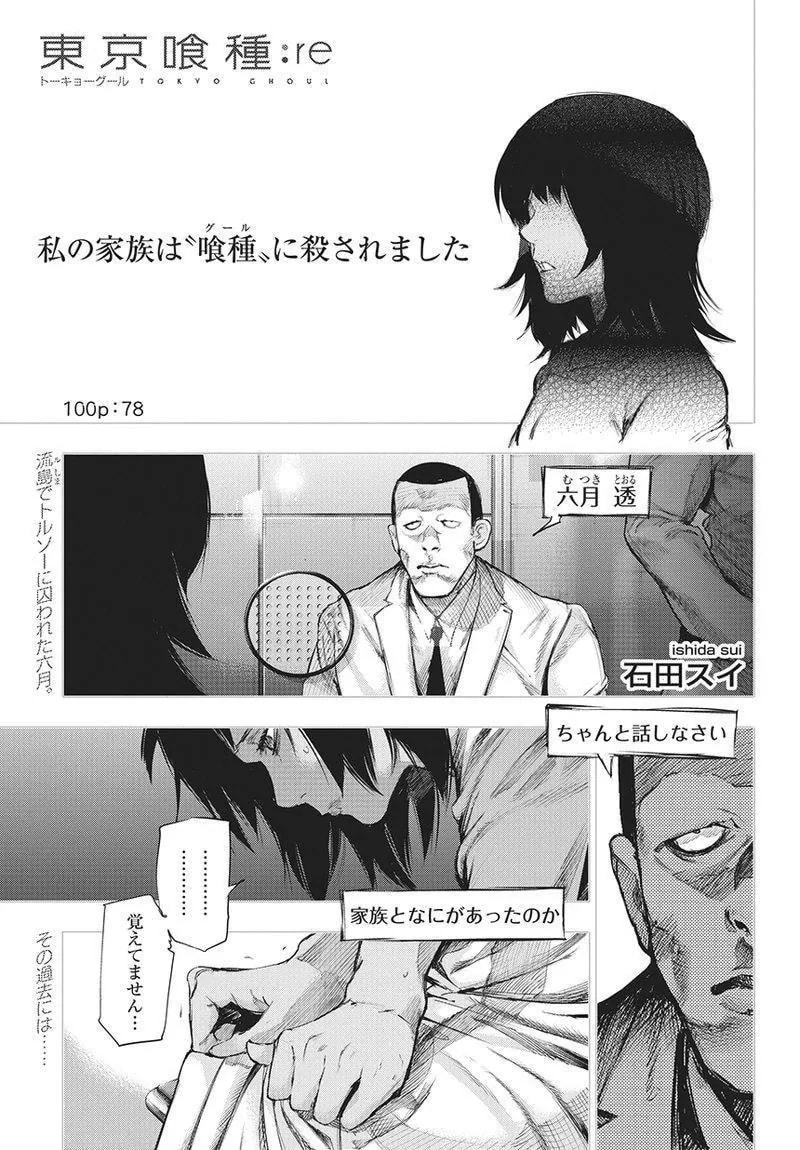
The seventy-eighth chapter of Tokyo Ghoul:re, titled 100p, is built almost entirely around Karao Saeki's confession to a captive Mutsuki, tracing the abusive, isolated childhood that turned him into the killer known as Torso.
Summary
Mutsuki dreams of an investigator pressing him about what became of his family, a question he cannot answer because he does not recall it, and the man accuses him of lying. He wakes limbless under Saeki's watch. Told he had been crying in his sleep, Mutsuki says he is hungry, then coaxes his captor into talking about his own life, hoping the distraction will keep Saeki from striking him.
Saeki describes growing up in a tent on a mountain, raised only by his father, who called him a fool and warned that capture by the CCG would doom them both. His father once confessed to eating his own wife, Saeki's mother, when his hunger grew unbearable. Left alone for stretches, the boy passed time staring at the pictures in books. During one month-long absence, starvation drove him into a nearby village, where he met a human girl named Minomi. Her company transformed his world; she taught him to read and write, and their games briefly quieted his hunger. He hid his ghoul nature by claiming strict parents kept him from school.
Minomi confided that she wanted to escape somewhere far away, and Saeki noticed bruises she attributed to family circumstances, finding her determination to live beautiful. After her family relocated abroad, his father learned of the village visits and abandoned him for the risk he posed. Searching for his father, Saeki instead reencountered Minomi and sheltered her in the tent, promising to drive her to the ocean someday. They fell asleep, but strange noises drew him outside, where he found his father dismembering her body and inviting him to feast. Enraged, Saeki killed his father, then became fixated on Minomi's clean, intact torso, and from that day he began collecting torsos. He tells Mutsuki that forgetting the past might be a mercy, and just as Mutsuki feels he finally understands the man, Saeki rises and lifts him up.
Key Events
Saeki, the killer called Torso, recounts his origin: a starving, abused upbringing, his father's cannibalism of his mother, and the murder of the human girl Minomi. The discovery of her preserved torso and his rage at his father birthed both the killing and his obsession that gives Torso his name. The chapter ends with Saeki hoisting the captive Mutsuki off the ground.

Related Reading
See all
Naruto vs Luffy: Does the Fight Change if Luffy Tickles Hinata?
Naruto vs Luffy with the twist nobody asked for: Luffy tickled Hinata on date night, and she kind of liked it. We break down the whole fight and commit to a winner....
Piccolo Gets the Namek Hoes: Namek Has No Women, and He Pulls Anyway
There are no women on Namek. That isn't an oversight, it's the biology. Why we handed Piccolo the one thing his own species rules out, and why it had to be trap soul....
Frequently Asked Questions
What happens in Tokyo Ghoul re Chapter 78?
Tokyo Ghoul re Chapter 78, titled 100p, centers on Karao Saeki, the killer known as Torso, confessing his abusive and isolated childhood to his captive, Mutsuki.
Who is Karao Saeki and why is he called Torso?
Karao Saeki is a ghoul raised in isolation by an abusive father who once ate Saeki's own mother. After his father murdered a human girl named Minomi whom Saeki cared for, Saeki killed his father and became fixated on collecting torsos, which is how he earned the name Torso.
Who was Minomi and what happened to her?
Minomi was a human girl who befriended Saeki in his childhood, taught him to read and write, and dreamed of escaping her family situation. Saeki's father killed and dismembered her, which drove Saeki to kill his father in a rage.
What does Mutsuki dream about at the start of the chapter?
Mutsuki dreams of an investigator pressing him about what became of his family, a question he cannot answer because he has no memory of it, and the man accuses him of lying.
How does the chapter end?
Chapter 78 ends with Saeki rising and lifting the limbless, captive Mutsuki off the ground after finishing his confession.
Sources & Information
Looking for more on :re Chapter 78? The Dragon Ball Wiki on Fandom has a dedicated page with community notes.
View on FandomThis content is original writing by Daddy Jim Headquarters based on the Dragon Ball anime series, manga, and official materials. Episode and chapter references are cited where applicable.
Character and scene imagery on this site is original artwork by Daddy Jim Headquarters, not screenshots or licensed imagery. Official cover art is used on three types of pages for editorial commentary:
- Movie pages: theatrical posters and key visuals, credited to Toei Animation and Shueisha.
- Game pages: official box art, credited to Bandai Namco, Atari, and other publishers.
- Manga chapter pages: Jump Comics volume covers, credited to Shueisha and Akira Toriyama.
Official resources:
Help Us Keep This Wiki Accurate
Daddy Jim Headquarters maintains this encyclopedia. If you spot an error, a translation issue, or something that doesn't look right, let us know.