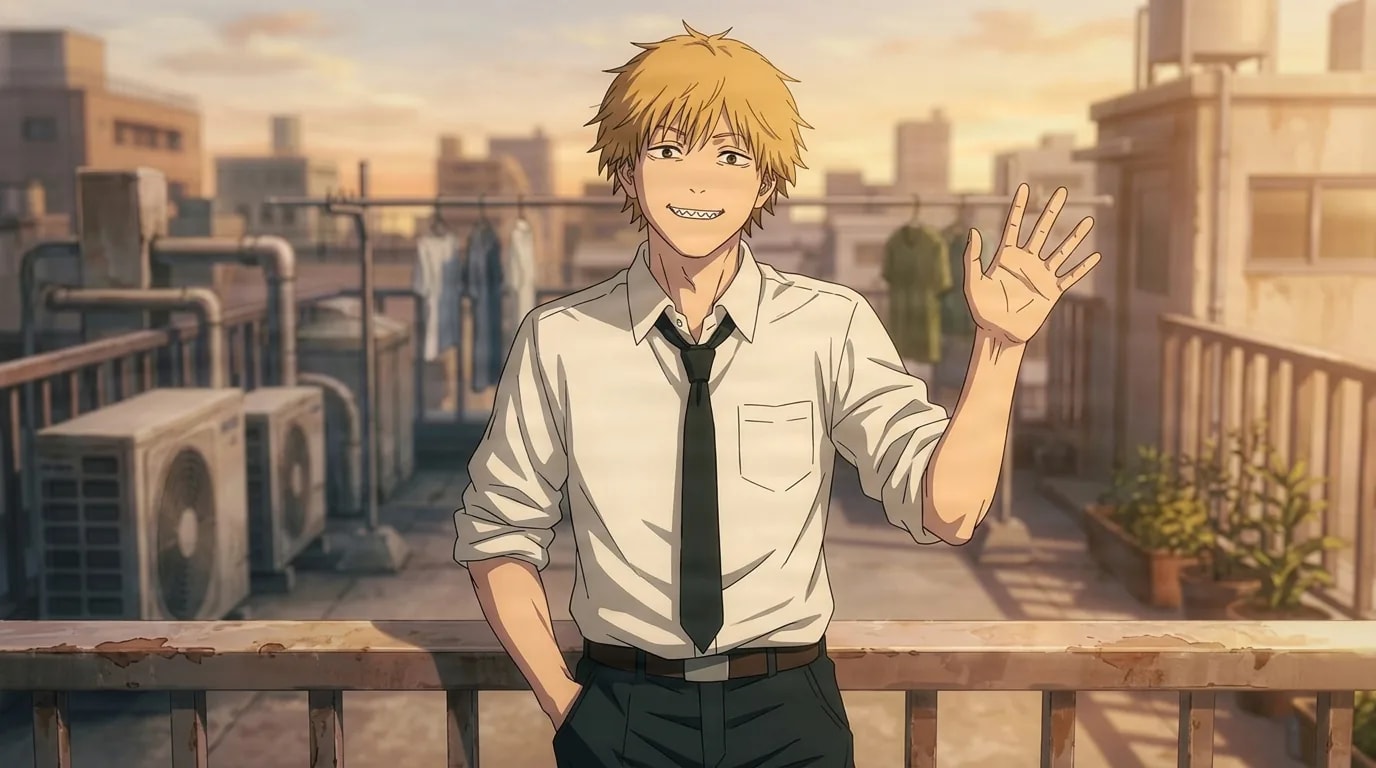
Denji
CharacterDenji is the chainsaw-headed hero at the center of the series, a penniless boy who inherits his father's debt and trades his ordinary life to merge with the devil Pochita. Pulling the cord in his chest turns him into Chainsaw Man, and his hunger for love, food, and a normal life drives everything that follows.
Appearance
Blond and perpetually disheveled, Denji is a wiry teenager whose hair juts and falls across a tired, hollow-eyed face set with sharp teeth. Childhood starvation left him gaunt, ribs showing above lanky legs, and his hard life makes him read as older than he really is. Early on he is missing an eye behind a patch along with several spare organs, and he favors a loose tank top, green jacket, and dark pants; fusing with Pochita restores what he lost and fills out his build.
Much of Part 1 he spends in a rumpled Public Safety uniform, later trading it for the dark, open-collared garb of Fourth East High School. Pulling his chest cord while he has blood to spare erupts his head into a fanged, mechanical shape with chainsaws bursting from skull, arms, and legs, every one retractable at will; with too little blood, only a blade partly surfaces from his face. Giving himself wholly to Pochita unleashes the true Chainsaw Devil, a towering armored brute, while his final merger with Pochita against Yoru produces a conscious, red-armored form that conjures chainsaw constructs at will.



Personality
Denji is blunt, coarse, and naive, the product of growing up too poor for schooling or friends, which leaves him crude and childish on the surface yet genuinely kind, quick to save people in danger and clever enough to outwit devils. Once Public Safety meets his basic needs, much of his drive narrows to sex, and he takes reckless missions chasing fleeting gratification before realizing how empty it leaves him. Transformed, he turns ruthless, bloodthirsty, and darkly playful, savoring the slaughter of devils. His deepest wound is a desperate craving to be loved, which he pours into Makima to the point of wishing to become a mindless dog so loss can never hurt him; her betrayal and Power's death break him completely.
By Part 2 his appetites have grown grander, steak over jam and a crowd of girlfriends, and he flirts with exposing his identity for attention, but the trauma shows in his haggard face and his nightmares. The maturing core beneath it all is Nayuta: he hoards money in degrading ways purely to fund her education, revealing a real sense of responsibility. He treats women with far more warmth than men and never acts without consent, yet he refuses to let desire override his conscience, walking out on the Chainsaw Man Church the moment its cruelty becomes plain. Drawn again and again to being Chainsaw Man for the adoration it brings, he keeps relapsing into the same mistakes, until Pochita, seeing he is never truly content, erases himself to grant Denji a gentler world where a steadier, more grown version of him can finally chase his dreams.
Abilities
Merging with Pochita grants Denji strength beyond a normal human even when untransformed, enough to shrug off Power's hammer or the Bat Devil's grip and to behead a fiend with one axe swing, and his brutal upbringing gave him a punishing tolerance for pain that lets him fight for days on end. Pulling the cord on his chest, provided he has blood, turns him into a chainsaw-bladed devil of enormous power, able to smash walls and most enemies with a single blow, catch and hurl cars, and regenerate endlessly so long as he keeps drinking blood, a self-described perpetual motion machine. Chainsaws sprout from his arms, legs, and head, retract on command or on instinct, and their chains can be detached to ensnare, grapple, and reel in foes.
So long as enough blood reaches him, he heals from nearly any wound and even from death, returning whole whenever someone tugs his cord, a near-immortality that has survived decapitation, curses, and his body being blown apart. His pacts define him: Pochita's contract, traded for a normal life, is the source of his hybrid power; Power's contract, sealed with her dying blood, lets him manifest a horned blood chainsaw, the weapon that undid Makima's regeneration; and a later deal with the Aging Devil ends their fight. Trained by Kishibe, he fights shrewdly rather than on raw strength, exploiting weaknesses like Reze's vulnerability to water and Santa Claus's to fire and light, and he learned to swim from Reze herself. His one real frailty is blood loss, which starves his transformation and forces him to feed in order to recover.
Related Reading
See all
Viral Anime Wars: How Reze vs. Bakugo Memes Took Over Social Media in November 2025
Look, the origins of this viral showdown trace back to a single tweet that playfully juxtaposed Reze's enigmatic allure against Bakugo's expl...
Super Saiyan Pubes: The Song About Where Super Saiyan Hair Actually Goes
The transformation everyone knows, the follow-up question nobody would touch. Why we made a smooth R&B track about the golden glow Dragon Ball never talks about....

Frequently Asked Questions
Who is Denji in love with?
Denji's deepest wound is a craving to be loved, which he pours into Makima, his main love interest, while Asa Mitaka becomes another love interest later in the series.
What exactly is Denji?
Denji is a human-devil hybrid who merged with the Chainsaw Devil Pochita, letting him pull the cord in his chest to transform into the chainsaw-headed hero Chainsaw Man.
How old is Denji?
Denji is a teenager whose age spans roughly 16 to 18 across the series, though his hard, starvation-marked life makes him read as older than he really is.
How does Denji turn into Chainsaw Man?
Denji turns into Chainsaw Man by pulling the cord on his chest while he has blood to spare, which erupts his head into a fanged mechanical shape with chainsaws bursting from his skull, arms, and legs.
What are Denji's powers as Chainsaw Man?
As Chainsaw Man, Denji wields enormous strength and chainsaws that sprout from his body and retract at will, plus near-immortal regeneration so long as he keeps drinking blood, though blood loss is his one real frailty.
Sources & Information
Looking for more on Denji? The Chainsaw Man Wiki on Fandom has a dedicated page with community notes.
View on FandomThis content is original writing by Daddy Jim Headquarters based on the Chainsaw Man anime series, manga, and official materials. Episode and chapter references are cited where applicable.
Character and scene imagery on this site is original artwork by Daddy Jim Headquarters, not screenshots or licensed imagery. Official cover art is used on three types of pages for editorial commentary:
- Movie pages: theatrical posters and key visuals, credited to MAPPA and the Chainsaw Man Movie Project.
- Game pages: official promotional artwork, credited to the licensed publishers.
- Manga chapter pages: Jump Comics volume covers, credited to Shueisha and Tatsuki Fujimoto.
Official resources:
Help Us Keep This Wiki Accurate
Daddy Jim Headquarters maintains this encyclopedia. If you spot an error, a translation issue, or something that doesn't look right, let us know.