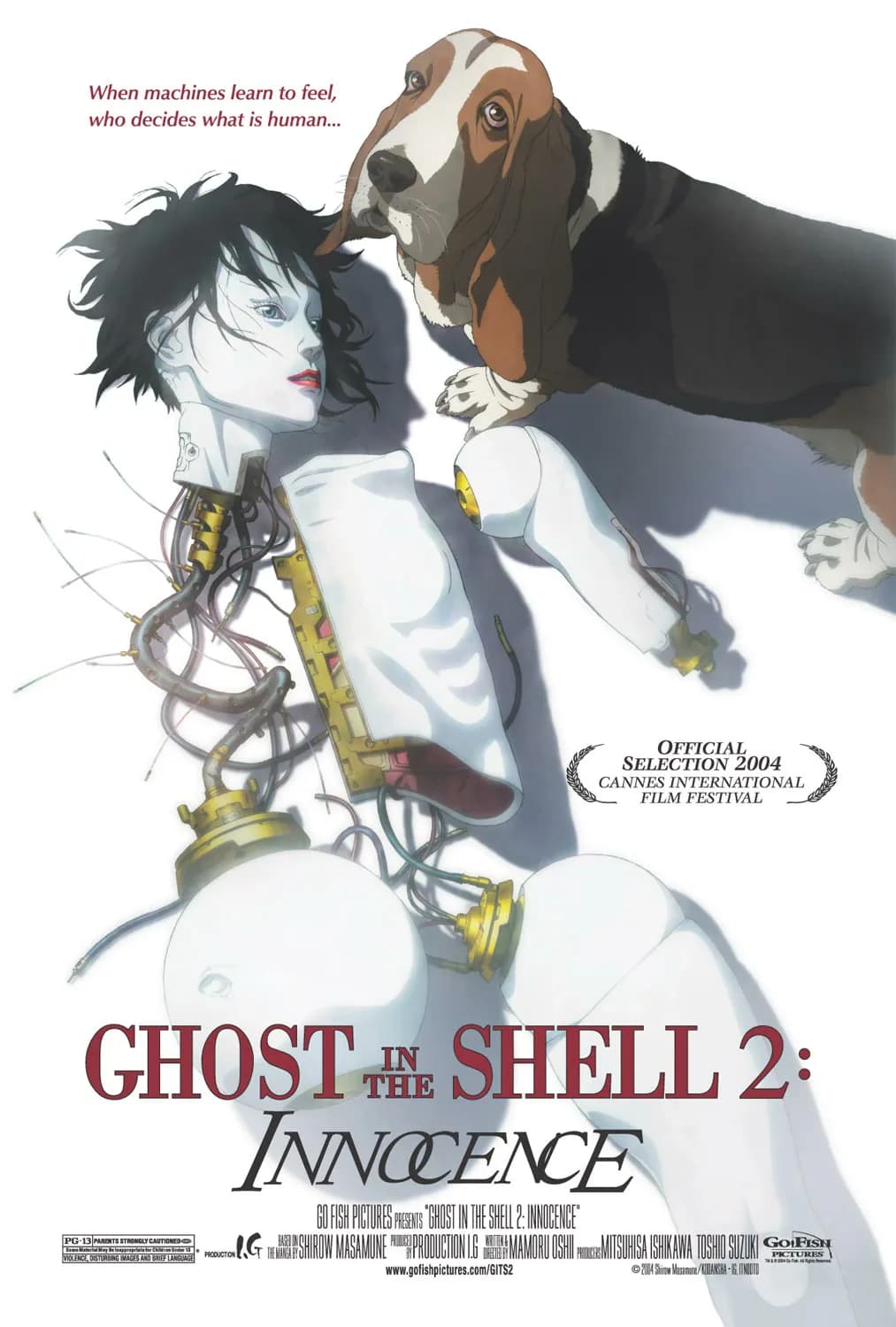
Ghost in the Shell 2: Innocence
MovieGhost in the Shell 2: Innocence is Mamoru Oshii's 2004 follow-up to the original anime film, a meditation on lifeless objects and figures as forms of artificial life. With the Major gone, a lonely, fully cybernetic Batou and a reluctant Togusa chase a string of killings tied to gynoid sex dolls.
Overview
Released in Japan on March 6, 2004 and in the United States that September, Innocence carried a production budget near twenty million dollars, roughly two billion yen. To cover so large a sum, Production I.G president Mitsuhisa Ishikawa brought in Studio Ghibli's Toshio Suzuki as co-producer. Mamoru Oshii directed, working from a story only loosely tied to Masamune Shirow's manga, and the same studio that made the first film and the Stand Alone Complex series handled production. A companion novel, After the Long Goodbye, was published as a prequel to the movie.

Plot
Much of the narrative reworks the manga chapter Robot Rondo, heavily altered. The action opens in 2032, in cities shared by shrinking numbers of humans, purely mechanical androids, and cyborgs like Batou, who still holds a ghost yet remains open to ghost hacking. With Major Kusanagi vanished since the first film, Batou now works beside a hesitant Togusa who feels he can never measure up to her. Section 9 turns its attention to a cyborg firm called Locus Solus and its gynoids, female androids sold as sex dolls, after eight people are killed. The malfunctions turn out to be engineered on purpose to force a police inquiry.
The dolls carry a ghost, which is exactly what made them so prized, produced by an illegal ghost-dubbing machine that spits out degraded mass copies while killing the originals. Young girls abducted by the Yakuza were sold to Locus Solus for the process, and two of them plotted with a shipping inspector named Volkerson to trigger the failures and draw official eyes to their captivity. Batou, whose body is now wholly artificial and holds little of his old humanity beyond fragments of brain and his memories of Motoko, follows the case with Togusa. The Major herself is officially missing while agents hunt her for what she knows about Project 2501. In the climax, as combat-enabled gynoids overwhelm Batou, Kusanagi downloads part of her consciousness into an empty gynoid and helps him shut the killers down, promising she will always remain with him online before the borrowed body powers off.

Reception
Innocence competed at the 2004 Cannes Film Festival, only the sixth animated feature ever selected, and stood alongside Persepolis as one of two animated finalists for the Palme d'Or, an award that ultimately went to Fahrenheit 9/11. Its home release proved rocky in the United States, where the DreamWorks DVD drew heavy criticism for swapping the theatrical overlay subtitles for closed-caption text that cluttered the visuals with needless notes like footsteps or an approaching helicopter, prompting an exchange offer for corrected discs. Many viewers also objected to the absence of an English dub, though Manga Entertainment later issued a dubbed UK version using the Stand Alone Complex cast. Critically the film is dense with quotation and philosophy, threading references from Buddha to Milton through a doll-obsessed story, and Kenji Kawai's score, echoing the first film's Making of a Cyborg theme, deepens an atmosphere often compared to Blade Runner.
Frequently Asked Questions
Is Ghost in the Shell 2: Innocence a sequel?
Yes, Ghost in the Shell 2: Innocence is Mamoru Oshii's 2004 sequel to the original 1995 Ghost in the Shell film, following a lonely, fully cybernetic Batou after the Major's disappearance.
Is Ghost in the Shell 2: Innocence a bad movie?
Ghost in the Shell 2: Innocence is generally well regarded critically; it competed for the Palme d'Or at the 2004 Cannes Film Festival, one of only two animated finalists that year, though its US DVD release drew criticism for altered subtitles.
What is the plot of Ghost in the Shell 2: Innocence?
Ghost in the Shell 2: Innocence follows Batou and Togusa of Section 9 as they investigate a string of killings by gynoid sex dolls made by the firm Locus Solus, uncovering an illegal ghost-dubbing scheme built on abducted girls.
Who directed and scored Ghost in the Shell 2: Innocence?
Ghost in the Shell 2: Innocence was directed by Mamoru Oshii with a score by Kenji Kawai, and was produced by Production I.G's Mitsuhisa Ishikawa alongside Studio Ghibli's Toshio Suzuki.
Did Ghost in the Shell 2: Innocence compete at the Cannes Film Festival?
Yes, Ghost in the Shell 2: Innocence competed at the 2004 Cannes Film Festival, becoming only the sixth animated feature ever selected and one of two animated finalists for the Palme d'Or.
Sources & Information
Looking for more on Ghost in the Shell 2: Innocence? The Ghost in the Shell Wiki on Fandom has a dedicated page with community notes.
View on FandomThis content is original writing by Daddy Jim Anime based on the Ghost in the Shell anime series, manga, and official materials. Ghost in the Shell was created by Masamune Shirow, published by Kodansha, and animated by Production I.G. All rights to Ghost in the Shell and its characters belong to their respective owners. Episode and chapter references are cited where applicable.
Rights holders
- Created byMasamune Shirow
- Published byKodansha
- Animated byProduction I.G
All rights belong to their respective owners.
Character and scene imagery on this site is original artwork by Daddy Jim Anime, not screenshots or licensed imagery. Official cover art is used on three types of pages for editorial commentary:
- Movie pages: theatrical posters and key visuals, credited to Production I.G and Kodansha.
- Game pages: official box art, credited to the game's respective publishers.
- Manga chapter pages: volume covers, credited to Kodansha and Masamune Shirow.
- Licensed imagery: Photographs of real people, including creators, voice actors and production staff, are used under licence from the rights holder or the applicable stock provider, or under the terms of a public licence permitting editorial use. Each such image is reproduced in its licensed form and remains the property of its owner.
- Exceptions: Limited exceptions to the practices described above may apply to individual entries. Where an exception applies, it is noted on the entry itself alongside the applicable attribution. Rights holders may contact us regarding any attribution and it will be reviewed promptly.
Official resources:
Help Us Keep This Wiki Accurate
Daddy Jim Anime maintains this encyclopedia. If you spot an error, a translation issue, or something that doesn't look right, let us know.
