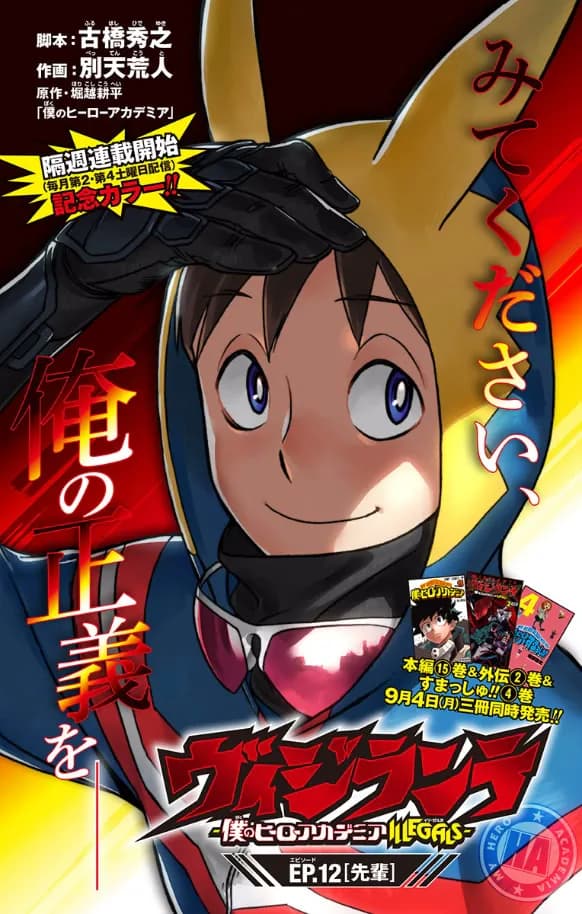
A tutoring offer from a sharp classmate pulls Koichi Haimawari into academic territory that cuts uncomfortably close to his double life. Makoto Tsukauchi wants a bodyguard for her thesis fieldwork, and the subject she is chasing happens to be the very vigilante sitting across from her.
Main Characters (1)
Summary
With the Stendhal affair behind him, Koichi Haimawari returns to the ordinary grind of university, where the coursework is beating him. A classmate slides in beside him and asks what he is reading. He shows her his hero sociology text, she agrees it is heavy going, and she volunteers to tutor him. Another student identifies her as Makoto Tsukauchi. Her terms are simple: help her with an errand and the tutoring is his.
At Koichi's place, Kazuho Haneyama is already inside with a book and hears the two of them approaching, so she ducks out of sight while Koichi stalls Makoto at the door long enough to tidy up. Once inside, she glances at his registration form and promises lecture notes and old exam papers, though attendance remains his own problem. Turning to the subject giving him trouble, she walks him through the third chapter of his textbook, which covers the friction between vigilantism and the sanctioned hero system.
Her explanation frames vigilantism as a phase rather than a fixture. When Quirks first threw society into disorder, private citizens stepped in to hold the line, and as stability returned that impulse either faded or was folded into official structures. Legislation converted some of those figures into heroes. The catch, she notes, is that the first such law, passed in Rhode Island, granted hero status to only seven of one hundred and eighty-nine vigilantes and branded the rest as Quirk-using villains. Personal justice, she concludes, gave birth to a system founded on societal justice, and it survives as a counterweight to mass surveillance.
She springs a question on him: what actually decided who counted as a hero and who did not under that original law. He has no answer. She tells him the answer is hidden, that it will never appear on his exam, and that it is the spine of her thesis. She wants his help with the research and promises to tell him eventually. He agrees. The task is a field survey on the rumored Naruhata vigilantes. Koichi hesitates, since prying into other people's affairs sits badly with him even if he has heard good things about the group, but she says that is precisely why she needs a bodyguard. They settle on ten o'clock Saturday at the station. The moment she leaves, Kazuho reappears in a foul mood over the other girl.
Elsewhere, Naomasa Tsukauchi comes home to find his younger sister waiting. He asks after her thesis and she says her sources are falling into line. When she fishes for information about villains or heroes, he refuses to leak anything confidential and tells her to keep away from villains. She reads that as advice not to get caught, and he repeats himself more firmly: no danger. Back at Koichi's, Kazuho stews about Makoto treating the apartment as her own, while Koichi shrugs it off and buries himself in his assignments.

Key Events
Makoto Tsukauchi is introduced and strikes a bargain with Koichi Haimawari, trading tutoring for his help as a bodyguard on her thesis fieldwork.
The origins of the hero system are laid out, including the Rhode Island legislation that recognized only seven of one hundred and eighty-nine vigilantes as heroes and labeled the remainder villains.
Makoto reveals her research target is the Naruhata vigilantes, unaware that Koichi is one of them, and her brother Naomasa warns her away from villains.
Related Reading
See all
Naruto vs Luffy: Does the Fight Change if Luffy Tickles Hinata?
Naruto vs Luffy with the twist nobody asked for: Luffy tickled Hinata on date night, and she kind of liked it. We break down the whole fight and commit to a winner....
Namek Has No Women, and Piccolo Pulls Anyway
There are no women on Namek. That isn't an oversight, it's the biology. Why we handed Piccolo the one thing his own species rules out, and why it had to be trap soul....
Notes
Hideyuki Furuhashi writes and Betten Court illustrates My Hero Academia: Vigilantes. This nineteen-page chapter arrived on August 26, 2017 and was collected in the third volume.
It opens the Senpai arc, from which it takes its title, and The Crawler appears on the cover. Makoto Tsukauchi debuts here.
The chapter sits between Chapter 11 and Chapter 13 and was adapted as the seventh episode of the Vigilantes anime. Knuckleduster appears only in a flashback.
Frequently Asked Questions
Who is Makoto Tsukauchi and how is she introduced in Vigilantes Chapter 12?
Makoto Tsukauchi is a sharp university classmate of Koichi Haimawari who debuts in Chapter 12 of My Hero Academia: Vigilantes, offering to tutor him in exchange for his help as a bodyguard on her thesis fieldwork.
What is the twist in Makoto Tsukauchi's thesis research in Chapter 12?
In Chapter 12, Makoto Tsukauchi's thesis research targets the rumored Naruhata vigilantes, without her realizing that Koichi Haimawari, the classmate helping her, is actually one of them.
What does Makoto Tsukauchi explain about the origin of the hero system in Chapter 12?
In Chapter 12, Makoto Tsukauchi explains that vigilantism gave way to the legal hero system after Rhode Island's first hero law recognized only seven of 189 vigilantes as heroes and branded the rest as villains.
How does Naomasa Tsukauchi react to his sister's research in Chapter 12?
In Chapter 12, Naomasa Tsukauchi refuses to leak any confidential information to his sister Makoto and warns her firmly to stay away from villains.
Which anime episode adapts Vigilantes Chapter 12?
Vigilantes Chapter 12 was adapted as Episode 7 of the My Hero Academia: Vigilantes anime.
Sources & Information
Looking for more on Chapter 12: Senpai? The My Hero Academia Wiki on Fandom has a dedicated page with community notes.
View on FandomThis content is original writing by Daddy Jim Headquarters based on the My Hero Academia anime series, manga, and official materials. My Hero Academia was created by Kohei Horikoshi, published by Shueisha, and animated by Bones. All rights to My Hero Academia and its characters belong to their respective owners. Episode and chapter references are cited where applicable.
Rights holders
All rights belong to their respective owners.
Character and scene imagery on this site is original artwork by Daddy Jim Headquarters, not screenshots or licensed imagery. Official cover art is used on three types of pages for editorial commentary:
- Movie pages: theatrical posters and key visuals, credited to Bones and Shueisha.
- Game pages: official box art, credited to the game's respective publishers.
- Manga chapter pages: volume covers, credited to Shueisha and Kohei Horikoshi.
Official resources:
Help Us Keep This Wiki Accurate
Daddy Jim Headquarters maintains this encyclopedia. If you spot an error, a translation issue, or something that doesn't look right, let us know.