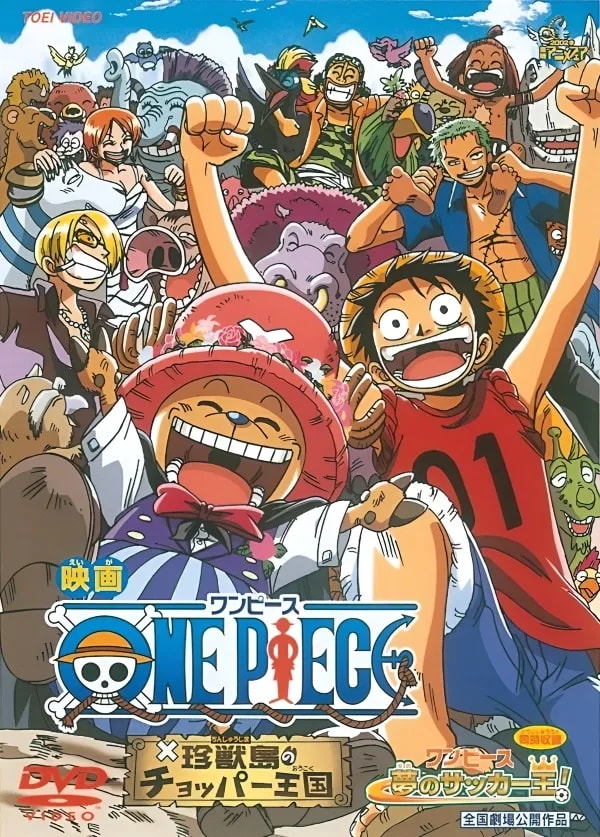
Chopper's Kingdom on the Island of Strange Animals
MovieChopper takes the spotlight in the crew's third feature, mistaken for a prophesied King of Beasts on an island populated by talking animals. A horn-obsessed count schemes after a fabled treasure, forcing Chopper to shield both his new subjects and a boy named Mobanby who despises pirates.
Overview
Opening in cinemas during March 2002, this 56-minute short puts Tony Tony Chopper front and center and takes place in a world set entirely apart from the main canon. Word of a hidden treasure lures the Straw Hats to O-Kan Island, a wild land where the beasts think and speak as humans do. When circumstance splits Chopper from his companions, he unwittingly fulfills an old prophecy and finds himself crowned the island's guardian. Across its theatrical and home-video runs, the picture was packaged together with the separate short Dream Soccer King.
Plot
Chasing an old map, the crew is thrown into the air when geysers batter the Going Merry beside O-Kan Island, and Chopper is tossed off into the woods. The rest of the Straw Hats wash up on shore and encounter the thinking animals, who are waiting on a successor to their golden-horned king, the Kirin Lion, now dead of old age. Chopper drops into the middle of their gathering, his cry of pain is mistaken for a call for a king, and the beasts crown him at once. Grieving over a father, a naturalist slain by a pirate, the human boy Mobanby pleads with Chopper to stay and rule.
The real threat surfaces in Count Battler, who commands armored Horn Eaters through a hypnotic violin and has been harvesting horns wholesale in search of a legendary treasure rumored to reside inside the Animal King's own horns. When his tune even hijacks Luffy's mind, the Straw Hats regroup with Chopper, only for Battler to strike hard. Chopper draws the Horn Eaters off, the crew peels away to battle Battler's brutal lieutenants Heaby and Hotdog, and Mobanby agonizes over whether to lift the Kirin Lion's sacred horn to lend aid.
Battler consumes every gathered horn and swells into a colossal golden beast, badly hurting Luffy and admitting he was the very pirate who murdered Mobanby's father. In a rare reversal of their usual matchups, Sanji bests Heaby while Zoro wears down Hotdog. Enraged, Luffy comes back to crush Battler's horns in his hands and hurls the count away with Gomu Gomu no Bazooka. Once calm returns, the sky molds the island's rising steam into a crown, recognizing Mobanby as the true new Animal King. Chopper says a tearful goodbye to his friend, and the crew sets sail once more.
Reception
Toei paired the film at its 2002 Spring Anime Fair with the unrelated Digimon Tamers: Runaway Locomon. Although the movie drew a smaller crowd than the entry before it, the combined program still helped bring in a gross of around two billion yen. Eiichiro Oda turned up at a preview screening and voiced his approval in Weekly Shonen Jump. Merchandise tied to the release ranged from exclusive Carddass cards to a soundtrack disc and a printed novelization. The picture also carries the distinction of being the first in the series to plainly break with canon, leaving out both Vivi and Robin and depicting Luffy skipping across water by inflating himself.
Related Reading
See all
The Most Popular Women of One Piece: A Fan's Journey Through Anime's Greatest Female Characters...
When I first decided to commit to watching One Piece seriously, I knew I was embarking on one of anime's longest and most beloved series. With over 100...
Super Saiyan Pubes: The Song About Where Super Saiyan Hair Actually Goes
The transformation everyone knows, the follow-up question nobody would touch. Why we made a smooth R&B track about the golden glow Dragon Ball never talks about....
Frequently Asked Questions
What island did Chopper end up on?
In Chopper's Kingdom on the Island of Strange Animals, Chopper is separated from his crew and lands on O-Kan Island, a wild land where the animals think and speak like humans, and he is unexpectedly crowned their king after fulfilling an old prophecy.
What is One Piece movie 3 about?
Chopper's Kingdom on the Island of Strange Animals is the third One Piece film, released in March 2002, in which Chopper is mistaken for the prophesied King of Beasts on O-Kan Island and must protect its animal inhabitants and a boy named Mobanby from Count Battler, a horn-obsessed villain hunting a legendary treasure.
Who is the villain in Chopper's Kingdom on the Island of Strange Animals?
The villain is Count Battler, who commands armored Horn Eaters through a hypnotic violin and harvests horns across the island while searching for a legendary treasure said to be hidden within the Animal King's horns.
How does Chopper's Kingdom on the Island of Strange Animals end?
The Straw Hats destroy Battler's absorbed horn form, defeat his lieutenants Heaby and Hotdog, and the boy Mobanby is recognized by the island's rising steam as the true new Animal King, after which Chopper says a tearful goodbye and the crew sails on.
What movie was Chopper's Kingdom on the Island of Strange Animals paired with?
Chopper's Kingdom on the Island of Strange Animals was packaged together with the short featurette Dream Soccer King for its theatrical and home-video release.
Sources & Information
Looking for more on Chopper's Kingdom on the Island of Strange Animals? The One Piece Wiki on Fandom has a dedicated page with community notes.
View on FandomThis content is original writing by Daddy Jim Headquarters based on the One Piece anime series, manga, and official materials. Episode and chapter references are cited where applicable.
Character and scene imagery on this site is original artwork by Daddy Jim Headquarters, not screenshots or licensed imagery. Official cover art is used on three types of pages for editorial commentary:
- Movie pages: theatrical posters and key visuals, credited to Toei Animation and Toei Company.
- Game pages: official box art for the One Piece console and mobile games, credited to Bandai Namco.
- Manga chapter pages: Jump Comics volume covers, credited to Shueisha and Eiichiro Oda.
Official resources:
Help Us Keep This Wiki Accurate
Daddy Jim Headquarters maintains this encyclopedia. If you spot an error, a translation issue, or something that doesn't look right, let us know.