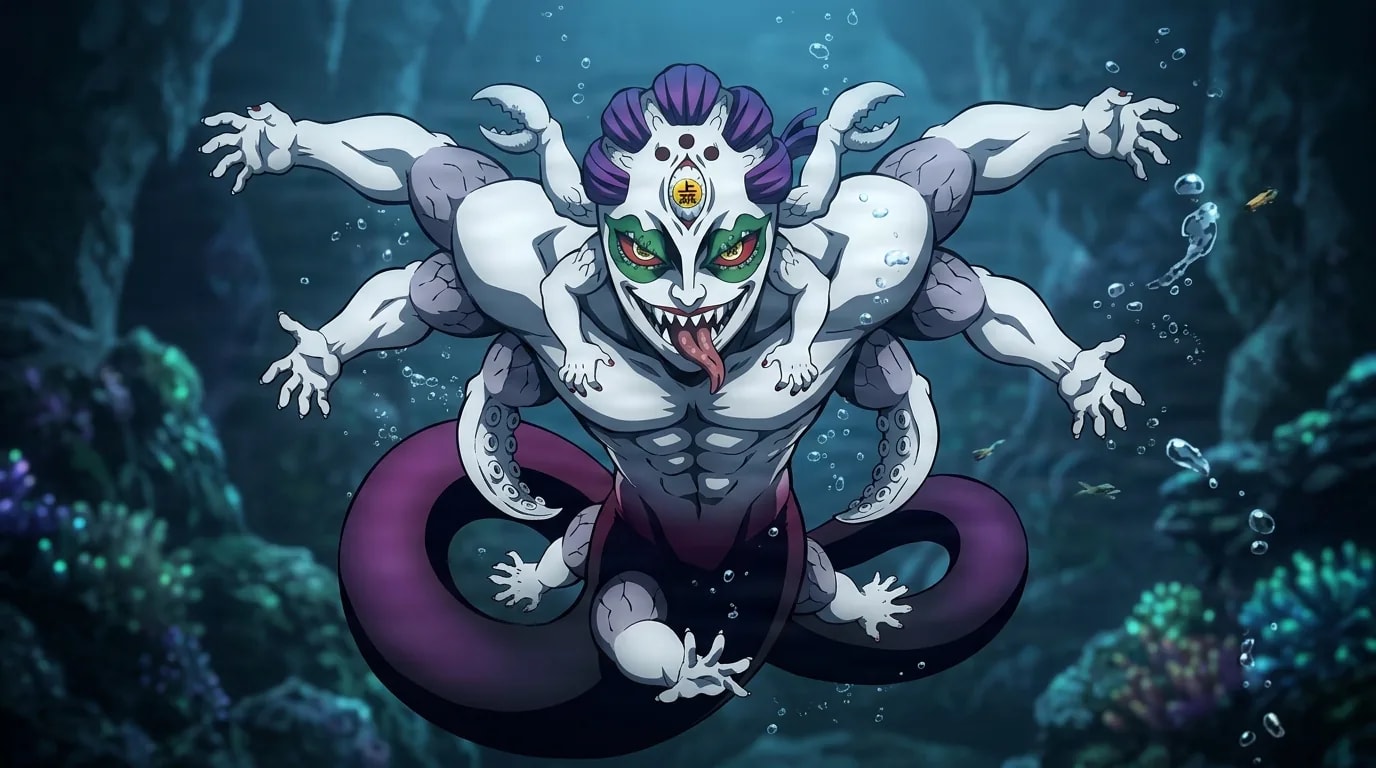
Gyokko
CharacterGyokko was a major antagonist of the Swordsmith Village Arc and Upper Rank Five of the Twelve Kizuki. A demon obsessed with twisted art and porcelain vases, he was once a human named Managi before Muzan turned him.
Appearance
Gyokko had a bizarre and grotesque build, resembling a pale, armless humanoid statue rising out of a white porcelain vase decorated with leaves and branches, much like a djinn. His midsection was a red-violet shade and his tail-like lower half was black. Numerous small, infant-like hands with red nails lined his body and head, and thin fins shaped like cornrows and a ponytail stood in for hair.
His face was even stranger, with green-lipped mouths set where the eye sockets would normally be, while his true eyes, golden with honey-brown centers, sat vertically on his face and forehead. In combat he could molt into a far larger merman-like form, gaining two great arms, webbed hands, turquoise scales, and a long serpentine tail.


Personality
Gyokko was easily excitable, forever fawning over fresh inspiration for what he considered his art and slipping into euphoria whenever Muzan was involved, even taking pleasure in being decapitated by him. He was short-tempered, shallow, and arrogant, especially regarding his work, and flew into a rage when Muichiro Tokito mocked the quality of his creations.
He was also petty and jealous, mutilating the swordsmith Hotaru Haganezuka out of envy for his focus, and his contempt for humans ran to grotesque extremes. He saw human lives as raw material, brutally mangling swordsmiths together into a gruesome display and drawing out their suffering for his own amusement. Even as the human Managi, his disturbed nature was evident, as he found beauty in the corpses of his drowned parents and murdered a child who teased him.
Abilities
Holding the fifth position among the Twelve Kizuki made Gyokko a tremendously formidable demon, ranked above Gyutaro and Daki. His unique Blood Demon Art, themed around the sea and aquatic creatures, let him outclass ordinary demons and threaten even the Hashira. In his duel with Muichiro Tokito he held the upper hand for most of the fight and nearly killed him, only failing because of his own ego and Muichiro's awakening of his Demon Slayer Mark.
His powers centered on porcelain vases conjured from his own flesh, through which he could teleport, trap victims, and spawn monstrous fish-like creatures wielding poison needles. Techniques such as Water Prison Pot and Octopus Vase Hell drowned and restrained opponents. He also possessed flesh manipulation, immense regeneration, great durability, and, in his molted true form, scales harder than diamond and Godlike Hands that transmuted whatever his fists touched into fish.
Related Reading
See all
Demon Slayer Infinity Castle Is the Biggest Anime Movie Ever but It Still Lost in Japan
Demon Slayer: Infinity Castle earned $778 million globally and nearly 40 billion yen in Japan, but it still couldn't top Mugen Train's domestic record. Here's why that barely matters....
Super Saiyan Pubes: The Song About Where Super Saiyan Hair Actually Goes
The transformation everyone knows, the follow-up question nobody would touch. Why we made a smooth R&B track about the golden glow Dragon Ball never talks about....

Frequently Asked Questions
Who kills Gyokko in Demon Slayer?
Gyokko is killed by Muichiro Tokito during the Swordsmith Village Arc. Although Gyokko held the upper hand for most of their duel and nearly killed Muichiro, he failed because of his own ego and Muichiro's awakening of his Demon Slayer Mark.
Who was Gyokko before he became a demon in Demon Slayer?
Before becoming a demon, Gyokko was a human named Managi. Even as a human his disturbed nature was evident, as he found beauty in the corpses of his drowned parents and murdered a child who teased him.
Is Gyokko Upper Rank 4 or 5 in Demon Slayer?
Gyokko is Upper Rank Five of the Twelve Kizuki. He ranked above both Gyutaro and Daki.
Is Gyokko stronger than Gyutaro in Demon Slayer?
Gyokko held the fifth position among the Twelve Kizuki, ranking above the Upper Rank Six pair Gyutaro and Daki. His sea-themed Blood Demon Art let him outclass ordinary demons and threaten even the Hashira.
How old is Gyokko in Demon Slayer?
Gyokko is chronologically over 133 years old in Demon Slayer.
Sources & Information
Looking for more on Gyokko? The Demon Slayer Wiki on Fandom has a dedicated page with community notes.
View on FandomThis content is original writing by Daddy Jim Headquarters based on the Demon Slayer anime series, manga, and official materials. Episode and chapter references are cited where applicable.
Character and scene imagery on this site is original artwork by Daddy Jim Headquarters, not screenshots or licensed imagery. Official cover art is used on three types of pages for editorial commentary:
- Movie pages: theatrical posters and key visuals, credited to ufotable and Aniplex.
- Game pages: official box art, credited to Sega, Aniplex, and other publishers.
- Manga chapter pages: Jump Comics volume covers, credited to Shueisha and Koyoharu Gotouge.
Official resources:
Help Us Keep This Wiki Accurate
Daddy Jim Headquarters maintains this encyclopedia. If you spot an error, a translation issue, or something that doesn't look right, let us know.