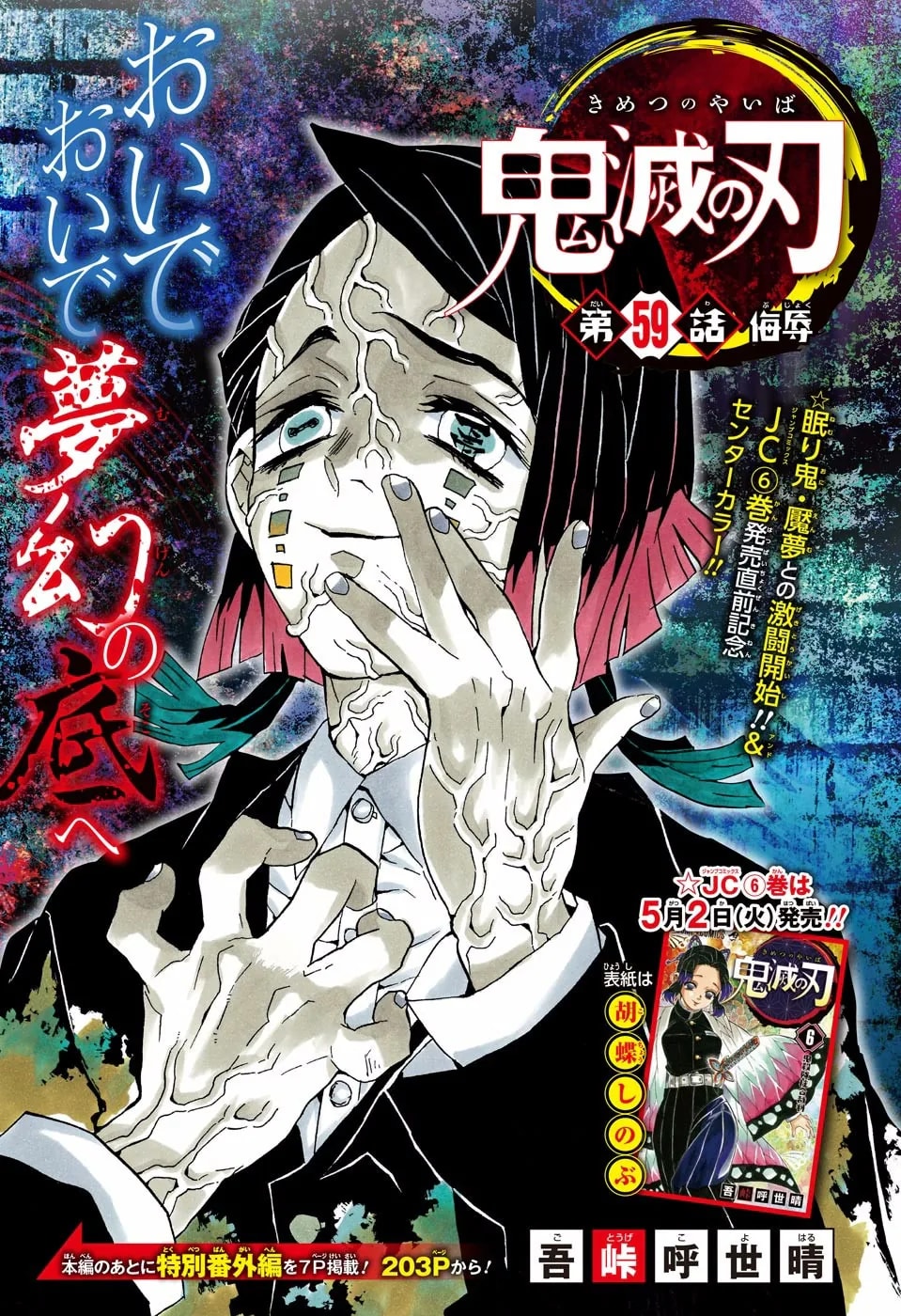
The fifty-ninth chapter of Kimetsu no Yaiba pits Tanjiro against Enmu aboard the Mugen Train. The Lower Rank One demon repeatedly tries to lull Tanjiro into sleep, taunts him with a cruel nightmare, and then reveals that beheading him has changed nothing because he has merged with the train itself.
Summary
Enmu revels in human despair and explains that the conductor's punched tickets triggered a hidden spell that put the slayers to sleep. He cannot fathom how Tanjiro pierced the dream and woke. As Tanjiro draws his sword and condemns the demon for invading people's hearts, Enmu spots his earrings and grows eager, believing he can earn more of Muzan's blood and rise in rank.
Tanjiro attacks with Water Breathing, Tenth Form, while Enmu counters with a Blood Demon Art that commands sleep through the mouth on his palm. Each time Tanjiro drifts off he wakes again, and the demon realizes the slayer is killing himself inside the dreams to break free. Enmu then conjures a nightmare of Tanjiro's dead family blaming him for surviving, but the cruelty only enrages him. Declaring that his family would never speak such words, Tanjiro beheads the demon with Constant Flux.


Key Events
The duel between Tanjiro and Enmu begins, with the demon trying again and again to force sleep while Tanjiro repeatedly wakes himself by dying within the dreams. When Enmu weaponizes a vision of the slain Kamado family, Tanjiro's fury drives him to decapitate the demon.
The beheading proves hollow. Enmu's head reattaches to the roof, and he reveals that the body destroyed was never his true form. While everyone slept he fused with the entire Mugen Train, turning it into his own flesh and making its roughly two hundred passengers his hostages. Just as Tanjiro begs his sleeping companions to wake, Inosuke bursts through the ceiling and joins the fight.
Notes
This chapter sits within the Mugen Train Arc and corresponds to Episode 30 of the anime. It escalates the dream-spell premise into a full body-horror reveal, establishing that the locomotive is now a single demonic organism. The arrival of Inosuke at the end sets up the multi-slayer defense of the passengers that follows.
Related Reading
See all
Demon Slayer Infinity Castle Is the Biggest Anime Movie Ever but It Still Lost in Japan
Demon Slayer: Infinity Castle earned $778 million globally and nearly 40 billion yen in Japan, but it still couldn't top Mugen Train's domestic record. Here's why that barely matters....
Super Saiyan Pubes: The Song About Where Super Saiyan Hair Actually Goes
The transformation everyone knows, the follow-up question nobody would touch. Why we made a smooth R&B track about the golden glow Dragon Ball never talks about....


Frequently Asked Questions
What happens in Chapter 59 of Demon Slayer, "Insult"?
Chapter 59 of Demon Slayer, titled "Insult," pits Tanjiro against Enmu aboard the Mugen Train. Tanjiro beheads the demon, but Enmu reveals the destroyed body was never his true form because he has merged with the entire train.
How does Tanjiro defeat Enmu in Chapter 59 of Demon Slayer?
In Chapter 59 of Demon Slayer, Enmu conjures a nightmare of Tanjiro's dead family blaming him for surviving, which only enrages him. Declaring that his family would never speak such words, Tanjiro beheads the demon with Constant Flux, the Eleventh Form of Water Breathing.
How did Enmu put the slayers to sleep in Chapter 59 of Demon Slayer?
In Chapter 59 of Demon Slayer, Enmu explains that the conductor's punched tickets triggered a hidden spell that put the slayers to sleep. Enmu also uses a Blood Demon Art that commands sleep through the mouth on his palm.
How does Tanjiro wake himself from the dreams in Chapter 59 of Demon Slayer?
In Chapter 59 of Demon Slayer, Tanjiro repeatedly kills himself inside the dreams to break free, waking up each time he drifts off. Enmu realizes this is how the slayer keeps escaping his sleep spell.
What anime episode covers Chapter 59 of Demon Slayer?
Chapter 59 of Demon Slayer, "Insult," sits within the Mugen Train Arc and corresponds to Episode 30 of the anime. It ends with Enmu fusing with the train and taking its roughly two hundred passengers hostage before Inosuke bursts through the ceiling to join the fight.
Sources & Information
Looking for more on Insult? The Demon Slayer Wiki on Fandom has a dedicated page with community notes.
View on FandomThis content is original writing by Daddy Jim Headquarters based on the Demon Slayer anime series, manga, and official materials. Episode and chapter references are cited where applicable.
Character and scene imagery on this site is original artwork by Daddy Jim Headquarters, not screenshots or licensed imagery. Official cover art is used on three types of pages for editorial commentary:
- Movie pages: theatrical posters and key visuals, credited to ufotable and Aniplex.
- Game pages: official box art, credited to Sega, Aniplex, and other publishers.
- Manga chapter pages: Jump Comics volume covers, credited to Shueisha and Koyoharu Gotouge.
Official resources:
Help Us Keep This Wiki Accurate
Daddy Jim Headquarters maintains this encyclopedia. If you spot an error, a translation issue, or something that doesn't look right, let us know.