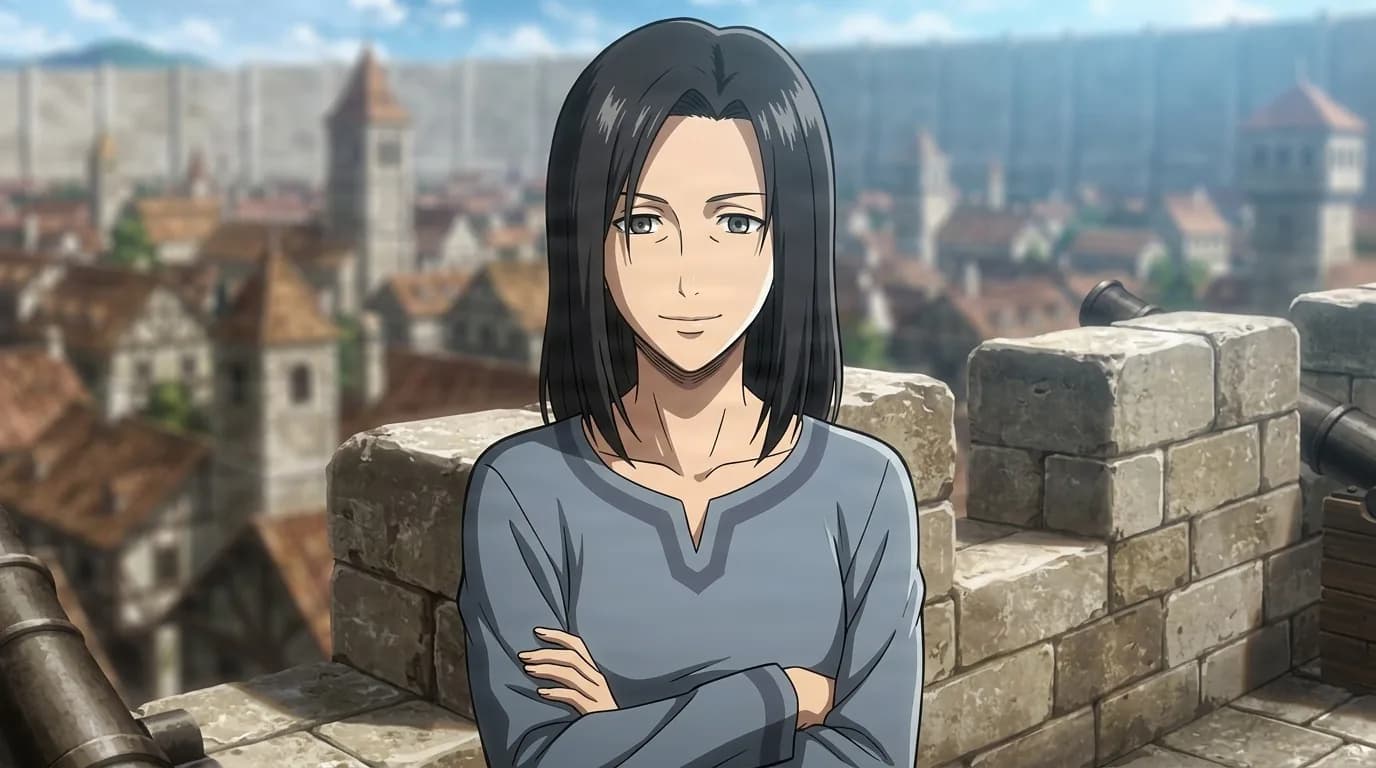
Mikasa's mother
CharacterThe Azumabito crest on Mikasa's wrist is her mother's parting gift, carved in a ritual passed down a dwindling Asian bloodline. A gentle woman living quietly in the forest near Shiganshina, she died fighting the traffickers who came for her daughter, the same night Mikasa's Ackerman power first woke.
Appearance
Gray eyes beneath a calm, faintly weary expression give Mikasa's mother a quiet presence. Of Asian descent and seemingly in her mid-thirties, she wears black hair past her shoulders with bangs split at the center, occasionally gathering it into a small bun. Plain clothes, a white buttoned shirt over dark trousers, mark her as a commoner.

Personality
Warmth and tradition anchor her. She raised Mikasa with obvious love, treating the painful clan-marking ritual as a legacy worth preserving and telling her daughter she would one day pass the symbol to children of her own. The gentleness had a limit: the instant intruders threatened her family, she turned ferocious, throwing herself between the men and her daughter and fighting with everything she had.
Related Reading
See all
Naruto vs Luffy: Does the Fight Change if Luffy Tickles Hinata?
Naruto vs Luffy with the twist nobody asked for: Luffy tickled Hinata on date night, and she kind of liked it. We break down the whole fight and commit to a winner....
Namek Has No Women, and Piccolo Pulls Anyway
There are no women on Namek. That isn't an oversight, it's the biology. Why we handed Piccolo the one thing his own species rules out, and why it had to be trap soul....
History
On the day of her death she was bandaging Mikasa's freshly marked arm while awaiting a visit from Dr. Grisha Yeager, explaining the meaning of the Azumabito symbol she had cut into her daughter's skin. A knock at the door proved to be not the doctor but human traffickers who planned to sell mother and daughter on the Underground's black market; the last survivors of their race made valuable merchandise. Her husband died at the threshold. She shielded Mikasa and fought back, and one of the men killed her without meaning to, ruining half the prize. The kidnappers took Mikasa, only to die soon after at the hands of Eren Yeager and Mikasa herself.
Years later, when Levi asks Mikasa about the Ackerman name, she recounts what her parents told her: her father's bloodline was persecuted within the cities, her mother's Asian family likewise lost any place to live inside them, and the two met as outcasts driven into the mountains, where they married and built their simple life. Grisha found the couple's bodies when he finally arrived, and the loss defined the daughter they left behind.
Frequently Asked Questions
Who is the mother of Mikasa Ackerman?
Mikasa Ackerman's mother is an unnamed woman of the Azumabito bloodline who lived quietly in the forest near Shiganshina with her husband, an Ackerman, and their daughter.
Why was Mikasa's mother killed?
Mikasa's mother was killed when human traffickers broke into her home intending to sell her and Mikasa on the Underground's black market; she fought to protect her daughter, and one of the kidnappers killed her, though not intentionally.
What was Mikasa's mother doing on the day she died?
On the day she died, Mikasa's mother was in the middle of carving the Azumabito clan crest into Mikasa's wrist as part of a ritual passed down through her family line, telling Mikasa she would one day pass the symbol to children of her own.
How did Mikasa's mother meet her husband?
Mikasa's mother's Asian family, like her husband's persecuted Ackerman bloodline, had no place left inside the Walls, and the two met as outcasts driven into the mountains, where they married and built a simple life together.
What happened to the traffickers who killed Mikasa's mother?
The traffickers who killed Mikasa's mother and took Mikasa captive died soon afterward at the hands of Eren Yeager and Mikasa herself.
Sources & Information
Looking for more on Mikasa's mother? The Attack on Titan Wiki on Fandom has a dedicated page with community notes.
View on FandomThis content is original writing by Daddy Jim Headquarters based on the Attack on Titan anime series, manga, and official materials. Attack on Titan was created by Hajime Isayama, published by Kodansha, and animated by MAPPA and Wit Studio. All rights to Attack on Titan and its characters belong to their respective owners. Episode and chapter references are cited where applicable.
Rights holders
- Created byHajime Isayama
- Published byKodansha
- Animated byMAPPA
- Animated byWit Studio
All rights belong to their respective owners.
Character and scene imagery on this site is original artwork by Daddy Jim Headquarters, not screenshots or licensed imagery. Official cover art is used on three types of pages for editorial commentary:
- Movie pages: theatrical posters and key visuals, credited to MAPPA, Wit Studio and Kodansha.
- Game pages: official box art, credited to the game's respective publishers.
- Manga chapter pages: volume covers, credited to Kodansha and Hajime Isayama.
Official resources:
Help Us Keep This Wiki Accurate
Daddy Jim Headquarters maintains this encyclopedia. If you spot an error, a translation issue, or something that doesn't look right, let us know.