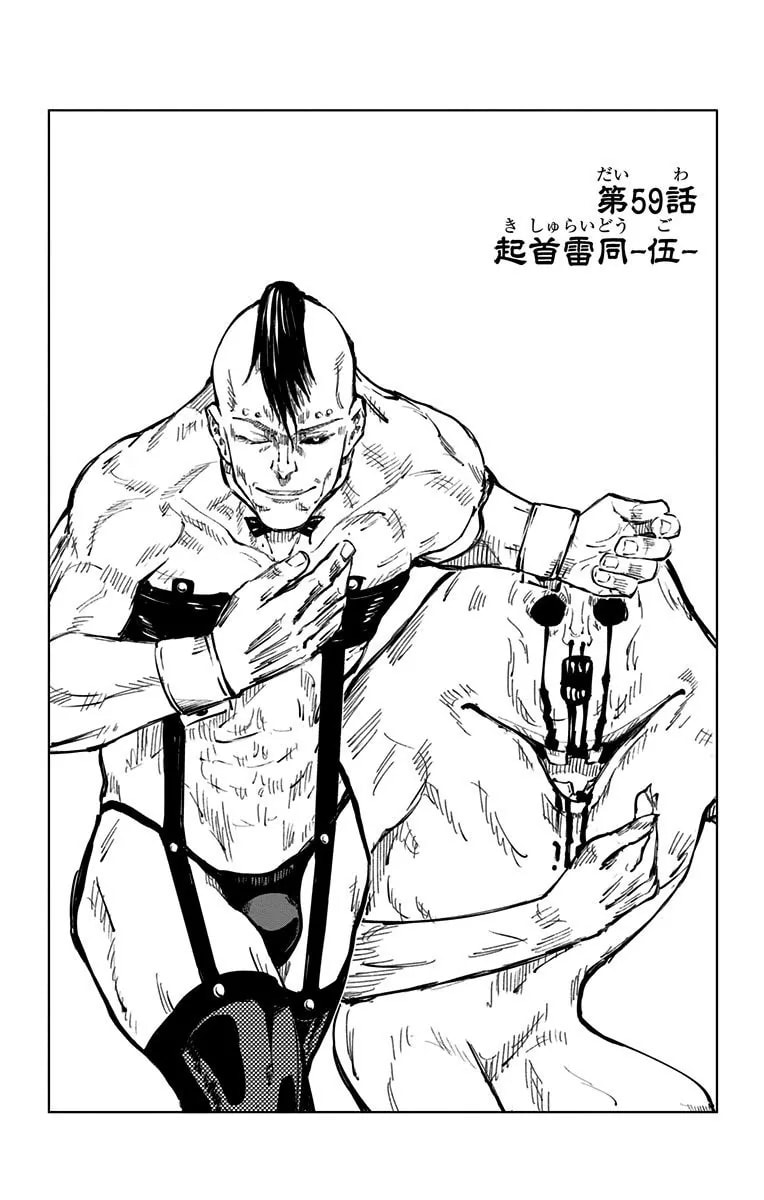
The fifty-ninth chapter closes out Megumi's struggle and slips into his school days with Tsumiki, while Yuji and Nobara square off against the brothers spawned from the Death Painting Womb.
Summary
Winning his fight leaves Megumi running on fumes, and as his collapsing domain melts away he sways on his feet while clutching Sukuna's finger. Sukuna, watching through the severed digit, is delighted by what the young sorcerer pulled off. Megumi throws up and drops to the ground, his mind drifting back to his middle school years. In those memories he is the boy who roughed up the local bullies, telling them that respecting another person's dignity is the one boundary nobody should cross. The teenagers he flattened never grasp why he came after them, and an old caretaker named Takeda eventually steps in to break things up.

Key Events
The flashbacks fill in how Megumi came to live alongside Tsumiki. His father wed her mother during his first year of grade school, then the pair vanished almost at once. Gojo turned up to explain that the Zenin clan had effectively bought the boy, with Jujutsu High footing his support in return for future sorcery work, leaving Megumi bitter toward the white haired teacher and the entire profession. Tsumiki, irritated by his habit of brawling, once cracked a milk carton over his head after he sneered that decent people are revolting. She later fell under a sleeping curse that has never lifted, and at the present-day bridge Megumi quietly begs her to wake before exhaustion finally drags him under. Across the area, Nobara and Eso both clock the vanished domain and reason that whoever beat the Finger Bearer must be hurt.
Notes
Eso lunges for the finger, but Nobara moves to block him, prompting a threat on her life. The standoff breaks when Kechizu surfaces with Yuji hot behind him, confirming both sorcerers can see the warped face riding Eso's back. After Nobara clubs him across the skull with her hammer and questions his strange outfit, Eso reveals that the stench around them rises from that very back. He triggers his Rot Technique through Maximum: Wing King, sprouting wasp-style wings formed from his blackened blood. This installment marks the opening of the duel pitting Yuji and Nobara against Eso and Kechizu, and it aligns with the anime's twenty-third episode.
Related Reading
See all
Super Saiyan Pubes: The Song About Where Super Saiyan Hair Actually Goes
The transformation everyone knows, the follow-up question nobody would touch. Why we made a smooth R&B track about the golden glow Dragon Ball never talks about....
The Bleach Female Characters Nobody Can Agree On, Settled
Five Bleach female characters, ranked and settled. Yoruichi sits at number five, the spot nobody expects, and our number one is an Arrancar with a soft heart....
Frequently Asked Questions
What happens in Chapter 59 of Jujutsu Kaisen?
Chapter 59, The Origin of Obedience Part 5, closes out Megumi's fight and slips into his middle-school flashbacks with Tsumiki, while Yuji and Nobara begin squaring off against the Death Painting brothers Eso and Kechizu.
How did Megumi come to live with Tsumiki?
In Chapter 59 a flashback shows that Megumi's father married Tsumiki's mother during his first year of grade school, then the pair vanished almost at once, leaving the two children together.
Why does Megumi resent Gojo and sorcery?
Chapter 59 reveals Gojo turned up to explain that the Zenin clan had effectively bought Megumi, with Jujutsu High funding his support in return for future sorcery work, leaving him bitter toward the teacher and the profession.
What happened to Tsumiki in Chapter 59?
The chapter recalls that Tsumiki fell under a sleeping curse that has never lifted, and at the present-day bridge Megumi quietly begs her to wake before exhaustion drags him under.
What technique does Eso unleash at the end of Chapter 59?
Eso triggers his Rot Technique through Maximum: Wing King, sprouting wasp-style wings formed from his blackened blood, opening the duel that pits Yuji and Nobara against him and Kechizu.
Sources & Information
Looking for more on The Origin of Obedience, Part 5? The Jujutsu Kaisen Wiki on Fandom has a dedicated page with community notes.
View on FandomThis content is original writing by Daddy Jim Headquarters based on the Jujutsu Kaisen anime series, manga, and official materials. Episode and chapter references are cited where applicable.
Character and scene imagery on this site is original artwork by Daddy Jim Headquarters, not screenshots or licensed imagery. Official cover art is used on three types of pages for editorial commentary:
- Movie pages: theatrical posters and key visuals, credited to MAPPA and Toho.
- Game pages: official box art for Jujutsu Kaisen Cursed Clash, credited to Bandai Namco.
- Manga chapter pages: Jump Comics volume covers, credited to Shueisha and Gege Akutami.
Official resources:
Help Us Keep This Wiki Accurate
Daddy Jim Headquarters maintains this encyclopedia. If you spot an error, a translation issue, or something that doesn't look right, let us know.