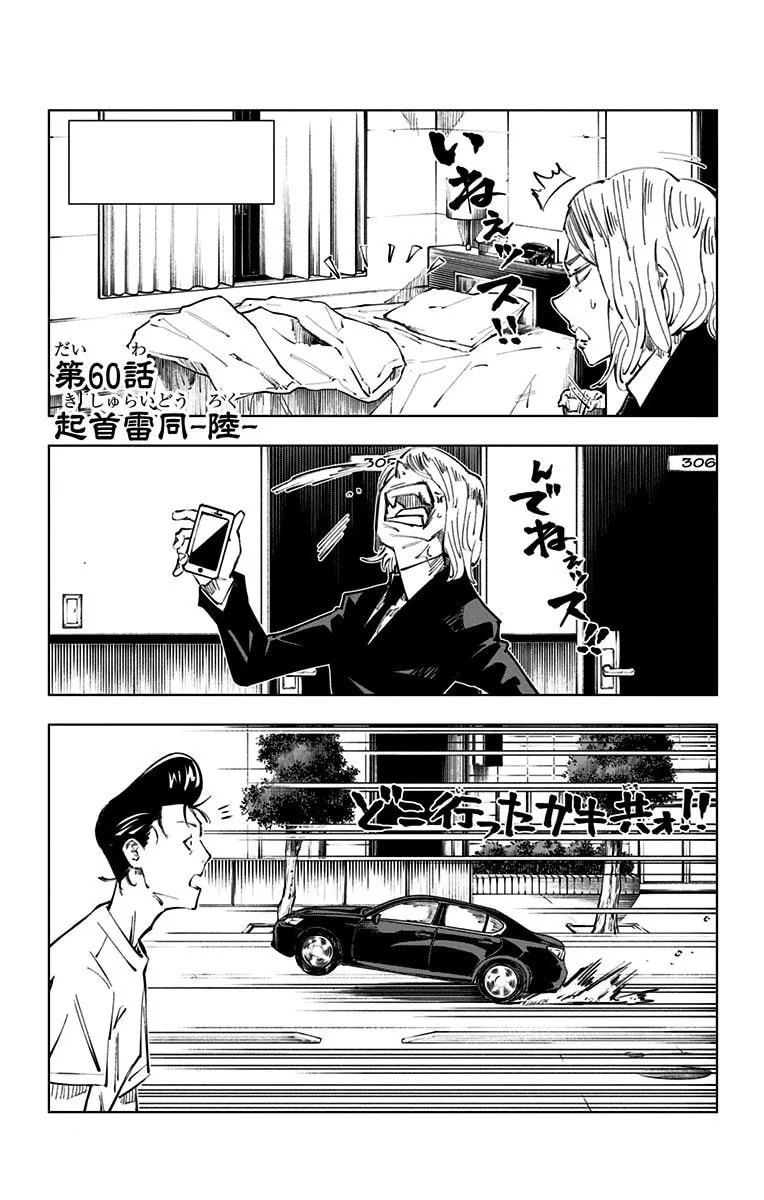
The sixtieth chapter deepens the fight against the Death Painting brothers, peels back their century-and-a-half origin, and ends with Nobara turning her enemies' own blood into a weapon.
Summary
Back at the dormitory, Akari Nitta finds every bed empty, fails to reach the students by phone, and drives off to hunt them down. Out in the field, Eso unfurls his Maximum: Wing King, insect wings spun from his poisonous blood, and promises his foes a death by wasp. As lines of toxic blood hunt the two sorcerers, Nobara cannot outrun them on her own, so Yuji scoops her up and tears through the trees at blistering speed, weaving until the curse loses sight of them. Eso shows no fear of the chase. The moment Nobara thanks Yuji for the save, Kechizu ambushes them, having taken a direct route while Yuji circled around, and Wing King clips Nobara from behind.
Key Events
Eso catches up and explains that his acidic blood is less about killing outright and more about agony. He activates Rot Technique: Decay, which blooms floral marks across the wounds his blood has touched. Yuji assumes it is poison, but Eso clarifies the real effect is decomposition, the bodies of his targets breaking down where they were struck. A long memory then unspools across the era. In the Meiji period a woman carried a child mixing cursed spirit and human blood, was cast out by her family, and took shelter at a temple run by Noritoshi Kamo, history's most wicked sorcerer. Nine pregnancies ended in nine abortions, every record wiped clean. The resulting Death Painting Wombs never knew their mother and bear no grudge against sorcerers.
Notes
For roughly a century and a half the three wombs existed sealed away with only one another for company, and when they were finally given flesh they chose to stand with Mahito. Their eldest, Choso, urged them to live for each other and to fight for the future the cursed spirits had imagined. Eso offers to end his opponents' suffering, but Nobara only laughs, granting that the brothers are powerful while insisting she is the worst possible matchup for them. She triggers Straw Doll Technique: Resonance and drives a nail into her own wrist, the wound echoing into both Eso and Kechizu. Grinning as her blood runs, she invites them to play a game of chicken. This chapter introduces Choso in flashback and the ancestral Noritoshi Kamo, and ties to the anime's twenty-fourth episode.
Related Reading
See all
Super Saiyan Pubes: The Song About Where Super Saiyan Hair Actually Goes
The transformation everyone knows, the follow-up question nobody would touch. Why we made a smooth R&B track about the golden glow Dragon Ball never talks about....
The Bleach Female Characters Nobody Can Agree On, Settled
Five Bleach female characters, ranked and settled. Yoruichi sits at number five, the spot nobody expects, and our number one is an Arrancar with a soft heart....
Frequently Asked Questions
What happens in Chapter 60 of Jujutsu Kaisen?
Chapter 60, The Origin of Obedience Part 6, deepens the fight against the Death Painting brothers, peels back their origin, and ends with Nobara turning their own blood into a weapon.
What is the origin of the Death Painting Wombs?
Chapter 60 reveals that in the Meiji period a woman carried a child mixing cursed spirit and human blood, was cast out, and sheltered at a temple run by Noritoshi Kamo; nine pregnancies ended in nine abortions, producing the Death Painting Wombs.
What does Eso's Rot Technique: Decay do?
In Chapter 60 Eso clarifies that Decay is not poison but decomposition, blooming floral marks across the wounds his blood has touched so that his targets' bodies break down where they were struck.
Why did the Death Painting brothers side with Mahito?
Chapter 60 explains the three wombs were sealed away for roughly a century and a half with only one another, and when given flesh they chose to stand with Mahito, their eldest Choso urging them to fight for the future the cursed spirits imagined.
How does Nobara turn the tables at the end of Chapter 60?
Nobara triggers Straw Doll Technique: Resonance and drives a nail into her own wrist, the wound echoing into both Eso and Kechizu, then invites them to play a game of chicken.
Sources & Information
Looking for more on The Origin of Obedience, Part 6? The Jujutsu Kaisen Wiki on Fandom has a dedicated page with community notes.
View on FandomThis content is original writing by Daddy Jim Headquarters based on the Jujutsu Kaisen anime series, manga, and official materials. Episode and chapter references are cited where applicable.
Character and scene imagery on this site is original artwork by Daddy Jim Headquarters, not screenshots or licensed imagery. Official cover art is used on three types of pages for editorial commentary:
- Movie pages: theatrical posters and key visuals, credited to MAPPA and Toho.
- Game pages: official box art for Jujutsu Kaisen Cursed Clash, credited to Bandai Namco.
- Manga chapter pages: Jump Comics volume covers, credited to Shueisha and Gege Akutami.
Official resources:
Help Us Keep This Wiki Accurate
Daddy Jim Headquarters maintains this encyclopedia. If you spot an error, a translation issue, or something that doesn't look right, let us know.